
Podcast Episode 35 min
From Telemetry to Intelligence: What Cumulocity’s IIoT Platform Actually Does
IIoT platforms are hiding in plain sight: in elevators, wind turbines, and even medical devices. It's time we talked about what they are and why AI makes the underlying data architecture important!
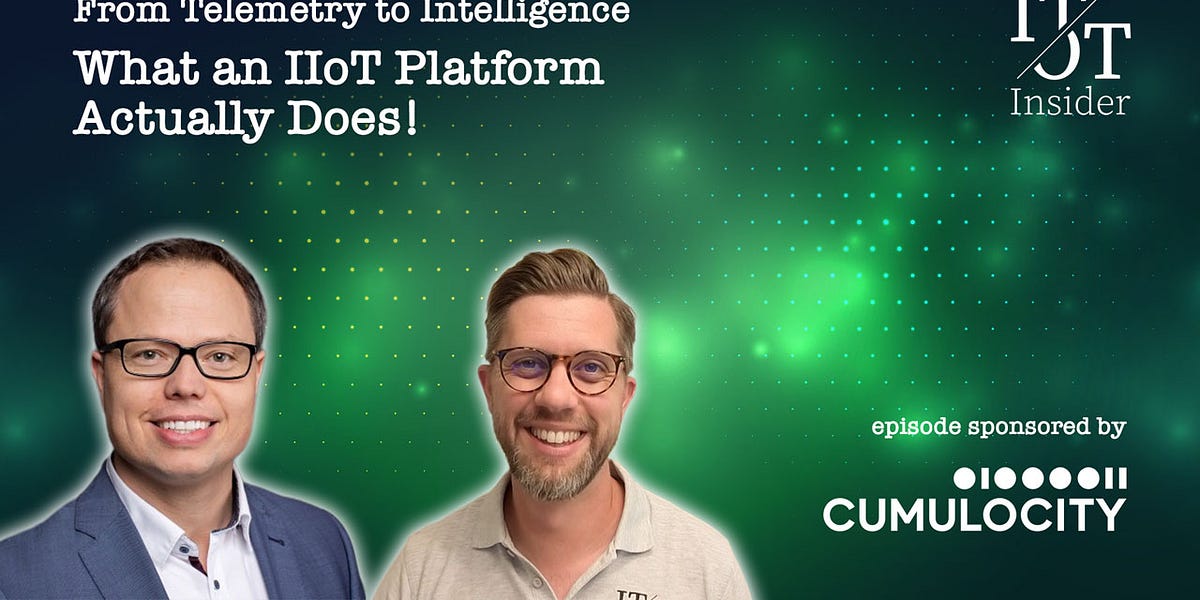
In This Episode
- Jürgen Krämer, Chief Product Officer at Cumulocity, led the 2024 management buyout that made Cumulocity a standalone independent AIoT platform as of January 2025, after years running Software AG's IoT & Analytics business unit (which had acquired Cumulocity in 2017).
- Cumulocity connects over 25 million devices and processes more than 3 billion messages a day for over 1,000 enterprises, including a notable partnership with SAP, which deprecated its own IoT platform (Leonardo) and now white-labels Cumulocity as the IIoT engine behind its Asset Performance Management application.
- Jürgen's practical rule of thumb: historians suit large, single-site process plants best, while IoT platforms like Cumulocity shine with globally distributed assets the customer doesn't fully control the network for, citing a wind-turbine customer with 30,000 turbines connected worldwide.
- Jürgen's concrete before/after example of AIoT: a maintenance alert that once meant two hours of manual log-diving now arrives as a fully pre-diagnosed package (probable cause, ordered replacement part, repair guide) requiring only a human's approval to act.
- Cumulocity's "semantic layer," sitting between the system of record and the agentic AI layer, supplies the metadata, units, alarm thresholds, and asset hierarchies AI needs to reason correctly; in Cumulocity's own demos, the same natural-language query produced fabricated KPIs without the semantic layer and accurate ones with it.
- Jürgen argues the foundational "system of record" layer, secure device connectivity at scale, should never be built through AI-generated "vibe coding," since it has to run under mission-critical SLAs 24/7; AI-assisted development belongs instead on the vertical application layer built on top of a proven platform.
Meet Jürgen Krämer: 20+ Years in IoT Analytics, Now Leading Cumulocity's Product Strategy
00:00 – 01:38Jürgen Krämer is Chief Product Officer and one of the managing directors at Cumulocity, with more than 20 years in the IoT analytics space. He was previously general manager of the IoT and Analytics business unit at Software AG, which acquired Cumulocity in 2017 and, shortly after, TrendMiner.
He was part of the leadership team driving Cumulocity's management buyout in 2024, and since January 1, 2025, Cumulocity has operated as a standalone, independent AIoT platform. Jürgen now runs the product teams, professional services, and the technical ecosystem.
“I was part of the leadership team driving the management buyout of Cumulocity in 2024. And since 2025... Cumulocity is standalone as an independent AIoT platform in the market.”
Jürgen Krämer · 01:12
1,000+ Enterprises, 25 Million Devices, 3 Billion Messages a Day
01:38 – 05:07Cumulocity's customer list spans ABB (connected robots), wind turbine operators, Solenis in water treatment, Eaton, Baxter Hillrom and Boston Scientific in healthcare, Flexlink (conveyor belts), Danfoss (automation and drives), and Konecranes, plus telcos like Deutsche Telekom, NTT, and Telstra, who white-label the platform to build their own IoT offerings.
The scale is real: more than 1,000 enterprises, over 25 million connected devices, more than 3 billion messages processed per day, operations in more than 20 countries, and recognition as a leader in Gartner's Magic Quadrant for global industrial IoT platforms alongside larger players like Microsoft, Siemens, and AWS. Jürgen also highlights a notable strategic partnership with SAP, which deprecated its own IoT platform, Leonardo, and now white-labels Cumulocity as the IIoT engine behind SAP applications, starting with Asset Performance Management.
“We have more than 25 million connected devices. With more than three billion messages processed per day. We operate in more than 20 countries... listed as one of the leaders in the Gartner Magic Quadrant.”
Jürgen Krämer · 01:38
What an Industrial IoT Platform Actually Is: The Bridge Between OT and IT
05:07 – 08:41Jürgen's own working definition: an industrial IoT platform, industrial specifically, not home automation, functions as the bidirectional bridge between OT assets and IT systems, pulling data out of OT to integrate with business processes and analysis on the IT side, and pushing actions back down, like parameter changes or software updates. It can run in the cloud, fully air-gapped at the edge with no connectivity at all, or as a distributed mix of both.
He breaks the required capabilities into five areas, starting with device management, securely connecting and managing potentially huge, globally distributed fleets, including over-the-air firmware and software updates, work made directly relevant by cybersecurity regulation like the Cyber Resilience Act and NIS2, followed by data management, acquiring and storing both asset metadata and time-series data, and integrating other relevant sources like historians.
“For me, an industrial IoT platform is the bridge between your OT assets and your IT systems... it's a bidirectional integration.”
Jürgen Krämer · 05:07
The Other Three Capabilities: Context, Analytics, and Application Enablement
08:41 – 09:45Rounding out the five capability areas: integrating other business data sources, data lakes, customer and SLA data, even weather data for wind turbine use cases, for genuine context; analyzing and visualizing the data, avoiding what Jürgen calls a "big data graveyard" by combining real-time streaming analytics with traditional historical analytics; and application enablement, since a platform is fundamentally a toolbox that individual enterprises build and tailor their own specific applications on top of.
Taken together, Jürgen frames an IoT platform's purpose simply: helping asset-intensive industries transform their operations toward greater efficiency.
“It's a toolbox. But you need to build and run your applications on top... the last step is then really an application enablement component that allows you to run and manage your own applications on top of the IoT platform.”
Jürgen Krämer · 08:41
Historian vs. IoT Platform: Distributed Global Fleets vs. a Single Big Plant
09:45 – 11:45Jürgen offers a practical rule of thumb for choosing between the two: a historian is genuinely well suited to a large, single-site process plant, the kind of massive facility visible driving toward the Netherlands. An IoT platform like Cumulocity shines instead with distributed assets spread across the globe, where the customer doesn't control the network and has no physical access to the equipment.
His concrete examples include a Swiss elevator company, a Liechtenstein power-tool manufacturer, and wind-turbine customer Anacon, which has 30,000 turbines connected worldwide.
“If you're in a manufacturing setup in the process industry, you have a big plant... a historian is very well suited... but if you have a lot of distributed assets around the globe, this is a totally different situation because then you don't control the network.”
Jürgen Krämer · 09:45
From M2M to IoT to AIoT: Three Waves, and Why Agents Change Everything
11:45 – 14:32Jürgen frames three distinct eras. The first, "machine to machine," starting around 2010 (Cumulocity itself was founded in 2012), focused purely on device connectivity, onboarding, firmware and software management, and remote access. The second, a genuine "IoT" era running roughly 2015 to 2024, added application enablement, dashboards, analytics, and edge components, more sophisticated, but still fundamentally human-centric, with manual troubleshooting assisted by analytics.
The current "AIoT" wave pushes further toward automated operations through agentic AI. His key structural insight is that IIoT was primarily a SaaS model, humans logging into a tenant, using web dashboards, rule engines, and configuring workflows, while AIoT flips that: agents will increasingly do the actual work themselves, mimicking specific existing personas like maintenance technicians, plant managers, or supply chain planners, for example a "field technician assistant" agent, though physical, on-site work obviously still needs a human.
“In the new AIoT world, so when AI meets IIoT, agents will do most of the work in the future... there will be a field technician assistant, which will do some of the work of your field assistant.”
Jürgen Krämer · 11:45
From a Two-Hour Diagnosis to an AI-Prepared Action Package
14:32 – 17:06Cumulocity positioned itself as an AIoT platform more than a year before this recording, among the first companies to do so, investing heavily in both industrial data ops frameworks and agentic AI frameworks explicitly designed around customer control and trust, since the underlying data is customer IP.
Jürgen's concrete before-and-after example: in the old IIoT world, a maintenance ticket ("check pump 4") meant a technician spending two hours manually diagnosing the issue through various log files. In the new AI-assisted world, that same technician instead receives a complete, pre-diagnosed package, probable bearing failure, replacement part already ordered, repair guide attached, a request to approve shutdown at 2pm, with the agent doing as much of the legwork as possible so the human's real job becomes authorizing the recommended action rather than performing the diagnosis themselves.
“In the new world, with the AI assistant... pump four, bearing failure probable, replacement part number X ordered. Here is the repair guide. Please approve shutdown at 2pm.”
Jürgen Krämer · 14:32
Beyond AI: Deterministic Automation Already Resetting Wind Turbines
17:06 – 18:14Jürgen notes some automation doesn't need AI at all: existing wind-turbine customers already perform fully automated turbine resets today using pure streaming analytics and a deterministic parameter set. If specific, well-understood conditions are met, no human review is needed, the reset simply happens automatically, freeing the remote service team's attention for genuinely judgment-requiring tasks instead.
“We have customers today, wind turbine customers that do automated resets of turbines today... it's just using streaming analytics and a deterministic parameter set... you don't need a human being to just check the parameters again and click the reset button.”
Jürgen Krämer · 17:06
Three Layers: System of Record, Semantic Layer, Agentic Layer
18:14 – 20:03Jürgen structures Cumulocity's approach to context around three layers. The system of record is the secure, scalable connection and management of devices, potentially millions of them, a layer used in mission-critical environments that should never be casually rebuilt. On top of that sits the semantic layer, and on top of that, the agentic layer where AI agents actually operate.
His point is that even without AI, human operators need that semantic layer too: a newbie staring at error code 4711 from a pump has no idea what it means, since, as he puts it bluntly, nobody reads the handbook. AIoT platforms ultimately serve two audiences at once, humans and AI agents, both needing the same underlying context.
“The first layer is really about the system of record... but then on top, we have something called the semantic layer. And on top of that semantic layer, we have then the agentic layer, yeah, where the AI agents come into play.”
Jürgen Krämer · 18:14
Metadata, Alarms, Asset Hierarchies, and Why AI Hallucinates Without Them
20:03 – 23:11Jürgen unpacks what actually belongs in the semantic layer: metadata like sensor type and measurement units, alarm thresholds and history, linked maintenance documentation, and full asset hierarchies and relationships, this sensor belongs to this component, in this pump, on this production line, in this plant, in this region. That hierarchy is exactly what makes higher-level KPIs like OEE or pump uptime calculable at all.
Without it, AI agents genuinely don't understand how different pieces of data relate to each other, and the consequences are concrete: Cumulocity has run demos where the identical natural-language query produced fabricated, nonsensical KPIs without the semantic layer, and accurate, genuinely useful results once the agent was pointed at the metadata and asset hierarchies. The same context that helps AI avoid hallucinating, Jürgen adds, helps human operators too.
“We have demos where we run the same query without the semantic layer, and the AI was hallucinating... it showed you nice KPIs, but it was just a mess, it was not real. And if we then pointed the AI agent to the semantic layer... then the result was really, really very powerful.”
Jürgen Krämer · 20:03
300+ Protocols and the Digital Twin Manager: Mapping Physical to Logical
23:11 – 26:51Industrial IoT environments are genuinely heterogeneous, Jürgen explains, spanning brownfield, greenfield, and retrofit devices that speak more than 300 different protocols, not just MQTT and OPC UA, including plenty of legacy and custom ones, with the same sensor often named differently plant to plant. Making sense of that requires real data preparation, consolidation, and harmonization before anything can be linked to context.
A particularly important piece is mapping between the physical OT world and the logical asset models companies build in systems like an ERP, which Jürgen says are essentially never identical to physical reality in practice. Cumulocity's digital twin manager automates that mapping, something SAP itself relies on for its Asset Performance Management tool, where SAP's own logical asset models get reconciled against the physical world Cumulocity actually connects to.
“The physical world is not always equal to the logical world. I haven't seen any case where it was one. So what you need to do is you need to map your real world, physical world, to the logical world.”
Jürgen Krämer · 23:11
Buy and Build: AI-Powered Dashboards and Data Preparation
26:51 – 28:35Cumulocity itself uses AI extensively for coding, and has built AI directly into the platform: where users once manually configured dashboard widgets in a cockpit application, they can now simply describe what they want in natural language and let an AI assistant build the dashboard. A new AI-powered data preparation feature takes an asset's native format, maps it to Cumulocity's canonical format, and handles harmonization and transformation automatically, genuinely working well in practice.
Jürgen frames Cumulocity's long-standing philosophy as "buy and build," not buy or build: take a powerful, proven platform as the foundation, then focus development effort on the functionality that actually matters to customers, rather than reinventing Kubernetes, MQTT, and time-series databases from scratch, expensive, time-consuming work with a real learning curve that pushes out time to market.
“It's not buy or build, it's buy and build... take a powerful platform as the basis, and then focus your development teams on top of the platform to build the functionality that matters for your clients.”
Jürgen Krämer · 26:51
Why the System of Record Should Never Be Vibe-Coded
28:35 – 30:58Jürgen acknowledges current AI hype has some teams tempted to build everything themselves again, believing AI coding tools finally make that feasible. His counter is that the foundational system-of-record layer, secure, scalable, robust device connectivity operating under real customer SLAs, is precisely the layer that shouldn't be AI-generated, or "vibe-coded."
His reasoning is direct: an AI framework can generate a million lines of code for that layer and hand it over, but the team receiving it is still the one responsible for running it 24/7 under tight SLAs in genuinely mission-critical environments. That operational responsibility doesn't disappear just because the code was written quickly.
“Take that as a fundament and focus your development on your IP, what really matters to your customers. Because sending data over MQTT, that's not the differentiator.”
Jürgen Krämer · 28:35
AI-Assisted Development on Top of the Platform, and a Free Workshop Offer
30:58 – 34:02Jürgen's nuance is that AI-assisted development genuinely belongs on the layer built on top of a robust IoT platform foundation, vertical use cases, specific dashboards, tuned models trained on a customer's own cloud data, where generative AI and AI-assisted tooling can meaningfully speed up development and shrink time to market. His summary remains "buy and build," not build from scratch.
He closes by naming a wide range of real use cases Cumulocity supports, from predictive maintenance and asset performance management to remote service operations and Cyber Resilience Act compliance, and offers listeners a free, one-day consulting workshop to help identify the right starting point for their own AIoT journey, cautioning that enterprises often "play with technology" without a clear path to real business outcomes. For developers who'd rather explore hands-on immediately, he points to a free trial available directly at Cumulocity.com.
“Enterprises play with technology... that's not giving you the outcomes... what really counts these days... is business outcomes. So you need to exactly know where to start and where to get the right leverage from your investment.”
Jürgen Krämer · 32:18
Full episode transcript raw feed ▸
Speaker 2 (00:01) Welcome to the ITOT Insider Podcast. I'm still your host, David, and today we'll be talking about IIoT platforms. um Something which in all these years we haven't really touched upon yet. We talked about our data platform capability map, obviously, and we'll probably link that here as well. We talked about historians, but not yet about IIoT platforms. uh And to do that, ah I've invited Jürgen Krämer. Who is the chief product officer and managing director at Cumulocity? Jürgen, welcome and thanks for joining me. Speaker 1 (00:37) Thank you, David. Thank you. Great to be here. Speaker 2 (00:40) Yeah, um this is a long overdue talk. So I'm I'm I'm very, very happy that we that we can finally we can finally have it. Uh I think it's also interesting um for our audience to understand like what is a modern IIoT platform exactly, which components are there, w what is actually the role in the industry? So we'll be we'll be touching upon all these topics and obviously also a bit of AI because What else? Right. Um, but let's start just with with you and and Cumulocity, short introduction, a bit of history maybe. Speaker 1 (01:12) Okay, so I think you mentioned already I'm the chief product officer and one of the managing directors here at Cumulocity I've been working more than 20 years in the IoT analytics space, so I've gone through many, many um stages. Um maybe quick part of the history here. I was the general manager for the business unit IoT and Analytics at Software AG, which acquired Cumulocity in 2017 and shortly later also Trendminer, which you might have heard before. Speaker 2 (01:37) Yeah. Speaker 1 (01:38) I'm still and um What then happened is I was part of the leadership dream driving the management buyout of Cumulocity in 2024. And since 2025, first of January, Cumulocity is standalone as an independent AIoT platform in the market. So my role, as you can guess, is to sparehead and shape Cumulocity's product and services strategy. So I'm running the product teams and also the professional services teams and the technical ecosystem. To serve more than a thousand enterprises that use Cumulocity these days, yeah, and in our services around the globe. And some customers are some examples, yeah. For example, ABB, there we have connected robots, anacon connected wind turbines, Solenez in the water treatment business in the US, Eton, Baxter Hillrom in the healthcare in the US, or Boston Scientific. Flexcool, that's the conveyor belt business, Danforst, that's automation and drives, Kone Cranes, as the name says, for cranes. And we also have many telcos like Deutsche Telekom here in Germany or NTT in Japan or Telstra in Australia that white label our platform and build their IoT solutions on top. Overall, Cumulocity to give you some numbers, we have more than 25 million connected devices. With more than three billion messages processed per day. We operate in more than 20 countries. And we are listed as one of the um leaders in the Gardner Magic Quadrant for global industrial IoT platforms. With the likes like Microsoft Siemens at AWS, who are slightly bigger than Cumulocity. Yeah, so maybe to make it short, we connect industrial equipment like elevators, robots, wind turbines, heavy machinery, medtech, yeah. and um we connect that equipment in order to be able to analyze the data, yeah, turn this data into insights and then turn these insights into actions. And nowadays, with all the AI, this is then autonomous operations and the gentic AI workflows. But we'll come to that a bit later. Also, one thing I want to highlight here is our strategic partnership with SAP, because that might not be known for some here. Because SAP, they had a IoT platform in the past called Leonardo, which they deprecated. And now we're in a lucky position that they white-labeled Cumulocity. So in some of the SAP applications, and they started with APM Asset Performance Management, Cumulocity is now used as the IIoT platform behind the scenes. Yeah, it's pretty awesome. Speaker 2 (04:09) Um it it's it's also in in in previous talks, so when when you started discussing all the the customers you work with, um I found myself when I was just walking or driving around and I came across one of these one of these names. I meant like, yeah, maybe this device is connected. It's it's sometimes interesting. Anyways, um but um like before we step a bit or we start dreaming a bit more about a future of autonomous operations, I I would love to understand. Better what an IIoT platform is, at least in in in your uh opinion. And the reason I'm asking is I do see quite some let's say some confusion in the markets where the term IoT or I IoT um is put on quite a lot of applications, quite a lot of platforms. So so let's let's start a bit with what makes an IoT an IIoT platform an I IoT platform. Speaker 1 (05:07) Yeah, and then okay, let's do the traditional I IoT platform and not the AIoT. That's the next step. Okay, so an I IoT, like the name says, it's industrial. The first I stands for industrial IoT platform. So this is not your home automation, this is not your coffee machine or lawnmower. This is really industrial industrial assets. That's the first thing. And um Then basically, now there are very sophisticated definitions out there in the market. I'm pretty sure Gardner also has them, but in my own words, yeah. For me, an industrial IT platform is the bridge between your OT test OT um assets and your IT systems. So you need to get the data from the OT side into your IT landscape. And then you can do something on the IT side, integrate with your business processes, analyze the data, but also then get actions back to the OT side, like a parameter change, like a software update. So it's a it's a bidirectional integration. And it's so, in other words, an IoT platform is a set of software capabilities which can also be deployed, and it's tricky, in the cloud at the edge. So it's not just running in the cloud, some are very cloud-heavy. Um, but we also have scenarios that are even air gapped at the edge in a plant when you don't have any connectivity to cloud. And we have scenarios where it's distributed, so a mix of edge and cloud. So keep that in mind. And now these capabilities that I mentioned, the first set of capabilities is around device management. So you need to securely connect and manage these industrial assets. Yeah, and that's super important. And even nowadays, this whole cybersecurity, cyber resilience act, NIS 2 is super, super relevant. So Securely connect and manage your fleet of assets is key. That's level one. That's the minimum you need. And this also means you need to be able to do software updates over the air, firmware updates over the air for large fleets of distributed assets. They are not all on one shop floor, they can be distributed around the globe. The next area of capabilities is data management. So you need to be able to acquire and manage the data from these assets. So you need to store the data. So the data from the asset structures, the metadata, but also the time series data and deal with it. um Then you also, in many use cases, it's great if you get some sensor data in, but there is more data in the world. So you need to integrate other relevant data sources. Would be an IoT, an IoT use case is historian. So many use cases need an integration also to an historian, at least to read some of the data. Speaker 2 (07:39) Yep. Speaker 1 (07:40) And also other business data from data lakes. Yeah, there is customer data on on your SLAs with the customer or or other commercial data or even weather data in the wind turbines examples. Yeah, that's stored somewhere else, and you need to integrate with these data sources just to have the context available. And then the fourth area is analyze and visualize the data. Guess what? You want not just to collect the data and build a big data graveyard, you want to get insights. And then ideally also to act on that data. But we'll come to that a bit later. But first step, analyze, visualize, and then also try to do some action. And this means also you in many use cases you need real-time analytics or streaming analytics, yeah, but also the typical historical analytics. So you might have heard about Lambda architectures and so on. So these two flavors of analytics are also required. And then the last part is we call it application enablement. So you want to An IoT platform is more or less a powerful toolkit of software capabilities. It's an enabler. Speaker 2 (08:40) Yeah? Speaker 1 (08:41) It's a toolbox. But you need to build and run your applications on top. These are normally very specific to an enterprise and its specific use cases. So that needs some enhancements, some tailoring. So it's an the last step is then really an application enablement component that allows you really then to run and manage your own applications on top of the IoT platform. And these set of capabilities together, that's an IoT platform. And what it does, more or less, as I said, it's a it's a toolbox that helps asset-intensive industries to transform their operations to be more efficient, so to optimize their business processes. More or less, that's it what they do. Yeah. Speaker 2 (09:25) because we also mentioned you already mentioned historian. I also mentioned historian. Um like like like when does an historian, a typical OT historian, uh in your opinion, is best suited versus when is an um an IIoT platform best suited? Speaker 1 (09:45) Um yeah, that's a good question. Um, and this has to do with maybe i i it is difficult to be totally generic here, but for Cumulocity, we're quite strong when it comes to connecting, securely connecting, distributed assets. Yeah, so we have customers like Um a large elevator firm in Switzerland, right? Or or um power tool firm in Liechtenstein and wind turbines. Anacon, for example, I can name give the name here. They have 30,000 wind turbines connected all over the world. Yeah. So you have distributed assets around the globe. And that's a different scenario than having everything in a single facility. So, my perspective is that historian is well suited. If you're in a manufacturing setup in the process industry, you have a big plant, yeah, and they are very big plants. I know that. You see them when you drive to the Netherlands, and um then a historian is very well suited, yeah. But if you have a lot of distribute assets around the globe, this is a totally different situation because then you don't control the network. Yeah, the customer owns the network. You don't have a simplified environment, you have no physical access, Speaker 2 (10:57) it's anything remote, yeah. I think that's a very that's that's a very uh important statement here, is the the uh and and and it you you mentioned you you don't control the network, you don't control the devices, you um just from a cybersecurity perspective, just from a management perspective, you already need another a different type of solution than I would say the classic way we get data via OPC UA or whatever. uh in um in in the in such a plan. So I I yeah, I do get that and I think it's interesting also for an audience to know this difference. And you are really active in the indeed, you call it distributed assets. Uh I would maybe typically say OEM type of market or something like that. Um now you also mentioned AIoT and that's a new term for me. Speaker 1 (11:45) Okay, okay. Yeah. Uh this is more or less the uh the evolution, yeah, the next evolution of of IoT. So all that started uh if I go back a bit in history, in uh 2010 or so, yeah. There was this term to machine to machine. That was the first wave. And Cumulocity was founded in 2012. And this was really the first wave was just about Device connectivity, device onboarding, firmware software management, remote access. Then we had this IoT um era, I would say 2015 to 2024. Yeah. Where then you added on top of the connectivity all these things that I mentioned: the application enablement, the dashboards, the analytics, yeah, the edge components, much more sophisticated already to optimize um operational efficiency. But still very human-centric, manual troubleshooting and so on. But hey, not that bad, yeah, with analytics. And now the AIoT is really taking that to the next level. So from even more optimization, more automated, yeah, using agentic AI to really then drive, how should I say, um, to to reach the next layer of of automated operations, yeah. Through a gentic AI. And em what happened there also is interesting because AIoT, from my perspective, will change the way business outcomes are created. In the IIoT world, this was primarily SaaS. So you had a software as a service. Yes, some edge components connected, but you logged in and your tenant and you configured things. So users worked with a web-based UI, dashboards, analytical rule engines, and so on. Yeah. Um to define the applications and workflows. But now in the new AIoT world, so when AI meets IIoT, uh agents will do most of the work in the future. So you need agentic frameworks, yeah, and then you will have agents that run certain tasks, and these agents will mimic or will mimic the work of Some of your typical personas today, for example, maintenance technicians or plant managers or supply chain planners, there will be a a um a pendant to uh a field technician, yeah. There will be a field technician assistant, yeah, which will do some of the work of your field assistant. Certainly not the work on site, that's still manual work, right? But hey, uh to Speaker 2 (14:13) no, no. And and we in in we we we wrote a previous article um on that change and we called that the virtual operator or the virtual engineer uh engineer or virtual technician, where you're you're indeed you're not replacing the operator, you're not replacing the technician, but you you you yeah, you give them a very smart coworker. Speaker 1 (14:32) Exactly. And that's the that's the direction we are also evolving Cumulocity or have been involving Cumulocity. So Cumulocity has actually been one of the first companies um more than a year ago that positioned itself as uh an AIoT platform. And we have invested really a lot into our industrial data ops frameworks because we'll come to that in a minute, I think. What is needed to get there, but uh also in our gentic AI frameworks, so how customers can control the agents because it's all about the trust in these AI tools. So you need to control the data because the data is the IP of the customers and so on. And we build a a framework that allows our customers to access and and and control the AI agents in Cumulocity. But let me give you an example of a maintenance technician. So in the IIoT world it was There was a wake ticket created by the platform Check Pump4. Then the human being, the maintenance technician, spent two hours diagnosing the situation. Looked at various log files and so on. And in the new world, with the AI assistant. He or she will receive a complete package. Yeah. Pump four, bearing failure probable, replacement part, number x ordered. Here is the repair guide. Please approve shutdown at 2 p.m. Maybe it's still a bit vicious, yeah, but that's what we can envision. Yeah. Because you you understand the whole situation much better. You have the context, and then you can do very specific things. And the agent, as good as possible, tries to prepare you to just make the uh to just authorize the action. Speaker 2 (16:09) Absolutely. And what I think is, and and this is this will or the the adoption here will be highly industry dependent. So if you take the the wind farm as an example, I can I can first of all the fact that you have a thousand windmills is already gives you a I would say a very good baseline to work your to be to base your predictions on. But also Deciding an aid an agent deciding or at least suggested suggesting to take one um windmill down at a certain time to do maintenance is something which in my mind is pretty we're pretty close to that. It's pretty simple to make that type of decisions. Where there will definitely be other industries like a big refinery, um, where yeah, that complexity is just much higher. Is that unreachable? No, but Those will just it it will just take us more time to get there, but in the end we'll get there, Speaker 1 (17:06) I'm sure. Yeah indeed we have customers today, so wind turbine customers that do automated resets of turbines today. Yeah, this is not using AI at the moment, it's just using streaming analytics and a deterministic parameter set. But if it's clear if you have these and these parameters and these and these conditions, then you don't need a human being to just check the parameters again and click the reset button. Yeah, you can do it automatically and j just focus the the remote service team. on tasks where they where we really need the the human being and human power, yeah. Speaker 2 (17:38) Yeah, absolutely. Now there is this one thing which is super important for AI, and the people who follow my work, they know I'm a very big fan of this word, and that word is called context. so um you need you don't you you don't just need telemetry data, you need to understand those agents need more than just raw data flowing in and they need to understand the context um they're they're they're working in. So um may I have thoughts but your thoughts as well. Speaker 1 (18:14) So what is context for you? Okay, so let me give you my perspective on the context. And I want to start with the three layers that we see. The first layer is really about the system of record. So that's the part of an AIoT platform that does the secure connection to the devices, the management of the devices, also in a very scalable fashion. Because you need to connect tens of thousands, maybe millions of devices in a secure way. And this system of record is important and nothing you can easily rebuild. Because that's These IoT platforms are used in mission critical environments, right? So that's why you should not mess up with the system of record layer. But then on top, we have something called the semantic layer. And on top of that semantic layer, we have then the agentic layer, yeah, where the AI agents come into play. But even without the AI agents, also humans, yeah, which are still using these platforms, they also need the semantic layer. Because if you're a newbie, And you get an error code 4711 from a pump, you still don't know what this means because no one reads the handbooks. It's just a fact. Exactly. And these AIoT platforms they serve two audience, the humans and the AI agents. But these are another three layers: system of record, semantic layer, and agentic layer. But let's now go a bit deeper into the semantic layer. So, what do we mean with the semantic layer? The semantic layer more or less makes industrial data AI ready. So it provides the um AI agent the right context, as you said. And um there you need um, how should I say? more than just the sensor data. Because if you have some values coming in every second, you don't know what it is. You need to know whether it's a vibration sensor or a flow sensor or pressure sensor or a temperature sensor, Speaker 2 (20:02) yeah. Speaker 1 (20:03) Cool, if you then have that, you need the metadata. Yeah. So what's the typical ranges? Is the temperature in Celsius or Fahrenheit? Yeah. You also want to understand maybe alarms. Yeah. Is there a certain, yeah, if the temperature is higher than 90 degrees, that that's not good. You should you might want to raise an alarm or also see the alarm history. Yeah. Or you also want to understand and link the maintenance documentation. Yeah. When has this Sensor been installed or replaced or whatever. And then you need to understand, and you know that from historians, the whole asset context. So we call it asset hierarchies, asset relationships. That's also modeled in the semantic layer. So this sensor is part of this component, which is built in this pump. And this pump is used in this plant, in this um in this production line, in this plant, in this region, yeah, whatever. So you have your asset hierarchies, and that's super powerful because this allows you then to also analyze or calculate higher level KPIs. Yeah, if you want to do an OEE for a plant or want to measure the uptime of a pump, you need to know how which sensors are related to it. Otherwise, you're just making you get just getting a lot of data, and the AI agents they don't know. The relationship of the data and how to interpret it. And what in the worst case then can happen is if you then ask the agent uh natural language queries, they will make up will make up data. Yeah, so that has happened. We have demos where we run the same query without the semantic layer, and the AI was hallucinating, right? It it showed you nice KPIs, but it was just a mess, it was not real. And if we then provided appointed the uh AI agent to the semantic layer, so to the metadata, to the asset hierarchies and so on, then the result was really, really very powerful. And so that's what we mean with the semantic layer makes the industrial data um accessible for AI. But also for humans, let's be honest. It's it's also good if the handbook is linked and all that metadata is available for humans. Yeah. Absolutely. Speaker 2 (22:12) Uh for industrial AI it's yeah, I I would even I I would say a necessity, but for humans it's I think the unfortunate thing here is that we've seen that those companies who've in the past invested in such a semantic layer for humans, because there was no AI yet. Exactly. They the gains they got are also tremendous for multiple reasons. Because, first of all, yeah, that operator might know what a certain tag means. But if you want to do whatever analysis you're doing, you still need to start taking data dumps and integrating several sources and cleaning the data sets. And so it is just it is so time consuming, and that's given the fact. That you know what data you are looking for. Yes, indeed. Speaker 1 (23:11) Indeed. And that's also another point when you asked about the comparison to historians. So in these industrial IoT scenarios, you have normally very, very heterogeneous landscapes. So you have to integrate um devices um That speak different protocols, right? So you have Brownfield devices, you have Queenfield, sometimes you have retrofit situations. They don't speak all MQTT and OPCUA. The world is much bigger. You have, yeah, we support more than 300 different protocols, and some are even total legacy and custom protocols, and you still have to integrate them. So you need a a whole range of integration options to really get the data. And then guess what? The payload is also not always the same, yeah. Be censored or tax, how you call them, they are they are named differently. Yeah, in different plants, they are named differently. And what you need to do is really a lot of data preparation, consolidation, harmonization, linking it to the context. And this linking between, let's say, but from the physical OT world, OT view, to the logical asset view, that's something we support in our digital twin manager, and that's something SAP is also working with us. That's quite nice because they modeled for SAP in this asset performance management tool. They modeled the assets in their ERP. So they have logical asset models. But guess what? The physical world is not always equal to the logical world. I haven't seen any case where it was one. So what you need to do is you need to map your real world, physical world, to the logical world. And that's something we can do there automatically in our digital twin manager. And that's quite powerful. And this also allows you and links to this context layer, yeah, that a semantic layer that I mentioned, yeah. Speaker 2 (24:57) So another yeah change we're seeing today in the world is coding becomes let's say accessible to people who've never coded before. um to put it politely, I sometimes have some doubts about the produced results. On the other hand, like if I if I look back uh 10 years ago, like everybody was also well everybody, many many people were also using uh their own VB macros uh in Excel and access uh databases etc etc so I I uh I think it's just c some kind of a logical evolution somehow because those same people they know how to know how they now know how to code Python scripts or they write their own PowerShell scripts, but in the end, um it it it actually becomes again a buy versus build type of thing. Yeah, I think uh if I look back to the to the past, like there is definitely been a time where lots of people were building their own stuff, and then a couple of years ago you had this um Yeah, the the platforms took over like everything, like the the no-code, low-code type of platforms. Um, I think we are now back a bit to we're building a lot of things yours ourselves. So, my first question here is, and I'm getting that question quite a lot, is can I a vibecode my own IoT platform? And um B like depending on that answer, like how do you see these? Let's call them vibecoders interacting with your environment. Speaker 1 (26:51) Yeah, so that's a that's a good question and we also certainly get that. And um I have a more differentiated answer. S I um we are also using AI tools to do coding these days, absolutely, right? And we we also use it in the platform. For example, you can now i in the past we had a cool cockpit application where you can build dashboards easily. Uh was extensible, you could add your widgets and then really configure the widgets, all good stuff. But no one does that anymore. Nowadays you just have your AI and you have your natural language query, so your prompt, and then the AI assistant builds you the dashboard you want. Or the whole data preparation that works actually quite well. We have a new data preparation application that takes the format from your asset. Takes the Cumulocity canonical format and does the automated mapping, even with some harmonizations and transformations and polishing, and that works really well. We also build certainly some debugging in there. But this automated mapping and transformation on the data preparation side works quite well, AI powered. Cumulocity also now a big a step back. In the past, we always said it's not by or build, it's by and build. So we said, hey, look. Take a powerful platform as Cumulocity as the basis, and then focus your development teams on top of the platform to build the functionality that matters for your clients. Because we saw a lot of companies really building everything from scratch. And then you start playing with Kubernetes, with MQTT, with time series databases. And that might be fun, but it's expensive. It takes time, you have a learning curve. And your time to market is pushed out. Speaker 2 (28:35) Yeah. Speaker 1 (28:35) So we said, hey, look, take a proven platform that has all these things in there: secure connectivity, scalability, robustness. It's tested by thousands of customers with millions of connected devices. Take that as a fundament and focus your development on your IP, what really matters to your customers. Because sending data over MQTT, that's not the differentiator. no, no, no, no. Speaker 2 (28:56) And I I I f I f I fully agree. This is a this is a matter of of of competitive advantage. Yeah. Um it's it's like and and and yeah, I had that discussion also so so many times where I go like, but I get the fact that you might be able to find some open source components on the internet somewhere, or you go to the the hyperscalers and you use one of their components. Speaker 1 (29:20) Well, one a dozen of their components tied together. with this AI hype, let's say some departments think now with AI, I can really do the build myself again. But now you have to differentiate from my perspective. I'm still pushing the buy-in build because As I said in the beginning, this system of record, so this scalable, robust, mission critical layer at the bottom, that's nothing you should wipe code. Yeah, you need a very professional, high-quality platform there. Because one thing is clear: your your framework, your AI framework, generates, I don't know, a million lines of code for this system of record layer, but you need to operate it with the SLAs, you agree with your customer. Yeah, so that means. Great, you have a tool that develops something for you, hands it over and wishes you good luck. But you are responsible for it and need to run it twenty four seven with very tight SLAs. It's mission critical applications. People shouldn't forget that. Speaker 2 (30:20) Yeah. Yeah. when when things really go sideways? Not even talking about uh availability here and just the cybersecurity part, for example. Um all your supply chain risk. And and and and and but but this is super super important in today's world, and I I fully I fully support that. That is that we need to focus our effort, time, money we have in a company on the things which make us special. And not all try to be IT developers. I'm afraid in the in the years to come we'll see a lot of very, very, very badly written software. Speaker 1 (30:58) It yeah, yeah. What what what I wanna say is I think for the We call it AI assisted development, yeah. I think that that will come, but more on this layer on top. Yeah. So you'll have still you have your IoT platform as the foundation, which is the robust, scalable um fundament, also highly secure. Um And then you will use the AI assisted development on top to build your vertical use case on top of the platform, like your specific dashboards, your specific KPIs, you tune your models by training the data over your your cloud data and so on. And that's something where I think the um the generative AI and the AI assisted tooling will really help us to build applications, vertical applications, much faster and even reduce this time to market further, right? So I still think it's a buy and build. Yeah. uh Yeah. Speaker 2 (31:52) Absolutely. So let's we're coming to the end of this of this podcast, Jürgen. Uh time flies when you're having fun. Um but I I wanna end here with with with with yeah use cases because in the end it's always about use cases, obviously. um I'm sure you have your own in-house services team. Um so that means that I assume you know what it takes to identify the right use case. Speaker 1 (32:18) Sure, sure. Yeah, yeah, yeah. So we have uh we have seen a lot of use cases, yeah, from from predictive maintenance to asset performance management, remote service operations, but also traditional device management, these cybersecurity questions, how can I deal with the Cyber Resilience Act, and so on. We've seen many, many use cases out there. And um I think what I can offer you here to the listeners of the podcast is maybe a a a one-day Free consulting workshop with us. So if you think hey, that sounds interesting, also where the AIoT can help us, so please approach us. We'll we'll get together in a one day consulting workshop for free. We'll discuss your specific ideas and use cases, and we can help based on our knowledge, we can help you to identify, let's say, the sweet spot for your enterprise. So the best starting point for your AIoT journey. Because what happens often and has happened often in the past is. Enterprises play with technology. Maybe that's a bit too harsh, right? But it's exciting these days to play around with all these AI tools and so on. And but that's not giving you the outcomes. Yeah. So what really counts these days, and what you also want to try to achieve with AIoT is business outcomes. So you need to exactly know where to start and where to get the right leverage from your investment. And that's why I want to offer you that one day. For free to really say, look, for this use case, you get quick outcomes. And um yeah, we can show you how to do that. And for those who can't wait getting their hands on the platform, there is also a free trial. So if you're a more developer, not interested in a workshop with our consultants, go to our website, Cumulocity.com, and go for a free trial, and you have access in one minute to your own tenant. Speaker 2 (34:02) We'll we'll we'll make sure to add the right information in the in the to the show notes. And actually because you mentioned that um yeah, identify use case type of thing, uh actually on our website, uh itotinside.com, you can also find uh or the y the listeners they can find uh our um workshop assessment guides. We we created some kind of a framework. Um actually I I would say it's the framework I use when I run these types of workshops. And we wrote it down, it's all on a website. So I think the combination of that one with your consultant that's gold. All right, perfect. So, with that, um yeah, Jürgen, thank you so much um for joining and sponsoring uh this uh this podcast. we'll again we will make sure to put all the details in the show notes and in the article. Um, to our listeners, also, thank you for. Tuning in, uh, you can uh subscribe to all our content via itoinsider.com. Um, Jürgen, thank you. Thank you, David, for having me and uh yeah, thanks for the great conversation. My pleasure. And to all the rest, take care until we meet again. Bye bye.