
Explainer 14 min
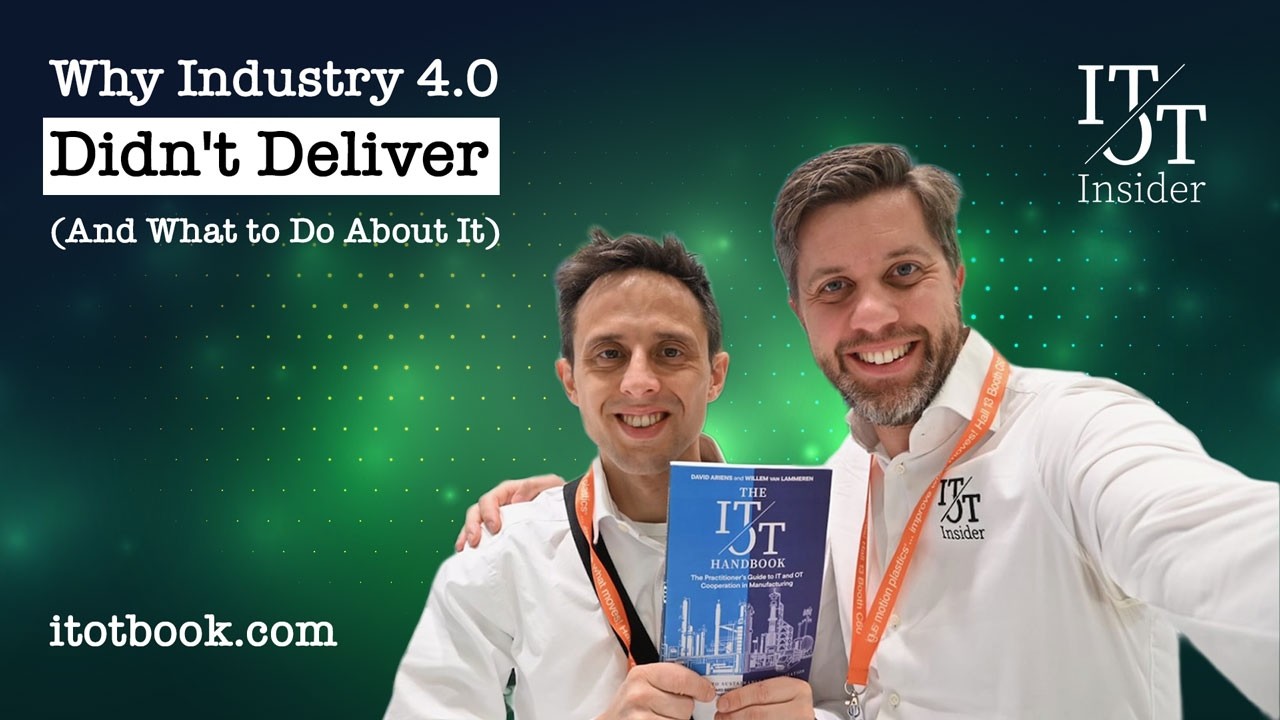
Why Industry 4.0 Didn't Deliver (And What to Do About It)
Fifteen years after the term was coined, is Industry 4.0 a resounding success? David and Willem look at three common traps (confusing connectivity with transformation, ignoring IT and OT's different life cycles, and architecture without a plan) and how to avoid them.
In This Episode
- Willem: fifteen years after it was coined, calling Industry 4.0 a universal success is overstating it, since for many companies a Google Sheet or an Excel file with macros is still the pinnacle of digitalization.
- Pitfall 1 is confusing connectivity with transformation: connecting machines and building dashboards doesn't change how people work, and connectivity is simply easier to sell than change.
- Pitfall 2 is ignoring life cycles: OT systems can last decades while IT cycles shrink to months, and the lower you go in the Purdue model, the slower things change.
- Pitfall 3 is architecture: Industry 4.0 was a vision, not a prescription, and the decisions you'll live with for ten or twenty years are made at the start, when you know the least.
- The solutions mirror the problems: connective tissue between IT and OT starting with COO and CIO alignment, decoupled IT and OT architectures through an operational data platform, and in-house skills.
- Willem warns against outsourcing judgement: a vendor's architect wants to sell their own products, and without people who understand both production and architecture you end up choosing based on sales pitches and pretty slides.
Cold Open: Three Reasons Industry 4.0 Fell Short
00:00 – 00:32The video opens with a quick teaser before the real conversation: David asks whether Industry 4.0 can be called a resounding success, and Willem answers that calling it a universal success would be overstating it.
Willem previews the three problems the video covers, change, life cycles and architecture, and the two hint at where the answers lie: translating the problem into an architecture, and having the skills to execute it.
“I think we underestimated change. We need to accept the fact that we have slow and fast life cycles. And finally, we need to talk about architecture, David.”
Willem van Lammeren · 00:12
Is Industry 4.0 a Resounding Success?
00:32 – 02:02David skips the usual welcome because the question is too important to wait. Willem notes the term was coined fifteen years ago, and some companies really are getting the most out of their data: not just showing dashboards, but changing how they work on the shop floor, building new business models, and experimenting quickly with AI.
Many others haven't got there. David's diagnosis: Industry 4.0 came with a vision but no manual, so the video first walks through the most common traps, then how to avoid them.
“There's still lots of companies where a Google Sheet or an Excel file with some macros is the pinnacle of digitalization.”
Willem van Lammeren · 00:56
Pitfall 1: Confusing Connectivity with Transformation
02:02 – 03:43Willem names the three pitfalls, and David starts with change, a favourite topic. The early focus was often on buying a new wireless IoT sensor or running a connectivity project, but connecting machines doesn't change how people work, and dashboards alone don't lower costs or improve products.
Connectivity is easier to sell than change, and, Willem adds, easier to understand and more exciting to talk about; change just sounds like hard work. David sees the same in consulting and the academy, where people tend to arrive with a technology question rather than a change question.
“Connecting machines is not the same as changing the way people work.”
David Ariens · 02:22
Pitfall 2: Slow OT and Fast IT Life Cycles
03:43 – 05:11Willem's second pitfall: IT and OT run on very different life cycles. OT systems can last decades, while IT cycles keep shrinking, from years to months. David adds that, in the Purdue model, the lower you go, the slower the life cycles, and that's very hard to change, though there are ways to work around it, covered later in the video.
David then introduces the third pitfall, architecture: there's no standard five- or ten-step plan from a disconnected to a fully digitized shop floor, and with so many technologies, full-ecosystem vendors and well-designed point solutions, it's hard to know where to start.
“OT has life cycles that really can span decades. And if you look at IT, it's only getting shorter and shorter.”
Willem van Lammeren · 03:43
Pitfall 3: Architecture Decisions Made When You Know the Least
05:11 – 07:38Willem argues that Industry 4.0 was a vision, not a prescription, and it all comes down to knowing which shop-floor problems you want to solve; connecting systems is only a step on the way. He likes a definition from Martin Fowler's website: architecture is about the important stuff, whatever that is, and each company has to define that for itself. The hard part is that the biggest decisions, ones you may carry for ten or twenty years because switching costs are so high, come at the start, when you know the least.
David agrees it's confusing. The academy's first hundred students asked for much more on architecture, so it now has two sessions on data architectures. He stresses the end goal is a moving target: not implementing the right architecture in one go, but keeping the flexibility to make changes nobody can predict yet.
“The moment that you know the least at the beginning is the moment when you have to make decisions that you will carry for ten, twenty, sometimes even more years.”
Willem van Lammeren · 05:51
Solution 1: Connective Tissue Between IT and OT
07:38 – 09:04On to the solutions. Willem says the answer to too much focus on connectivity is more connectivity, of a different kind: connective tissue between IT and OT. It starts at the top, with the COO and CIO, or whatever those roles are called, sharing a common vision, because changing a whole company from the bottom up is very hard.
With a mandate in place, simply telling people to cooperate makes no difference. Cooperation needs deliberate organizational design and different ways of working together, which is what the IT/OT Insider's cooperation patterns try to make concrete.
“Cooperation is more than just an on or off switch. It takes a design of your organization.”
Willem van Lammeren · 08:42
Solution 2: Decouple IT and OT with an Operational Data Platform
09:04 – 11:08After connecting people comes connecting systems. Because of the different life cycles and priorities, David argues the best solution is to decouple the IT and OT architecture. He recalls AI startups promising to connect to every machine, as long as it speaks REST or OPC UA; Willem adds the worse version, where you have to get the data to their API endpoint yourself.
David makes the case for a modern, future-proof operational data platform: connectivity on one side, a core of contextualization and ontologies that understands the physical world of manufacturing, which is still uncommon in IT, and connectivity to the outside world on the other. He points to the industrial data platform capability map video for more.
“The best possible solution is to decouple the IT and the OT architecture.”
David Ariens · 09:04
Solution 3: The Skills to Make the Right Architecture Choices
11:08 – 13:11The final ingredient is skills. You don't need 1,500 experts, Willem says, but you do need a few good people, because architecture decisions are the ones that are hard to undo. First, someone who understands the production problem you're solving; second, someone who can translate it into architecture, or you'll end up deciding based on sales pitches and pretty slides.
Can that knowledge be outsourced? Partly, but ask who your advisers work for and whether they'll stick around, for years rather than months, and ideally have several people in a bigger organization. A vendor's architect will naturally want to sell more of their own products, and their goal may not be yours.
“No matter how fancy the tool, if it's not helping anybody, it's just a waste of money.”
Willem van Lammeren · 11:08
Skills to Execute, and Where The IT/OT Handbook Fits
13:11 – 14:57With the problem understood and translated into an architecture, you still need the skills to execute. Willem says a good integrator, partner or experienced vendor helps, but can't take on every responsibility: someone inside has to drive the change and navigate internal politics.
David sums up: understanding each other, trust, the right ways of cooperating, and the right ways of technical scaling. That's exactly what The IT/OT Handbook is about, and he points viewers to the What is The IT/OT Handbook? video before signing off.
“You do need people who will go in there, make the change happen, drive internal politics and all those kind of decisions. It's not something you can outsource.”
Willem van Lammeren · 13:22
Full episode transcript raw feed ▸
David: Can we say that Industry 4.0 is a resounding success? Willem: It's like a universal success is is maybe overstating it. David: Start with the pitfalls and then explain how to how to avoid them. Willem: I think we underestimated change. We need to accept the fact that we have slow and fast life cycles. And finally, we need to talk about architecture, David. David: You are able to translate that all into an architecture and then comes Willem: You need skills to execute that. David: Yeah. Could we say that industry four dot zero is a resounding success? Willem: David, don't you normally start with Welcome to the IT OT Insider. David: Yeah, but this this question is just too important to ask, so let's dive in right away. Willem: Okay, okay. so industry four point zero was coined fifteen years ago and I think stuff has changed in the meantime, but to say that it's like a universal success is is maybe overstating it. I mean there are some that are really getting the most out of their data. They're like not just showing dashboards, but they're really changing the way that they are working on the shop force, even coming up with new business models. and those are also the companies that manage to experiment quickly with stuff like AI nowadays. you know, there's still lots of companies where a Google Sheet or a Excel file with some macros is the pinnacle of digitalization. David: Yes, Industry Four and Zero had a vision, but didn't really come with a with a manual. so let's explore in this video some of the most common traps when implementing those concepts. let's start with the pitfalls and then explain how to how to avoid them. so make sure to stick to the end. Willem, what exactly happened? Willem: Well, let's name three things. There's more, but let's stick with three. I think the we underestimated change very often. We need to accept the fact that we have slow and fast life cycles. And finally we need to talk about architecture, David. David: Yeah, so let's do the the change thing first. That's something we always love to focus on. Super important by the way. because I I I think it's fair to say that we often confused connectivity or systems with transformation. The initial focus often was on you know buying that new wireless IoT sensor, imp implementing a connectivity project. but you know Connecting machines is is is not the same as changing the way people work, yeah? So dashboards on their own, they don't translate to lower cost or or better products. so I think the first thing to really remember is that although connectivity is easier to sell than change, change is still something we can't avoid. Willem: Yeah. I I think it's also easier to understand and more exciting to talk about the new stuff. Change still doesn't sound very sexy, it just sounds like hard work. Like David: No Willem: you say the dashboard doesn't transform into change automatically. David: And we also see that in our, you know, in our discussions in our in our in our consulting jobs or our academies where people often come in with a technological question first and not the change question first. Anyway, so that was number one. Number two. Willem: Okay, we need to accept and deal with the fact that IT and OT have very different life cycles. So again, no no nothing special, but OT has life cycles that really can span decades. And I think if you look at IT, it's only getting shorter and shorter. Like we were talking first about years and now it seems to move into into months even. David: Yeah, and and typically and and by the way, I recorded a video on the on the Purdue model, which will link in the show notes. typically what we see is that the lower we go in the Purdue pyramids, or if you don't want to draw it as a pyramid, whatever, yeah. So the lower you go in the model, the slower your life cycles are. And y you need to accept that. We that's something which is very hard to change. but there are solutions to work around those lower or slower life cycles. And we come back to that in the second part of the video. so that was number two. And then number three is well, we talked about architecture. there is no standard five or ten-step plan to go from a disconnected to a fully digitized, integrated shop floor. Where do you start? There are so many solutions, there are so many technologies, there are vendors who are offering complete ecosystems, there are vendors who are offering very well. Designed point solutions. So where do we even start with them? Willem: Yeah, I four point zero was more about a vision than like a prescription, like these are the five things you need to accomplish and then you're gonna get there. So it it all boils down to knowing what problems you want to solve on the shop floor, and the answer is not I'm gonna connect systems. That's way towards that. but it's also architecture, because the points that you're bringing up, they do matter. And let's take a look at what the definition of architecture is. There's many. It's it's a question I like to ask every architect. Like, what is architecture according to each one has David: Good job. Willem: Yeah, and I mean it in an honest way, but they all have a different answer. I like a definition that I found on Martin Fowler's website, and that's architecture is about the important stuff, whatever that is. you need to define what that important stuff is for your company, because it's not gonna be the same for you as for somebody else. And The hard part is, David, the moment that you know the least at the beginning is the moment when you have to make often decisions that you will carry for ten, twenty, sometimes even more years because switching cost becomes really high David: Yeah, and and we do understand and we do notice that that it's it is confusing, it is difficult. and and and here also in our in our academy in in the beginning we only had a small piece on architecture. but the feedback we got from our first hundred students was really give us more, give us more architecture, give us more insights, explain how certain vendors fit into the landscape, explain how you start doing An architectural workshop ourselves. And that's why, you know, that's really now a very important part. We have two sessions on data architectures in the academy. We have a video on that, which you can which you can find here and also in the show notes. Don't forget, the end goal is always a moving target. It's not a right, it's not about implementing the right architecture in just one go. It's about making sure we have that flexibility. Just to keep on changing, to keep on making the the changes which are required, which we don't know yet, in the in the weeks and the months to come and the years to come. so with that, those are the three problems. Now comes the solutions. Willem: Yeah. So our first problem, David, was about putting too much focus on connectivity. well the solution is more connectivity but of a different kind. It's more about creating that connective tissue between IT and OT. Because you're not good. It's it's it's the soft side, it's that's cooperation that you need to really make the difference when it comes to digitalization in in in production. So it starts at the top, David. first of all, you need To have the COO and the CIO or whatever those roles are in your company to really be on the same line, to really have a common vision, it's gonna be really hard to change your entire company from the bottom up. So first first type of connectivity you need is that one. The second one, of course, is great, we have a mandate, let's start. Let's just cooperate. David, we know that absolutely yeah. Makes no difference. David: You shall work together. Exactly. Willem: Or else. no, you you need to take into account that cooperation i is more than just an on or off switch. It takes a design of your organization. You need to look at different ways of cooperating. I think there we really try to detail that and make that concrete in those cooperation patterns that we also discuss. David: Absolutely. on our cooperation patterns, we also have our book and other videos. But, anyways, so we have the connection between people. then comes obviously the connection between systems, and we talked about these different life cycles, different priorities. and that means that the best possible solution is to decouple the IT and the Auty architecture. you know, we've been talking to vendors also in the past, you know, where here is a new AI startup and they go like, but yeah, we will you know we we we can connect to every machine you have, you know? The only thing we request is a REST API or or OPC UA or something like that. And then okay, yes, but unfortunately most of my machines can't speak from the REST API. Willem: Or even worse, they're like it's awesome as long as you can send the data to our API endpoint, and you need a way to make that happen. David: For yeah, so from our perspective, we still believe that having a modern, future-proof operational data platform is still something which is super important. Yes, it goes hand in hand with the IT world. Very, very short, is there is obviously the connectivity side, then there is really the heart of the platform where Contextualization ontologies, you know, understanding the manufacturing context, the physical world of manufacturing is really, really important. Something which is still yeah not so common in the IT world. And then obviously, we also have the connectivity part to the outside world. we have a full video on that, which is called our industrial data platform capability map, which you can find on the YouTube channel and also as a link in the show notes. we have connectivity between people, we have connectivity between technical connectivity between the IT and the OT world rulem. And then comes having the capability to actually execute and to build those type of things. So we have to talk about skills. Willem: skills. Yeah. you're not gonna need 1500 experts in every tiny domain, but you're gonna need a couple of good people in your organization to make the right decisions. Because when it's about architecture, it's about dealing with the stuff that's hard to change very often. If you don't have the skills, you're gonna choose the wrong thing. You're just gonna not be able to make the right choice. So what kind of skills are we talking about? Most important I'd say is the skill to understand what the problem is that you're trying to solve. I mean, no matter how fancy the tool, if it's not helping anybody, it's just a waste of money. So that's the first one, somebody who can understand production. The second one is somebody who can also make a translation to architecture. Like I said, if you cannot evaluate what you need and how you need it. You're gonna base yourself on sales pitches and pretty slides. And I think that's a poor decision basis. David: It's it's also c can we is it easy to outsource that's that knowledge? Willem: Partly, but you will need to take into account that the ones that you take in to make those decisions for you, who are they working for? And will they stick around? David: And not just for months, but for Willem: For years. Yes. so preferably also not just one person. If you're a bigger organization, you will need several people. But yeah, I mean the the architectural choices here will make the difference between a system that can evolve quickly and an absolute shit show of an expensive project that doesn't deliver. it's it's just the truth. You will need some impartiality because of course the vendor will send an architect, but their goal is of course to sell more of their own things. That might not be the same as your goal. David: So we have the we have the people, you know, we understand the business problem, we have a technology, we are able to all to translate that all into an architecture, and then comes Willem: you need skills to execute that. I mean it's good if you have the problem, you have the plan, but then you need to bring it into action. and of course here a a good partner, a good integrator is is key. a good vendor who has experience in in in what you're trying to solve helps. But they cannot take on every responsibility. You do need people who will go in there, make the change happen. drive internal politics and all those kind of decisions, it's not something you can outsource. David: No, absolutely. Okay, so with that, we discussed the three most important problems we see with industry four. We already gave you some hints towards the answers, but as you as you noticed, you know, we've pointed to different videos, different pieces of content. You can find lots more information on our channels. If we summarize that, it's about understanding each other, trust, it's about the right ways of cooperation, it's about the right ways of technical scaling, and that's exactly What our IT/OT handbook is behind me and also behind you, Willem. Yes. What our IT/OT handbook is all about. If you want to know more about the IT/OT handbook, we also have video on that. So check out our what is the IT/OT handbook video, which you can find again on the YouTube channel and in the show notes. with that, thank you very much for tuning in, Willem. Thank you also. Until we meet again, bye-bye. Willem: Goodbye.