
Explainer 9 min
What is The IT/OT Handbook?
David and Willem walk through what's actually inside The IT/OT Handbook: why they spent three years writing it, how it's structured across Understand, Cooperate and Scale, and who wrote its two forewords.
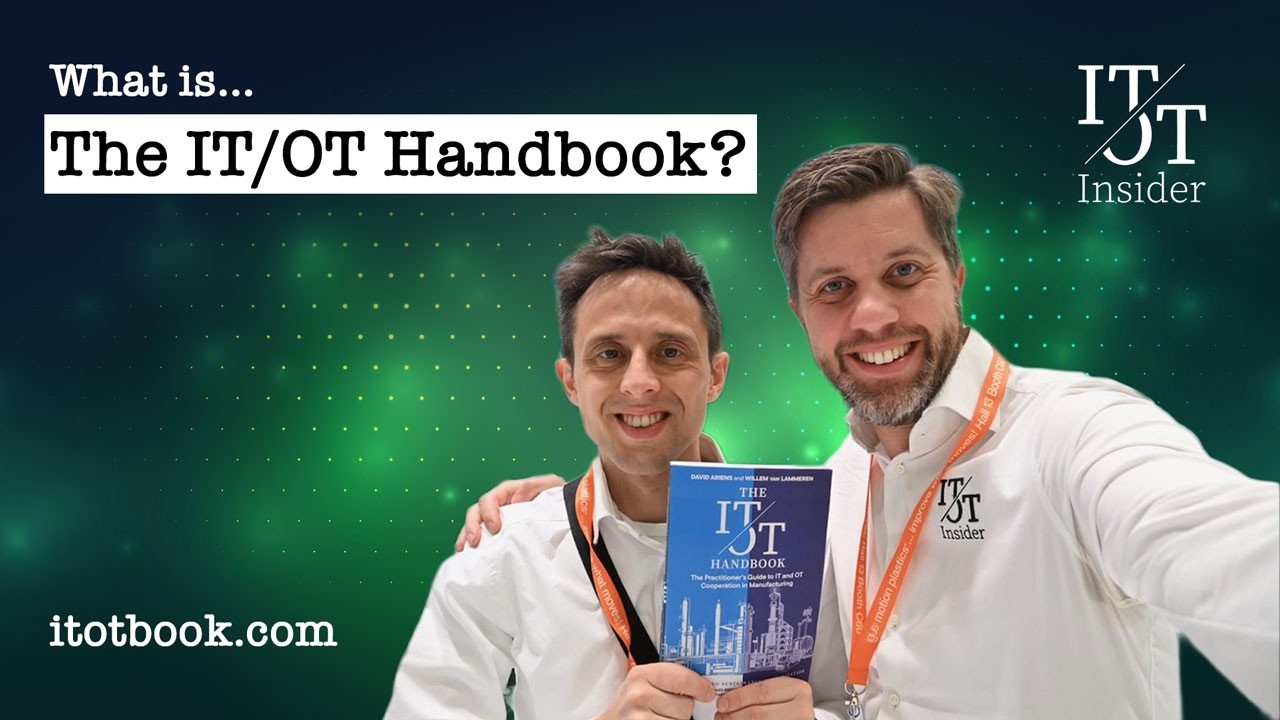
In This Episode
- David and Willem wrote The IT/OT Handbook because, despite publishing two well-received "IT/OT mini libraries" roundups, they kept finding no good book existed specifically on industrial and manufacturing digitalization.
- What was estimated as six months of work, three years ago, actually took three years — David: "the initial estimate was indeed six months, but hey, here we are."
- The book is structured in three parts: Understand (building trust between IT and OT), Cooperate (patterns and tools for making cooperation actually work, not just declaring it), and Scale (getting data and AI projects from proof of concept to production).
- David, on the book's real subject: it's not about organizational change for its own sake, but about how two technical organizations can cooperate meaningfully without restructuring the entire company.
- The book carries two forewords by design, one from each side: John Smart (IT Revolution) for IT, and Richard Beeson, former CTO of OSIsoft, for OT — and the manuscript itself was rewritten multiple times after feedback from industry, consultancy, integrators, and academia.
- The book opens with a true story about loading trucks, Willem's own, which he calls the first thing they wrote down and the one that best captures the frustration of digitalization inside a plant.
Cold Open: Why Isn't There a Good Book on Industrial Digitalization?
00:00 – 01:09The video opens with a quick teaser of David naming the gap the book fills, before the title card and the real conversation begin: why write a book at all, in an age that already feels saturated with digital content?
Willem frames it as a deliberate counter to how fast everyone's day already moves, meetings and decisions left and right, and calls a book a kind of luxury: the chance to sit with a topic in more depth than a normal workday allows.
“There is, however, a problem though — there was not really a good book about industrial or manufacturing digitalization.”
David Ariens · 00:00
The Crazy Idea That Was Supposed to Take Six Months
01:09 – 01:53David explains the backstory: he and Willem had already published two well-received "IT/OT mini libraries" articles rounding up good books in the space, but kept running into the same gap, there wasn't a good book specifically on industrial or manufacturing digitalization.
Willem recalls the moment the idea flipped into action, and his own skepticism about the timeline: David's original estimate was six months. Three years later, David admits the estimate was optimistic, but they got there.
“That's when you came with the crazy idea — why don't we write a book? My response was, David, this is gonna take years, it's a lot of work. And I think your estimate was six months?”
Willem van Lammeren · 01:09
Meet the Publisher, and the Book's First Two Parts: Understand and Cooperate
01:53 – 03:27David introduces IT Revolution, the publisher behind the book, and lays out its three-part structure: Understand, Cooperate, and Scale. Part one is about getting IT and OT to understand each other, different priorities, different language, often different organizations altogether, and building the trust that everything else depends on.
Willem picks up part two, Cooperate: understanding each other is necessary but not sufficient, so the book spends real space giving nuance, language, and tools for making cooperation actually work in practice, since there's no single way to do it.
“It takes more than just somebody saying, ‘let's cooperate,’ to make cooperation happen.”
Willem van Lammeren · 02:59
Cooperation Patterns, and Scaling from Proof of Concept to Production
03:27 – 05:24David clarifies what the book is and isn't about: not a book about organizational change for its own sake, but about how two technical organizations can cooperate meaningfully without restructuring the entire company. The cooperation patterns range from simple to advanced, with guidance on how to move from one to the next.
That cooperation is what enables execution, which is part three: Scale. Proof of concepts aren't enough; the book explains what it actually takes to scale data and AI projects from small pilots to something large, the real bottlenecks around connectivity and contextualization, explained in a way a plant manager can follow, plus how to get started: running a workshop, assessing current maturity, and picking the next steps.
“It's not a book about change. It's a book about how you can have those two technical organizations cooperate in a meaningful way, without having to change the entire hierarchy of your company.”
David Ariens · 03:27
Two Forewords, and a Manuscript Pressure-Tested by the Industry
05:24 – 07:33Because it's a book about IT and OT, David and Willem wanted two forewords, one from each side. Willem introduces John Smart, also published by IT Revolution, as the IT foreword: an expert on how IT functions inside organizations and how to run one in a modern way.
David introduces the OT foreword: Richard Beeson, former CTO of OSIsoft, whose PI System, he says, really changed the world of industrial digitalization. Willem then shares that the manuscript wasn't written once, it went through several rounds, deliberately pressure-tested with feedback from people in industry, consultancy, integrators, and academia, which David credits with making the final book noticeably better.
“We have the foreword from OT, written by Richard Beeson — the former CTO of OSIsoft. The PI system really changed the world when it comes to industrial digitalization.”
David Ariens · 05:45
The Story of the Trucks, and How to Get the Book
07:33 – 09:47David mentions a few of the real stories tucked into the book, a steam cracker, water infrastructure, and one about loading trucks that's Willem's own story. Willem leaves the details for readers to discover, but calls it a true story and the very first thing they wrote down for the book, one that captures the frustration around digitalization in plants.
David closes out the practical details: the book is available as a paperback, an e-book, and an audiobook narrated by a professional voice actor, through itotbook.com or any major bookseller. He points listeners toward the IT/OT Academy for going deeper after reading, and asks that a review, if the book helps, since that makes a real difference for them. The video ends on David and Willem's usual sign-off, with a short, self-aware blooper tacked on after the goodbye.
“It's a true story, and it's actually the first thing we wrote down for the book. It really captures the frustration around digitalization in plants.”
Willem van Lammeren · 07:33
Full episode transcript raw feed ▸
David: There is however a problem though, there was not really a good book about industrial or manufacturing digitalization. Willem: And that's when you came with the crazy idea, why don't we write a book? David: It's a book about how can you have those two technical organizations cooperate in a meaningful way without having to change the entire hierarchy of your company, which we won't be doing at all. Willem: What is The IT/OT Handbook? David: If somebody needs to know the answer, it has to be us, Willem. We've been working on the damn thing for the last three years. We're gonna explore that in this video. But first, simple question why a book in the time of digital? Willem: quick question. David, both of us and I think lots of others have their lives, you know, goes fast. You have meetings, decisions, left and right, and sometimes it feels like you're on a train. And a book feels like some sort of luxury to sit down and explore a topic with a bit more depth than you can in, you know, your normal work day. David: Fully agree, not just reading books, also gifting away books, by the way. We all we we both love to do that. so because it's so important to share that knowledge here, which are the good books in our domain, we've published two articles which we call the IT/OT mini libraries in the last years. They are really well received. There is, however, a problem though. There was not really a good book about industrial or manufacturing digitalization. Willem: Yeah, and that's when you came with the crazy idea, why don't we write a book? To which my response was David's gonna take years, it's a lot of work. And I think your estimate was six months? David: The initial estimate three years ago was indeed six months, but hey Willem: I mean could be worse. David: Here we are. Now we didn't just want to write something down. We really want to make something really, really good. That's why we well why we also looked for a very good publisher. So we are super happy that IT Revolution, really one of the big names in the industry, is behind our book, really made it into a very, very nice to read product. We're really proud of. let's understand what our or let's explain what our readers can expect from the book. it's a book in three parts: understand, cooperate, and scale. first of all, understand. So the first part is about having IT and OT understand each other. Both have different priorities, they have different language, they have even different organizations in most companies, unfortunately. So that first part is really on building that understanding layer, that trust. Between two sides of the organization. And with that trust, we can go to the second part, Willem, which is cooperate. Willem: Yeah. Like you said, we need to understand each other, find out how we tick, but we also need to find ways to make that cooperation work. Because it takes more than just, you know, somebody saying, Let's cooperate to make cooperation happen. So we spent a big part of the book actually giving a bit more nuance and language and tools on how you can do that cooperation. So there's not just one way. David: Yeah, and this is where yeah okay, the the difficult word here is change, but it's not really it's not a book about change. It's a book about how can you have those two technical organizations cooperate in a meaningful way without having to change the entire hierarchy of your company, which we won't be doing at all. our cooperation patterns really go from very simple cooperation to very advanced cooperation, and we also explain how you get from one to another. so that's the second part. With that trust. With that cooperation comes the ability to start executing. And this is another part. So this is the part three. Scale. Just doing proof of concepts is not enough. You need to understand what it takes to scale data and AI projects from small to really large. The third part is about an explaining. What the bottlenecks are, it's about connectivity, it's contextualization. But we try to explain that in a maybe not too technical way. We try to explain that to in a way where you know also your your plant manager understands the difficulties on on what it takes to build that data foundation. now we don't only talk about the data foundation, we also talk about how you get started. So, how do you organize a workshop? How do you make sure you identify your current maturity and where you wanna end up? And what steps to take. So that's what the third part is all about. Those are the things we have written. It's our our concepts, our ideas. But that's not all. It's a book about IT and OT. So it does make sense, at least in our opinion, to also have two forewords. So we have a foreword from IT and a forward from OT. Willem, the foreword from IT has to be written by John Smart. We're really happy. That he took the time to do that. Willem: Yeah. so John Smart, also a writer with IT Revolution, actually, really is I'd say a specialist and expert when it comes to how IT functions within organizations and just even j in general. How do you run an organization? Yeah, absolutely in a modern way. David: And he is he has some very, very interesting insights, which are really, really valuable to understand before you start reading the book. And then we have the forward from Oti, which is written by Richard Beeson. Richard is the former CTO of OSIsoft they created the the PI system, and and we have to say that the Pi system, when it comes to industrial digitalization, industrial data. The PI system really changed the world. It's a very, very important thing. Many, many of us know the system very well. So we are really happy that Richard took the time to also write from his experience. Now, what I also think is valuable to mention is that we didn't just write the book once. Willem: So write writing is a very repetitive process. So I I think we wrote it several times and the reason is because we we asked for lots of feedback. Yeah. So you have a first version and we reached out to people in industry, people in consultancy, integrators, academia even, for their input, for their feedback. Because you know, is what we're writing, does it make sense? does the story work? Are there exceptions? So we had to integrate all that feedback from those people, for which we're very grateful because it made the book much better. David: No, absolutely. No, for sure. It it really, we really were able to take steps in the in in in the in an even better direction. and then the the the final thing you I just want to mention is there are a lot of stories. there is a story about steam crackers, there's a story about water infrastructure, there is even a story about loading trucks, and that's our own story. th th it's it's your story, so you may maybe I don't Do you do you wanna say something about the story or do we just leave it for the reader to explore? Willem: I I'll leave the content for the reader to explore, but just a fun fact. Again, it's a true story. It's actually also the first thing we wrote down of the book. And it really captures the frustration around digitalization implants. So I'm not gonna tell more. Just get a book and in the first few pages you'll find a story of the trucks. So David, if we get a book. How can we how can we read it? How can we consume this media? David: As a paperback, the one which is behind me and the one you also were holding in your hands, as an e-book on most major platforms, but also as an audiobook. And that was actually really fun or we a couple of months ago we got in the the auditions because the audiobook is actually read by a professional voice art. Willem: Yes, you don't need to suffer our English. David: Much, much better English. so with that, if you are interested in buying or gifting the book, just go to itotbook.com where you'll find all the information or to your favorite online bookseller, they are available across the globe. we'll we'll make sure to put links in the show notes when you yeah when you're watching, when you're consuming this video on our YouTube channel. But wait, there is more, because if after you have Read the book, you want to delve deeper, you want to interact with us, with others in the industry, maybe the IT/OT Academy is something for you. now we have a separate video about what it takes or whether what the academy is all about. You can find that also on our YouTube channel and in the show notes. or you go to itot.academy to learn more. So, with that, thank you very much. We really hope you enjoy the book. And if you do, leave a review because that really, really Willem: That actually really makes a difference for us. David: Thanks for tuning in. Until we meet again, take care. Bye bye. Willem: Bye David, what's the OT app? David: But first, why did we write a book about