
On Stage 1h 11m
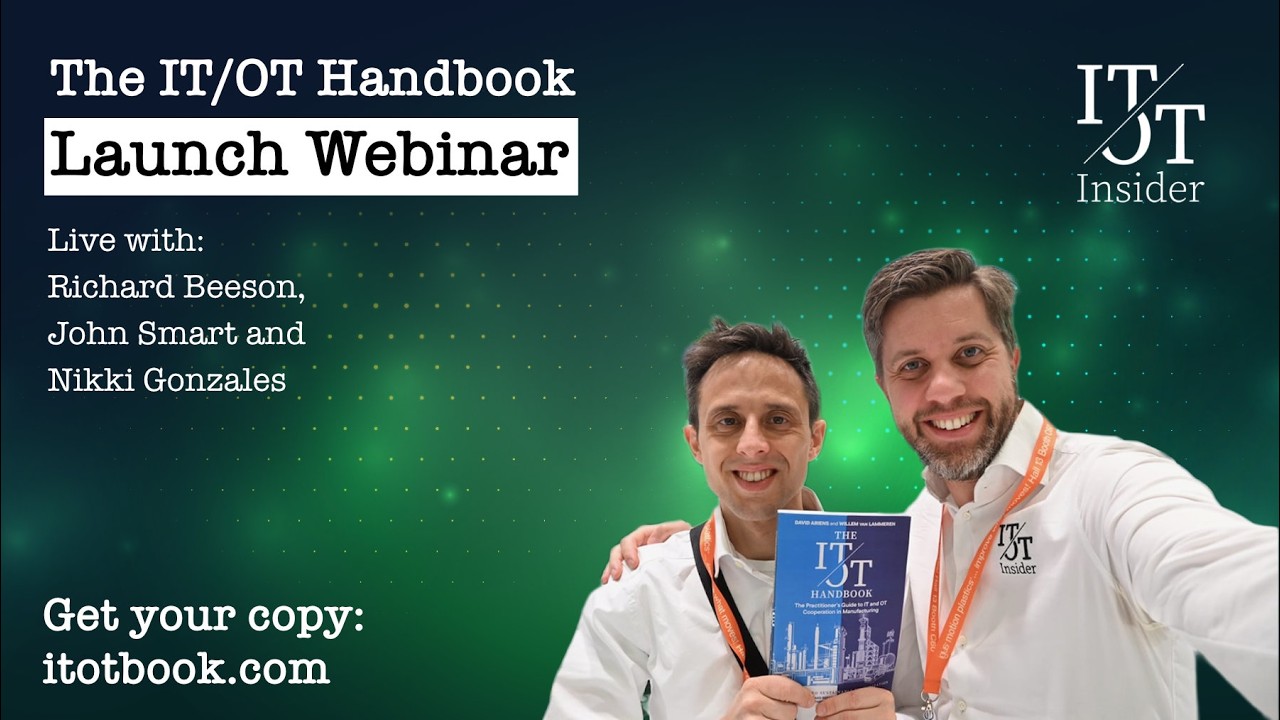
The IT/OT Handbook Launch Webinar: Live with Richard Beeson, Jon Smart and Nikki Gonzalez
We went live to officially launch The IT/OT Handbook and we didn't do it alone. Moderator Nikki Gonzalez hosted a full hour with the two people who wrote our forewords: Richard Beeson (OT) and Jon Smart (IT), plus the two of us.
In This Episode
- Richard Beeson: as long as IT and OT exist as categories, the boundary between them will too; like organs in a body, the goal isn't to remove the tension but to keep it healthy rather than dysfunctional.
- OT information is grounded in physics: between two thermocouple readings the temperature has a real meaning, unlike the value of a stock between two trades, one reason IT and OT can talk past each other with the same words.
- John Smart traces today's silos to 1771's Cromford Mills and Taylor's separation of thinking from doing, a way of working he calls simply not future fit for faster, more emergent, AI-driven work.
- Silos persist because people follow the incentives of their silo; shared goals and incentives, as in DevOps or Halifax Water bringing IT and OT under one roof, are the only real path to cooperation.
- Cooperation doesn't always require a reorganization: one renewable energy company started with a facilitation model and, two years later, is moving to an integrated operating model where IT and OT keep their identities.
- On AI, Willem says no model is useful without data, so the technical and sociotechnical foundation becomes table stakes, while Richard calls discernment, judging whether AI output is right, the crucial skill.
Welcome to the Official Launch of The IT/OT Handbook
00:40 – 04:03Moderator Nikki Gonzalez opens an invite-only launch event for people who pre-ordered The IT/OT Handbook. She introduces the two foreword writers, Richard Beeson, former CTO of OSIsoft, for the OT side, and John Smart, author of Sooner Safer Happier, for the IT side, alongside authors David and Willem.
She sets an informal tone, invites the audience into the chat, and frames the hour: not reading the book aloud, but a conversation between the authors and foreword writers, because the book is about making a change and helping people learn from each other.
Why This Book, Why Now, and How Feedback Shaped It
04:03 – 06:37Willem explains the motivation: he and David worked together for years and kept seeing other people face the same problems. The IT/OT Insider blog was a start, but they wanted to go deeper and write the book they wished they'd had when starting out. David notes it's launch day and that copies are still shipping from the US to readers around the world.
Nikki jokes that the authors should only be held accountable for the IT/OT content, not shipping or publishing hiccups. David explains why the book took a couple of years: feedback from colleagues, the academy, the blog and LinkedIn, and reviewers, including Richard and John, who also wrote the forewords.
Richard Beeson: IT and OT Won't Merge, but Their Tension Can Be Healthy
06:37 – 14:48Nikki introduces Richard: 32 years at OSIsoft and AVEVA, where he helped create PI 3 and Asset Framework, now CTO of Creation Energy and a partner in Mr. Dewey's Cashew Creamery. Asked whether IT and OT will ever stop misunderstanding each other, Richard argues that as long as the categories exist, the boundary will too. Like organs in a body, each plays a vital role, and every healthy system needs tension; the real question is whether it's functional or dysfunctional, a lens he found running through the whole book.
IT and OT might eventually dissolve into something different, he suggests, but only when the underlying physical and conceptual landscape changes, which is where AI gets interesting. Until then, it's fundamentally a people question: you can optimize every section and still de-optimize the whole. An audience comment widens the point to other tensions, such as mechanical versus electrical teams.
Family Dinners, Shadow IT, and Engineering With Feelings
14:48 – 22:15Richard compares a vendor or consultant entering a plant to joining a family's holiday dinner for the first time, landing in the middle of decades of dynamics, and stresses the care needed not to become a pawn in an unhealthy tension. Prompted by a comment that IT sees OT as the Wild West, David revisits a recent clip about shadow IT that some read as calling OT engineers less advanced. He insists both groups are highly technical; they just start from different constraints and solve different problems, and AI's pace means both have to learn from each other faster.
Nikki adds that the tension is also about how people relate, and shares a story of a project manager who insisted engineering is not about feelings while very visibly expressing his own. David picks up a comment that the primary tension lies in data ownership, acknowledging that data starts earlier than the time-series signals the book begins with, back in the engineering process.
From Asset Framework Trees to Physics: Why OT Data Means Something Different
22:15 – 27:26David recalls a podcast discussion about PI Asset Framework's tree structure, which can't capture a plant's full complexity, and how Richard started from an ontology before moving back to the tree to keep it approachable. Richard explains that OT people think about information fundamentally differently from IT: between two thermocouple readings an hour apart, the temperature has a well-defined meaning tied to physics, whereas the value of a stock between two trades has no physical meaning at all.
That difference is why IT and OT can talk past each other while using the same words: information, data, measurement, sample. The authors' remedy is simple: get people into the plant, so the data becomes tangible, and make plant visits a company-wide habit, not just an operations one. Nikki agrees, explaining she came back to the industry because she missed standing next to a machine, and adopts John's term from the chat: it's always sociotechnical systems.
John Smart: A Jet Engine Factory Where OT Out-Worked IT
27:26 – 32:15Nikki introduces John Smart, co-founder and CEO of Sooner Safer Happier, an agile and lean practitioner since the early 1990s, and lead author of Sooner Safer Happier: Patterns and Antipatterns for Business Agility. John, whose background is IT, tells of touring a jet engine turbine blade floor: value streams labelled on the ceiling, raw materials arriving on one side and finished blades leaving on the other, and an obeya room full of visual management.
The same plant ran a 1996-era PC no one would replace for fear of downtime and new bugs. But IT, in the building next door, had worse ways of working than operations, and had never walked over to look. His advice echoes the book's first part, Understand: go and see the factory floor, the gemba walk, and remember that lean and agile originated there.
From Cromford Mills to Taylor: Why We Still Work in Silos
32:15 – 36:53Jon traces today's silos back to 1771 and Cromford Mills, the first factory system at scale: a thousand people, three quarters of them children, split into fifteen role-based specialties with work passed down the line. Frederick Winslow Taylor put specialization on steroids by separating thinking from doing, and Henry Gantt's original chart tracked whether workers had shovelled enough coal; the human relations movement grew up as a reaction.
We still work this way despite faster change and more emergent, unknowable work, especially with AI, and John calls it simply not future fit. A chat comment about MES engineers who never visited the shop floor matches his own automotive example: an MES installed by IT without talking to operations sends four identical parts to four different machinists, suboptimizing the whole.
DevOps Lessons and the Incentives That Keep Silos Alive
36:53 – 41:03Jon explains how David and Willem drew on DevOps. Having owned both IT development and operations, he inherited developers lighting fires, separate testers, and an operations team putting them out. The DevOps answer around 2010 was you build it, you run it: common goals and incentives under one roof, with people rotating roles, which is a strong motivator when you'll get the 3 a.m. call yourself.
Why isn't this everywhere yet? John quotes a line about rational people following incentives in a complex system: pay, promotion and job security are tied to the functional silo, like saying the hole is on your side of the boat. Organizations are changing, through models such as Spotify's squads and tribes, because they have to, and AI will amplify the need. As John puts it, survival is not mandatory.
Steam Crackers, CIA Versus Safety, and IT and OT Under One Roof
41:03 – 45:56Jon notes every organization is as dysfunctional as its survivability allows, and the panel explains what a steam cracker is for anyone unfamiliar, prompting Nikki to praise spelling out acronyms, since different companies use different words for the same thing. The authors contrast priorities: IT optimizes for confidentiality, integrity and availability, while operations put safety first and think of integrity as the physical asset not blowing up.
Picking up a comment that IT and OT aren't incentivized to accept risk the same way, John argues shared goals and incentives are the only real path to cooperation, while respecting that IT can fix forward with a limited blast radius and OT often can't. He highlights the book's Halifax Water story, where IT and OT moved under one reporting line and became we rather than us and them; David adds that this works brilliantly but isn't politically possible in every organization.
Cooperation Without Reorganizing, and Optimizing for Outcomes End to End
45:56 – 51:10David describes a renewable energy company that lacked the political capital to restructure, so it started with the facilitation model: architects and facilitators from each group gauged what needed to change with management's backing. Two years on, they're moving to an integrated operating model, integrated but each keeping its identity, since good IT and good OT are not interchangeable skill sets, and in large multinationals there will never be just one group anyway.
John wraps up his reflections: define the outcomes and value end to end for the business, not per silo, then bring multidisciplinary teams with IT, OT, operations and engineering expertise together with shared goals and incentives. Nikki connects it to the future of work: as AI agents take over tasks, even machine operators need to understand where they sit in the value stream and why.
Is AI the Catalyst? Blockchain, the Metaverse and the MSN Era
51:10 – 59:08Nikki asks whether AI will be the catalyst for wholesale change. David admits they often wondered whether to turn it into an AI book, but recalls blockchain and the metaverse, hypes that never mattered on the shop floor. AI feels different: yes, there's hype, but it's more like the early internet, the era of MSN, AOL and GeoCities, when nobody could imagine what came next. Citing Gene Kim, he calls AI a reset button that puts most companies in roughly the same place, making now the time to get on board, starting with understanding, cooperation and a scalable data foundation.
Willem notes that the more experts know about AI, the less they claim to know about where it's going; we underestimate its medium-term impact and focus too much on chatbots. Frontier models already outpace what organizations can integrate, and no model is useful without data, so the technical and sociotechnical foundation becomes table stakes. David jokes about a pinky promise to their wives not to write another book anytime soon.
Will AI Take My Job? Discernment, Battle Scars, and Starting Today
59:08 – 67:28Nikki relays questions from young engineers worried AI will write their PLC or robot code, calling resistance futile. Richard argues discernment is the crucial skill: is the AI hallucinating, is the output correct, is it going to blow somebody up? Experienced people are less distressed because their battle scars let them judge, and he worries about how young people will build that experience. David hears the same from banking, where hiring juniors gets harder because using AI tools well takes more architectural knowledge, not less, and shares how Claude first denied, then admitted, wiping his test database.
Nikki observes that experienced OT engineers are scarce and quickly rehired, while IT skills have become far more common, which gives hands-on, physical-world understanding lasting value. David's closing advice: ask where you and your company want to be in five years. The answer will involve AI somehow, so start today, building skills, trying, failing, building the data foundation and understanding the operational reality.
A Champagne Bet, Academy Deep Dives, and Goodbye
67:28 – 71:13Asked for final words, Willem reveals a bet: he owes David a bottle of champagne if the book reaches fifty Amazon reviews. David explains reviews are the only way the message reaches a wider community, and asks attendees to leave one once their copy arrives.
Nikki thanks Richard and John and praises the collaborative community. Responding to a suggestion that this become more of a community, David mentions the academy and an upcoming format called Academy Deep Dives. He thanks John, whom he recently met in London, and Nikki for her moderation, before the event signs off.
Full episode transcript raw feed ▸
How cool was that? Speak over to Top David. Hey everybody. Welcome to the official launch event for the IT OT handbook. Welcome, friends. You're like this is one of those exclusive webinars that is not advertised to the public. So everybody here has pre-ordered the book. You know these folks here, or most of them on the call. maybe not me. Hi, I'm Nikki Gonzalez. Not yet. I will be the moderator today. I'm kind of good at hosting. My last my last gig was hosting my friend's baby shower a couple of weeks ago. So delighted to be here today to host a book launch party for our friends. And we are gonna also gonna be joined by two very interesting guests today that wrote the four words of the book. one from the OT point of view and one from the IT side. So I want to welcome Richard Beeson, former CTO of OSI Soft. Welcome, Richard. And John Smart, author of Sooner, Safer, Happier, a business book that I hear David and Willem are huge fans of. And of course, by David and Willem themselves, the authors. Hello. Hello. And I'll say good morning. I'm in Houston, Texas. it is 9 a.m. for me. I'm having my first cup of coffee. I know for many of you it is the afternoon or maybe some other time of day. So would love to get you guys active in the chat. This is, you know, we have a bit of an agenda today, but this is also fairly informal. We'd love to get your questions, your feedback, interactions with each other in the chat. so go ahead and open the chat if you haven't yet. thank you to everybody that's already sent messages. If you haven't yet, give it a shot, you know, practice the chatting a little bit. Say hi, where are you from? good morning or good afternoon, something like that. It's just so fun to see how, you know, we are able to reach so many people across the globe on this platform. It is impressive. And we were just talking about how cool it would have been if we could have done this in person. It's of course very nice to be able to get in a room together and the energy where we actually can, you know, kind of feel each other's vibes. But you can do okay over over the Zoom. I think we've all gotten kind of used to that. And the other thing is there's obviously no way all of us would have been here if if this was in person. So Absolutely. Thank guys for putting this together. So in this next hour, we're gonna be exploring various aspects of the IT/OT cooperation as the topic of the book pertains to. we're not gonna, you know, read the book for you or anything. You obviously pre-ordered the book. You already know that you want to read that, but having a discussion between the authors, the guests that wrote the foreword, and just kind of, you know, let's this book is not just about having a book. It's about trying to make a change. It's about trying to teach people, right? all those good things. And I think a big part of what these guys do also with their trainings is to get people to learn from each other. so I I will say sort of for my part, that's what I'd love for this hour to be. so I I guess yeah, and please post questions for our speakers as we go. We'll try to get them answered. we'll try to ask them. And then I guess I'm gonna go ahead and start with our first questions and letting our authors kind of tell us why this book? Why now? What are we doing? Well, I I don't think it's because we were bored, David. or or wanting for time or it's probably also not our get rich quick scheme either. neither no selling books about things. So you're about to get rich pretty quick. Yeah, yeah. ~ I hope. Nikki, if they took ten books in stock, then I think I see. No. I I think the reason we we wrote the book was because well David and I, we worked together for a long time and you know, we were facing problems, but we noticed that other people were just facing the same problems. So as you know, we started writing on the IT OT insider, but we really wanted to make something where it could go a bit deeper. and make you know the book we wish we had when we were starting out to get some ideas of what are the problems you're facing and how can you solve them. Yeah. Small maybe small thing here from my side. So obviously today is the official launch date. So it's the book is available starting today. maybe some of you already received it, most probably won't so hopefully that book will come in in the next days, two weeks. So be a bit patient if you don't have it yet. It'll come. It just needs to be shipped from the US to, you know, wherever you ever w wherever you are in the world. So I will from just give a little aside here. obviously these guys are not ~ professional book publishers and we are not professional webinar runners either. So I think the only thing that you can really criticize these guys for is if you vehemently disagree with something that they say in the book on the IT/OT. technical side of things, right? That's what they should be held accountable for, not not everything else surrounding it, right? That's an Amazon and publishing problem. And even then, we still like to get feedback and if it's like Willem and David, your ideas suck. Absolutely. Absolutely. Because you know, it's not something we and and actually this is a perfect leanway, Willem, into into the into the first speaker. Because so here is the thing. it took us a couple of years, not just because writing takes a long time, but also because we got so much feedback. Yeah. Feedback from people we work with on a daily basis, feedback from our academies, feedback on the blog, LinkedIn posts, but very importantly, and that's where Richard and John come in, feedback from our reviewers and in the case of Richard and John, even the ones who wrote two brilliant forwards. Niki, so I guess that's our little pitch over to you. Okay. So why don't we go ahead and introduce Richard? Richard Beeson is a founding member and currently the chief technology officer of Creation Energy. He's also an executive member of the industry nonprofit Collaborative Utility Solutions. during his 32 years at OSI Soft and then AVEVA we we think we all know about OSI Pi, most recently as chief software architect and then CTO, Richard was instrumental in bringing operational data to the desktop, in the creation of Pi 3 and the asset framework, and in carrying that data to the cloud. So I can totally understand why you guys tapped him for feedback and the foreword here. He has been a partner in Mr. Dewey's Cashew Creamery since 2015, which keeps him grounded in the process manufacturing and retail at small scale. I love that. I have many potential side quests in the future. One of them involves a small retail store. but me and the automation ladies have also often thought, I wish we had a factory in order to operate and do all of the cool things that we talk about. We're trying to get customers to do. And it's like, if I just had my own, I could I could do it myself or prove it out. so Richard holds a degree in chemical engineering from the University of California, Berkeley. Thank you so much for joining us, Richard. and I'll just jump into the first question here for you. You have clearly been working at the intersection of IT and OT since I don't know, the dawn of man. No, since the industrial first bits started coming through the wire. Right, right. after so many decades, they still have problems understanding. each other. Do you ever see that changing? And what do we need to? I think I think David said not to get philosophical but I guess I I I'll ignore him. He's not in charge anymore I am so go for it. No, you know the way I think about it, the when you when you have these concepts, you have these categories, you actually create the thing. So I mean, as long as these categories exist, this boundary is going to exist. As long as you have operations, as long as you have this, this, you know, this IT concept, you're going to have this this division. you know, and and in any healthy system like the body, you know, you've got you've got lungs and you've got the brain, you got the heart, you got, you know, all the different systems, and they all play a vital role. and you know it's not like you're gonna say, well, I'm I'm gonna get rid of my well, some people do lose their pancreas, but I'm gonna get rid of my pancreas because my heart would rather, you know, have other things to do. It it doesn't work that way. So no. I don't think I don't think in the current landscape it it's going to change. I I do think there was a scenario where it will change and we can we could get on to that. Later, maybe if we have some time, but for now, no, I don't think it's gonna change. and in any healthy system like that, you you necessarily need tension. I mean, that there is no healthy system in the world that exists if you really study it and look at it. If if there's not tension in that system, the system doesn't continue to exist. The question is. Do you do you structure a a healthy system or a healthy tension? Or does it become a dys dysfunctional tension? And I think I think if I I I I did it ~ when I when I reread the book, I I was holding that kind of frame in my mind and I was like, wow, these guys are talking about all the the functional and dysfunctional tensions through this whole dynamic, through this whole book. And and I think that's a a very interesting way to think about it. but as long as you know IT holds its its purpose, its value, its mission, and OT as well, then then I think it is that f finding that health intention and the way that the that the whole system benefits is is key. ~ Yeah, that's that's the that's the first part of that. so I I mentioned I think on a longer timescale that that could change this this this whole notion of do you need IT and OT and and well a hundred a hundred years ago there wasn't there wasn't an IT OT tension, right? Right. There was no IT or no OT. So waiting to well it was probably a yeah operations. There was probably some technology. I mean, come on. ~ But what changed is the technology landscape changed, the fundamentals and the way things were changed and created this new this new dynamic. And I think you can only really talk about ITNOT going, you know, that there's this that this no longer ~ is is something to pay attention to and to to work with and embrace and optimize when the actual fundamental constructs that lead to it dissolve. And that, you know, that that is that is a and and this is I think where the the AI topic gets very, very interesting. But I think I think until the physical and conceptual landscape really changes, you won't see that dissolve. So Will it merge? No. I think it'll actually dissolve into into something a little bit different. So we're hoping and and I haven't read the book. I didn't I silly me, I didn't pre order it. I guess I may not invited I have mostly and I I haven't dealt too much personally with this sort of IT/OT projects, tension, stuff like that, but the ones I have been involved with, it was Say like people had good intentions, but it seemed like the tension was causing a lot of delays, a lot of problems. so I guess there are really some frameworks, some things that you can do to try to make that tension useful rather than just a deterrent and a hindrance. Do you say yeah, no, absolutely. And I think it's it's hit on in a number of different ways with within the book. and you know, it's the perspective that you know this is fundamentally a people thing. I mean, this is where Organizationalists as people. It's and and you see this in in any system that has that has specialization within it is and I'm sure you if you've if you've lived in the world for for for more than a couple of weeks, you probably realize that it is possible to optimize every single section and de-optimize the whole. Yeah, right. You see that happening all the time. all the time, right? Every so that's that's kind of the that's kind of the magic here when I talk about this healthy tension. It's like how do you how do you find a way to navigate this landscape so that you can that you can simultaneo so you can simultaneously do your job the best you can and understand how it is contributing to maxim you know the maximum the maximizing the whole outcome and that's there is an interesting remark made by Bart ~ about the fact that we are talking here about IT versus OT, but there are so many different types of tensions existing as well. And and yeah Bart you mentioned the mechanical teams versus the electrical teams. Nikki that's a little bit more yeah your your your expertise but richard i'm sure you you you found yourself in the midst of that type of discussion so any like like story from the past with or without naming companies that doesn't really matter but like any story from the past where you went like this is a bit touchy feely yeah well I I I'm not sure how I can if I can tell this without it naming names but the the general gist is especially as a as a consultant or a vendor or someone who's coming in, you know, you're you're you're trying to provide tools and technology to help people become superstars, you know, and and solve their problems. And it's in what's funny though is it's like you know, you're you're you're sitting at the at the at the Thanksgiving or Christmas table. with a family you've never sat with before and all of a sudden you're like in the middle of all the the the 30 or 50 years of of family dynamics. You know, so you're sitting in there and people you have to be very, very, very careful in that role to to not be used as a pawn against the the other side. So I I I I've walked into a number of situations where learning learning how to not not become part of creating a a an unhealthy tension was was important. So that's it. I think that's as much as I can say without naming names. So and we c I like the comment from Colin he said my IT colleagues view OT as the wild wests. Now so here is an interesting thing. yes no not yesterday a couple of days ago an interview which me and Willem did on another podcast was published on on LinkedIn. And ~ a you know that's what you have with these articles. people they highlight a single quote like or or or or 10 seconds of the video. And and that that quote Willem was the one where we talked about shadow IT or or shadow AI. and I think the one sentence which You or me we we we quoted was that a good shadow IT organization is a good thing because people on the OT side can actually learn quite a lot of things while while while doing shadow IT and and typically learn all the difficult ones. and so the the the comment I got was yeah but the way you position this sentence, David almost feels like you think that OT engineers are not advanced or they they They they have to learn from IT, or to Colin's point, that IT views the OT side indeed as the wild west or using our data technology. and that is absolutely not true. We are and and and John is gonna talk a bit more about that. But the fact is, A, we have two very, very, very technical, very, very advanced groups of engineers. They just run under, you know, a different set of starting points, they run different technology, they solve Different problems. And the good thing about that is learning, I would say, from each other. Something which we have been doing for for for decades, but now we come to the point that with this, I would say, increase in in speed, especially due to AI, we need to somehow catch up faster, I guess. We we had more luxury in the past, David. Like we we the distance was larger, it's getting smaller and yeah. you do need to learn from the other side. I it goes both ways. I think Colin says both sides of the medal. I think it also means you need to both learn from each other and except you still have to learn. Pace of change is not getting slower. That's true. And I think a lot of this, okay, so it is technology, right? We come from different sets of constraints. We come from different histories of what type of equipment, how we can procure it, how we can manage it, right? Like those life cycles are different. But when you have tension like this, it's it's a lot about how to relate to people, right? And I this is not really related to the book necessarily, but In the engineering field, we have a much higher occurrence of like neurodivergence than we do in the general populations. I think because our types of brains that like to solve problems, right, are are often interested in engineering because it solves lots of problems, right? But that also may mean that we may or may not have as good like social skills or or the ability to read people's emotions like we can read a schematic. and I I will throw out a story. And and this is in one of the organizations where I noticed this big IT OT, like it was causing this one project to just take forever. because they were having not just technical sort of difficulties, but also I think ego clashing and stuff like that. and one of the project managers got on a call and he was very upset. And and he was saying, Well, this is this is engineering, this is not about feelings. And I'm like here you are on a call expressing your very big feelings, man. To acknowledge that, you know, feelings and people's personalities and all of our baggage and all of our history and how we learned and who we came up under and who our mentors were, all of those things also affect like how you can relate. And particularly when you are in a relationship that has a tension that requires some conflict resolution and learning from each other. like This is a this is a definitely a a people sort of problem to solve as well as a technological one. Would you guys agree? Yeah, it really I I need to remember that one next time. I I need some, you know, a long time ago. Like this is not about feelings, just me about doing me doing perfect engineering work, whatever that may exist, whatever that may be. many questions in the chat, Kurt. we we I One from Kurt Anderson, Kurt, we've we had many interactions also in the past. Thank you for all the things you always how you challenge me. He says the primary tension exists in the ownership of the data. And yes, we indeed take in our book a certain point of view where it starts from from time series signals and and flowing up. but but but Kurt, to your point, I I do fully understand that data actually starts earlier, for example, in the engineering process. you know where relationships are already baked in in the in the in the in the stuff we do. Richard, there is this there is this one small thing we talked about in our podcast a couple of weeks ago where I I asked you about about asset framework. Yeah I think the people who use Pi they have to know asset framework or asset anal asset analytics. And we had this discussion where I said like one of the things which bothered me quite a bit was the fact that asset framework was this This tree structure, linear tree structure, which is easy to depict, but is not really capable of showing the entire complexity of a manufacturing plant. And I think I I I just wanted to repeat this because I really loved how you first started with an ontology and then moved back to to the to the tree. Yeah, yeah, that's you know, sometimes it trying to figure out how to bring technology to So that it's approachable by people that are using it is is is is where it kind of hits the road, you know? And and sometimes it takes a while to figure out how to translate this some some of those ideas into into how they flow. But one one thing that both your last comments triggered for me was I've spent a lot of time as as you imagine thinking about it just. information space in general when it comes to OT and IT. And I think one thing that's not really touched on is that I think when you when you talk to OT people about information and how and and and what information in operations means and how they work with it and how they think about it and what they expect from it. it's it's in many ways it's fundamentally very different than i think the way the it world has traditionally thought about that information space and so so there are still definitely technological aspects to this to this this landscape as well not just the people landscape ~ one of the examples I used to always use was you know, in if you've got a if you've got a thermocouple and I say, okay, we measured 20 degrees Celsius now, and then in an hour we measure 20 degrees point two Celsius, right? and and you know something about the process. The odds are you can pretty much say that the value of the temperature. between those two periods of time has a a well-defined meaning. It's tied to physics, right? but let's let's talk about a stock trade. Okay. If I have a stock trade that it's ~ at 30 point you know six euros and then another stock trade that's at you know 37.2 euros what was the value of the stock between those two points in time there's no way it's not a physical system right So it's there's just really fundamentally different ways of thinking about eng inflammation, I think that that play here, which is is kind of what makes this space fun and the conversations. I think it's one area you t you touch in the book is like are are you guys talking past each other or even talking about the same thing? You know, you're coming from one frame of reference and the other's coming from another frame of reference. Are they really actually talking about the same thing, even though they're using the same words? Well, this is information, this is data, this is a measurement, this is a sample. So Kind of a fun choice to be. I think also go ahead. I think one of the ways to solve that talking besides each other, and I say this so often, contrary to the stock trade, which is not physical, manufacturing is. So just going to the plant, seeing the process happen in front of your nose, suddenly makes that data very, very tangible. And I think that's also one of the best ways to start to resolve that ~ distance between IT and OT is like get those people into the plants and and and make it not just an operations thing to see the plant and the shop floor, make it a company thing. Christopher says it's also the most fun thing to do. I agree. Yeah. One of the reasons I came back to this industry from being in more of an IT related role or supply chain information, stuff like that, AI. was just I can't see the extended supply chain. I can't go look at it. Right. I can't go stand next to the machine and hear it and see it pump something out. So I personally missed the tangible things. It definitely you know helps with a a lot of these big abstract ideas. and Richard, you have one fan of your ice cream Lauren Usa in the in the in the room. Very cool. What a small world. What a small word. Yeah. I also love this term that John used, sociotechnical. I haven't heard that before. I don't know if that's a I I pride myself on having a fairly large vocabulary, so I'll add that today. Thank you, John. It's always socio technical systems. It's never the technology alone. Right, right. Great point. So with that, let's transition over to to you. so John's smart. is a co-founder and CEO of Sooner, Safer, Happier. John is a business agility practitioner, thought leader, and coach. He's been an agile and lean practitioner since the early 1990s. So again, a couple of OGs in their space. Right? John helps large organizations deliver better value sooner, safer, and happier through better ways of working. So let's talk about this business people side of the house here. He's the lead author of the award-winning and best-selling. Sooner, safer, happier, patterns and anti-patterns for business agility. So, John, what can we learn from the past and future of industrial cooperation? And how should those ways of working change to be future ready? Or do we need them to change? Yeah. Thank you, Nikki. ~ so I'm gonna start out with an anecdote with a story. So my my background is IT, and I was lucky enough just before the pandemic to have a tour. Of a turbine blade manufacturing floor. So this was a jet engine manufacturer. Yeah. Makes jet engines for Boeing, Airbus. And this was the turbine blade manufacturing floor. And we had a tour of the floor, and there was post there were like signs on the ceiling saying large commercial jet value stream, small small jet jet engine value stream. and so on. And you could see the flow going from the left to the right. The the trucks would would drop off the raw materials on the right. You could physically see the manufacturing flow and you would see the trucks picking up the turbine blades on the left. And the factory had been built so that if they needed more value streams, they could extend the building into the car park. so it's very visceral and it was very physical. And there was this really good obeyer room, this visualization room on the side. And there were people stood up in there. There was lots of visualization on the walls. And like, I like my my jaw hit the floor. It's like, my God, this is amazing. about half an hour earlier, I've been pointing to an old compact PC sitting on the fact on the factory floor. And I said, How old is that PC? about nineteen ninety-six. you know, back to the OT IT differences. Like, well, we can't possibly we can't possibly exactly it's working. It's working. We can't possibly completely normal. We can't possibly replace it because you know we don't we don't want the downtime and we don't want new bugs from the Microsoft operating system. We'd rather stick with the bugs that we know we've got. Thank you very much. and at the time we were doing s X XP for the win. At the time we were Doing some work with the IT department, which was in the building next door. IT had worse ways of working than OT and operations. It's like, my goodness, if you just went to the building next door, have a look at their ways of working, have a look at continuous improvement, the visualization of information, the feedback loops, the whiteboards. If you just went and had a look. You don't need to pay for external consultants to help you improve your ways of working. Your colleagues are doing it. And this was OT having better ways of working than IT. They the buildings were literally next door, and they hadn't they hadn't been in been in and had a look. So, for heaven's sake, you know, in the book, number one, understand. Go and visit the factory floor. Go and get and vice versa. Just go and understand as per. exactly. Yeah, lean and agile originated on the factory floor. Yeah, Lean, John I think it was Wo Mack who or Kraftkick who came up with the n who who gave the name Lean Production for what was the Toy Toyota production system. So it's based on the to Toyota production system. Yes, Gember Walk, go see. have a look, go and immerse yourself in the system. so I digress. That's an anecdote of IT and OT. and this is all about people and and why do we work the way we do today? Why do we have these silos? We have worked at large scale in functional silos with work passing since the late 1700s. 1771 was the world's first factory system at scale. Cromford Mills in Derbyshire in the UK. The very first time we had a thousand people in a factory, fifteen role-based specialities passing work down the line. Prior to that, it had been multidisciplinary teams, in this case sitting in the family cottage, processing cotton and spinning cotton into yarn. And then usually it was the husband on the top floor turning the yarn in weaving it into cloth. Now for the first time we got a thousand people in a factory, seven hundred and fifty of the thousand people were children. Because they were small and cheap, and there were no laws preventing the employment of children. they would they were the original OT practitioners, the children who were fixing the machines. and that was the beginning of the factory system at scale. Seventeen seventy-one, the bell rang, six o'clock in the morning, the bell rang, six PM in the evening, twelve hour shift, half an hour for lunch, very narrow role-based speciality. And then that continued Through all of the Industrial Revolutions, Frederick Winslow Taylor, he was the one that put it on steroids in terms of specialization. So Taylor separated thinking from doing explicitly, created the planning department, created instruction cards, and then as a worker, you specifically had to not think. You had to leave your brain at home, and you just had to follow the instruction card. So so we have had. Functional specialiser in the Gantt chart, yes. Henry Gant, the first apprentice to work for Taylor, he came up with the Gantt chart. the original version of the Gantt chart was called the Mande Record. Have you shovelled enough coal into the boiler today? If you have, you can go home. If you haven't, keep on shoveling, or you will get a pen a financial penalty. Autocratic ways of working, which led to the which side note, tangent. led to the it to led to the origination of HR. the people the people function. in it was human relations, not human resources, which is not a great term. It was human relations movement. Lillian Gilbreath and Mary Parker Follett was a reaction against Taylorism, time and motion studies. and so that's why we have role-based silos with work passing. It's how we have It's management innovation from the seventeen hundreds, amplified in the eighteen hundreds, but we are still working like that today, despite the fact that the pace of change is ever quicker, despite the fact that work is more emergent, it's more unknowable, and especially with AI and machine learning and artificial neural networks, even in the context of OT, the pace of change is getting faster. So and and The work we do is unique. So we can't work in functional silos with work passing. It just it's not future fit. It's just not future fit. We have to work together. comment in the chat. I remember a company where the external manufacturing execution system software engineers never visited the shop floor. The internal people would give the specs test and do the rollout. The engineers were totally demotivated. That comment really resonates because there's another Company I'm working with in the automotive section, very similar to that chat comment, the MES system, the manufacturing execution system, third-party system, installed by IT without talking to the operations and the people on the factory floor. And guess what? It doesn't optimize for execution. It suboptimizes. So, for example, if you've got four identical parts, it sends them to four different machinists rather than grouping them as a collection of four. So they're they're they're machined ever so slightly differently. As an example of people not talking. Yeah. so this is how we've always worked, and this is a big pivot. And this isn't only IT and OT, this is across organizations. Organizations, and this is where David and Willem took inspiration from DevOps. IT dev and IT ops. So I previously owned both IT dev and it ops in my past, and I inherited a team where I had IT developers who were who were creating fires, who were who were you know lighting fires, shipping bugs, and even worse than this, a separate silo of testers, a separate silo of run. Operations, IT operations. So IT operations are the ones putting out the fires. IT dev are the ones lighting the fires, but just don't care. Not my problem. I've written the code. Someone else is going to test it. Someone else is going to run it. And very clearly it it's very suboptimal when you have that the the role based silos with work passing because it's someone else's problem. People lighting fires, different people firefighting. So so this was right at the beginning of the DevOps movement, around about 2010. You build it, you run it, we brought people together ~ under a common roof with common goals, common incentives. so that then they could work together. And then and and we would rotate people throughout the different roles as well. So if you did something that was going to lead to an outage at three o'clock in the morning. You now cared about that because you were the one that was going to get the call at three o'clock in the morning to come and fix it. Yeah. It's a very good motivator. Yeah, it's it's it's a discussion me and Willem had when we were still working together at BASF for I say multiple multiple times. Yeah. to be honest, John, it all makes sense. And all these people are smart people. We've seen so many advancements on technology. Why are we not past that stage already for I don't know? Is not new. Why isn't this applied widely? What what's holding us back? Yeah, so I've just put a I've just put a quote in the chat. Never attribute to malice or stupidity that which can be explained by moderately rational individuals following incentives in a complex system. And it's it's back to the Comment the person who who typed in the comment about egos, I totally agree with that comment because it's all about the selfish gene. And so this is the problem, Willem, is because we've got these functional silos, people are incentivized in the functional silos. Your pay, your promotion, your job security is based on have you done a good job in your functional silo? So it's it's almost like s it's almost like being in a boat and saying, The hole is on your side of the boat, not my problem even though the boat is taking on water. I get it, but I'm still wondering how come I mean, these are all very smart people. I mean, they've studied I mean, if they would just spend a quarter of the effort that they do on the technical side on the social technical side, I think the world would be very different. Yeah, and I think and we are s we are obviously, as you have seen yourselves by looking at the parallels with DevOps, this absolutely is happening. And there's other there's other language you you may be familiar with as well, like the so-called Spotify model language, squads, tribes, chapters, and guilds. So it's absolutely a theme, it's absolutely happening because organizations have to do it in order to survive and thrive. AI is going to amplify this even more in terms of the need to do this. And ultimately, Willem, it's survival is not mandatory. So, you know, it's it's every organization is as is as dysfunctional as its survivability allows. Yes. So if you're central government, you're not gonna go bust. You don't actually have much of an incentive to be not dysfunctional. You can be dysfunctional and get away with it. If you're a steam cracker, d you know. I don't know what the boundaries are of dysfunction for a steam cracker, but it's not like it's easy to easy to set up a new business as a steam cracker. What is the steam cracker? a gigantic assets, gigantic football, multiple football pitcher sized plant where you're bringing in raw oil then and you're cracking it, you're heating it, you're cracking it into into lighter components. It's basically where I would say the entire oil chain starts, right? So you have to go from crude oil or from already lighter ~ oil components to to the ones we are using you know to fuel up our car. or so so many other applications that will be the chemical engineer. I was just I I I was thinking like David, you can take over from chemical engineering. Only thing I can add is by the way, you do this using steam. Sorry for Sidebar, I just in case there's somebody else here that doesn't know. I appreciated the effort earlier. Like most of us know what an MES is, but it's a very good practice to go ahead and say an acronym out loud because you never know what who doesn't understand your word salad, right? Or or maybe they have different definitions for the same things. I mean different companies have different names for the same things, and I've seen multiple vendors come by and looking confused. But you actually mean something. They don't say you mean something else, but you see it in their eyes. And and and I do I'd say to your original point and also to the one Christopher is making, like the the the boundary on average for these types of plant is don't blow up, please. I I I think it was like we were preparing the difference between the data priorities the or the priorities in IT and OT, coming back to Richard about attention, and in IT you have CIA. Confidentiality, integrity, ~ I forgot the last one, the a availability. With operations, it's SIAC, safety, we don't want people to die. And then there's also integrity, but the integrity is more of the physical asset. We don't want it to go boom. Yeah. And all the way down, you know, you find stuff like confidentiality in general. It's a very different world. Yeah, and maybe to come back to the original points you were making, John, comment Kurt, IT and OT are not incentivized to accept risk in the same way. Yeah, that's right. And that's so that's always that's always going to keep the silos as silos if there aren't shared goals and shared incentives, recognizing that there are very different constraints and very, very different implications and guardrails and implications and what's most like safety is most important for OT, for example. whereas with IT you you can fix forward much more easily. You can have you can have a limited blast radius. much more easily with IT than you can with OT. and shared goals and shared incentives is the only really real way to genuinely cooperate. Yeah. And there's a great example in your book around Halifax Water in Nova Scotia in Canada. Yeah. Where the leader there, she brought together IT and OT under one roof, into one reporting line. And this is This is actually in line with one of the comments in the chat about management structure. I forget who put the comment in. it's Drees. Dries put a comment in if I've pronounced that if I've pronounced your name correctly, I'm not sure. but yes, you've you so this this example of Halifax Water, by bringing together IT and OT, they had shared goals and they managed to make good progress around cyber and good progress around data because they weren't us and them, they were we. And I think that's the heart of this is we, not us and them. Yep. And and and to go like and and we are like we we decided not to go into like a theoretical discussion here in in in in in in this webinar, but like The under one roof analogy, where you know we have the story of Stephanie, and Stephanie actually also explained that in a couple of our academies really, really well. It is an example, it's not possible in every organization because it does come with quite a lot of political maneuvering, yeah, let's put it that way. but we've also seen brilliant examples of companies collaborating in a very, very, very positive way without having to change the hierarchy. And an an another example, it's a company we worked with, but we weren't able to name them. was a company who was yeah, they're active in renewable energies. they have a division who is working more on the the more let's say new IoT-like renewable assets. There is a part who still have their ~ traditional power plants. so they were already in two groups, and then you had IT. And the the what they actually did was ~ Because they weren't there was no political capital capital to start changing immediately from day one. But first thing they did, John, was they set up the facilitation model, which we think very highly of. So they they said, like, okay, we're gonna take architects, ~ facilitators from the different groups, and your job is now to start the collaboration process, figuring out how deep is the water, like what needs to change, with the like I would say the the the sanction or the the approval of of higher management obviously and they did that a year maybe two years ago and I talked to them just a couple of weeks ago ~ and they basically said like we are ready now to start taking the next step like because we we we took some time to get to know each other and now they're moving into more of an integrated operation model. Great. Integrated integrated operating model did you say? Yeah yeah yeah Yeah, more int that's it integrated, still still with their own identity and integrated. Yes, very important because good IT and good OT are not something you can like it's not an interchangeable skill set. Yeah. Yeah. Plus I think also depending on the size of your company, at a certain point you will create identities around groups. Depending on the size of your multi big multinational with an IT department of ten thousand people, you won't have even one IT organization. You'll have like several subgroups sitting closer to each other and have that dysfunction. So thinking you'll have one group even just from a people dynamics is is naive. Yeah. So I think the key to wrap up to wrap up kind of some of my reflections, I think the key learning here is be very clear what the outcomes are you're going after. What it what is what is the definition of value end to end? What are you optimizing for? Yeah. And not not not don't answer that question aligned to your functional silo. This is not what's OT optimizing for, what's IT optimizing for, but what are we as a business, what are we trying to optimize for? What are we trying to improve? Then bring your multi skilled, multidisciplinary team together, where you've got IT expertise and OT expertise and operations expertise and engineering expertise. Bring that together to work together to optimize for the outcomes end to end with shared goals and shared incentives. then yeah, then you're more likely to get further faster. You guys are making me feel very smart. because I have I have been known to say on some podcasts maybe over the last year or so that as AI gets more involved in what we do, there is the future to me, the future of work is really upskilling people to be more managerial over the peop over the maybe agents that are doing the tasks. Right. So taking the card and following the the instructions and just doing a task is no longer really a value if we can have an AI agent that produces the task. you need someone that understands the reason and the value of the task and how it interacts with the rest of the process. But then they also, if you have like, let's say a machine operator, for the longest time there was value in the machine operator coming in and pressing the button or machining the part or whatever. Now they need to, whether they're on the floor, in my opinion anyway, they need to understand what the value is of what the where they are in the process and what the whole value stream is so that they understand that what they're doing, how it relates to the final value, right? And and so we're kind of coming back to this, okay, everybody kind of needs to be involved in the process, whether you physically touch it or not, if you don't know where the ship is headed and why and and what the value is that the company ultimately needs in order for you to keep your job. ~ Then you may not, you know, you're very interchangeable. And I saw a comment earlier. there's way too many comments, and I love it. It's hard to go back, but somebody made a point that hello, my ADHD is showing. I just completely lost my train of thought. You okay, so let's bring it over to you guys. Yes, smooth. Yeah, right. I swear I I had it at the tip of my tongue and then I I had to clear my throat and and it disappeared. It'll come back. It totally will. At the most in the first time. So let's let's talk to you guys about AI. Because I feel like we've alluded to a lot of right now it's not changing, you know. For now, this is how it's gonna be. What is gonna be the catalyst for that wholesale change and is it AI? What's what's your guess's take on it? Willem, you go first or I go first? Because we I think both of us, of course. You go first, so I can think. So so he here was an interesting take. So obviously, while writing this book, we often asked ourselves, like, shouldn't we pivot in this becoming a book on AI? Like, is isn't that the thing everybody's doing right now? Right? ~ And and and obviously, you know, if we are going to write something new, it's probably is it's pro it's probably gonna be on AI. But so if we if we just go back a bit in time, we you know, I I I I was still on the end user side, you know, when when blockchain was introduced, and all of a sudden, like we all needed to in incorporate blockchain. Yeah, I I see your I see your Richard. Like all of all of a sudden we needed to incorporate blockchain in our logistics processes, etc. I also remember the introduction of of like the the the the metaverse and all of a sudden you know also in the industrial side I've been I've been also I've I've been walking around you know with with the glasses and the helmets and the you know the we never really jumped onto that train because like in all honesty all these things you know when you looked at it from from a bit of a distance with a bit of expertise I would say in the field Like you knew that wasn't like blockchain and metaverse and all these things wasn't really gonna make a meaningful impact in in in in in what we all do, you know, in our daily job. but if you look to like where AI is right now, like that's totally different. Like, yes, there is some hype, yes, there is some bubble, yes, you know, there are companies who are boot trapping a new solution on some LLMs. But but but This feels more like the early days of the internet, you know, in in in in our opinion. Like, you know, the the days where you know I used MSN and and and I had CQ. I had a BlackBerry and we went to GeoCities and you know. I believe or we believe that when it comes to AI, we are kind of in the same place. Like like we are living in the MSN. AOL era. You know, when you're living in that era, you go like, this is the pinnacle of of of website design, right? It's like this never we are improving is not possible anymore. and and and with with this, I would say what we're seeing right now with AI, we do have these possibilities for what is gonna happen in the in the next years, we don't know, let alone in the next decade. And very interesting. So we are we are fortunate to be talking to Gene Kim Willem quite quite often. Gene is the author of the Phoenix project, amongst other many, many interesting books. And and a couple of weeks ago, Gene made the comparison to AI being some kind of a reset button. And with a reset button, we mean that most of us, most companies today on the market. we are all kinda at the same place. Like, yes, there are companies who are a couple of years more advanced, you know, there are companies which are a couple of years lagging behind, but but we're all trying to figure this out like what is meaningful, what works, what doesn't work. and then yeah, and and then to come back to your question, so this is the perfect time to step onto that train. And yes, it starts with understanding each other, because if IT and OT doesn't understand their the you know the different points of view, then nothing much is gonna happen. It starts with cooperation. because honestly, you know we have to like OT people, we have to work with IT because that is where I would say the the the initial input you know comes in. ~ And then it's about scaling and yeah, then we go back to you know building that data foundation, data of quality, contextualization, all the good stuff. But with that in place, you know, we enable so many different or so many things for the future. Willem, I I just I don't know whether your train of thought is already like I was just I was just going. I I think that the thing that you pointed to, but also Richard pointed to is that We have no idea what the future is gonna be in five years. And I have lots of discussions with lots of experts and of of all different fields and in and industries on this topic. And I noticed the more that they know about the subject, the less that they ha that they know what the future is gonna be like. I think we vastly underestimate its impact on the on the medium to long term, and we focus too much on on what that chatbot can do. Already you can see that the chatbots or let's say the the the frontier models are already way more powerful than most organizations can can integrate. I think in essence the book is ~ something you will need, the topics we're discussing there, because I work with AI for AI in in in manufacturing, and no matter how fancy the model, if you don't have data, it's not gonna be very useful. So getting that foundation up and running from a technical perspective, from a social technical perspective, is gonna become a non-negotiable. It's gonna become table stakes in the future. Because if you don't have that in order, you cannot even join the game. Once you start working on that, honestly, I think it's for us to start to figure out. And I think that's something we haven't written too much about because we're also still figuring it out ourselves. We don't like to write stuff just to have the clicks ~ These are the five ways AI is gonna innovate your plants, unless we did proper research and and and and discussed it with people. coming back to your question, Nikki, I think AI is absolutely gonna change the way we work. I think we want to figure out what it's gonna be. So we'll continue talking to to you, to John, to Richard, to others, to the people here to see what's happening. Because it's happening right in front of our eyes. Yeah. And and Willem, having said that, we kind of made this pinky promise to our the wi I would say both of our wives, that we won't start writing a book like anytime soon. We'll have to renegotiate that. We have so many good comments that I think yeah, a lot going on there. I'm I guess not gonna take that on right now. ~ But yeah, we've been having discussions. I moderated a panel on using MCP server in industrial automation. And we had a couple different, very different engineers that come at it from very different use cases. so and and I got a question on that panel of look from a younger guy. He well, he said he's 32 in the beginning of his career. how do I keep AI from taking my job if it can start writing PLC code and and so on? and I thought, you know, again, this is kind of a people are. Somehow I feel like younger people are more freaked out about AI than the older people that I meet. Anyway, I met a college student also, robotics graduate, or she was just about to graduate and she was like, Man, are the are you know our companies out there asking us to use AI to write the robot code? And she's like, No, I I don't want to. I like doing it by hand. And I'm like, Well, you're gonna have I think you're pretty sure you're gonna have to learn to be okay with that. 'Cause yeah, you can start with if you work for, you know, a local manufacturing plant that's not super advanced, they might not ask you to start using LLMs to write code anytime in the next year or two. But, you know, this resistance to AI, I mean, it's futile, right? One or one way or the other. It's it's gonna whatever is gonna happen is gonna happen, whether us OT people like it or not. Yeah. Right. So this being I know earlier I didn't want to use this term, but Turbulent times. We don't exactly know what's gonna happen. People are some people are more scared than others. Some people are entirely optimistic, like me always, because what else am I gonna do about it? Right. Rather than trying to just of it. but if it's unclear what the future brings, what what should you do? What advice would you give to that guy? can I can I jump in on the absolutely Richards? And I just love I love some of these comments. ~ Yeah, we're closer to retirement. So who cares right now. That's that's not at all and and this goes to a fundamental thing I have been observing working with this technology. fortunately, and I'm a I've I've been in a position where I've been able to go full in and not be not be bothered by too many external responsibilities. but still have to get stuff done. And what what I am seeing is that Discernment is the most crucial thing in this landscape. I mean, is it hallucinating? Is it making stuff up? Is is what it wrote that you can't even keep up with? Is it correct? Is it trustworthy? Is it gonna blow somebody up? You know? So so I think one of the reasons, honestly, whether they're conscious of it or not, that all Older folks, people with more experience, are are not as as distressed is because they're in a position to have the experience to have the discernment as to whether or not ~ these junior folks are doing the right thing. And if it was a team of people, it's the same thing. You've got You've got you've got managers who've who've you know they've got the battle scars and they can help and mentor and bring bring people on. And I think if you're a young person, the landscape for for building those battle scars and building that understanding to call bullshit and or or to say, yeah, this is this is really good, you don't. You don't have that, you don't have that level of discernment. And that's scary to me. And I the thing that's so so your your younger career friend, I it's it's it is kind of distressing. I'm like, how do we how do we bring people into this world, give them the opportunities to develop that experience and that discernment? So it's it's yeah, yeah. I was I was talking just Complete different sector, but I was talking to somebody from the the bank the banking sector, just John Moore, you up to your up to your alley. But and and and they it's a bit double. So first of all they also see this yeah, I would say AI coding not it's not a hype anymore it it's just there they they they see it coming in they also saw it becoming more and more difficult to hire juniors because of the not just because of the fact that they can't use the AI tools but because of the like the gigantic difference these people have because now if you're if you're a senior and using these AI tools You indeed need so much more knowledge in understanding the architecture and validating the output and setting the guardrail, etc. etc. It becomes actually much more complex. and just I've been I've been doing quite some coding myself in the last in the last time. And and I I am a software engineer, like I've been building software for many, many, many years. Like so I kind of know how it's how it goes, and then all of a sudden my database was wiped. And I I asked Claude, I like, I like, did you like wipe my database? Obviously on my test environment, don't get me wrong, but like, did you wipe my database? And he went like, no. It had it had to be literally like like the the the result was no, that had to be you. And I went like, I'm pretty sure I didn't wipe my database. And then he came back like, Yes, you are right. I indeed wiped it. I indeed wiped it sound like, okay, thank you. I remember what I was trying to say earlier. There was a comment about the risk tolerance of IT versus OT, because if an IT person loses their job, they're likely to be unemployed for a long time now. whereas an OT engineer, with that level of if you if you're an experienced OT engineer, there are just not enough of you in the world right now. And you will probably be able to find a job very quickly. and I I see that. Like IT was such a growth area for such a long time, but it is definitely less specialty. And there's you know, I have a friend that's really good at IT and on the OT space a little bit. And I like remember somebody in my I was having a chat with someone, they were having IT problems. I was like, do you need an a good IT person? Like I know someone. And the person laughed in my face and said, everybody, they're d they're everywhere now. They're a dime a dozen. Like I know I don't need to be introduced to a good IT person. so that is, you know, there's definitely, I think, a big value in having that hands on, understanding the physical world and not being so task dependent. And I think that's where, in my opinion, where it's absolutely and and luckily we are still in a world which is is is is is still, you know, people are still highly sought after. to come back, Nikki, maybe because we are going to a close of the of the webinar, to come back to your original question, like there is just one statement Me and Willem love to make when it's about turbulent times and what do we do, is like just ask yourself and within your company, like where do I want to be in in five years? and and the only and I I think the answer is always gonna be using AI somehow. Otherwise, we are in the Blackberry versus iPhone saga. So if you are if in in five years you want to be that company who understands what it takes, then that means that you simply have to start today. And that is with building the right skills. It's with trying, it's with failing, it's with trying again, it's with understanding that you need that that that data foundation, you need to understand the operational reality. You know, you you need to start building that. And there is no better time than starting today, honestly. We have to keep learning, right? I think it's things are moving very fast and we can't sit still. So with that, yeah, it looks like we are. I mean, time flies when you're having fun. We've got about five minutes left. so Willem, any final words from you? Or yes, start with you. I have one final word. David and I, we have a bet. Okay. And I need people here. to help David to help make David happy. So David, do you tell the bet? I I do love a bottle of champagne. People who know me really well, they know I I I I I like the the the the the good thing is France is nearby so I can just jump in my car, drive to the champagne region in France and you know. Willem actually promised me a bottle ~ when we get to fifty reviews on Amazon because here is the thing like the only way to be visible To the only way to make sure that you know we spread our message is by obviously all of you who are in the webinar and thank you so much for being here. being our early adopters, pre-ordering the book, hopefully also spreading the message. but to spread that message to a very, I would say, a wider, a bigger community, we need those reviews. So the only thing we can ask you is please consider, you know, once you get the book, please consider, you know. Writing down a review on Amazon or whatever platform you you you chose to to order the book. and I'll be watching the numbers very closely, Willem, because I do want that bottle of champagne. It's a concrete, so it's a good one. That's it. All right. Well, Richard, John, thank you so much for joining us and sharing your point of view, your experience, your insights to everybody that participated. Thank you so much. Clearly, you you guys have a great community. Willem and David. I and and even I think there was a a s suggestion in there, like can this be more of a community? I guess. Yeah, I I've I've seen it multiple times. I've seen it multiple times. And and and I I I've I I love I love the suggestion. We have to do something in that direction. Well obviously we already have our academy, which is a small version of the a paid for version of of the community. We are actually going to launch something which we call the Academy Deep Dives, where we have this type of sessions around certain topics. so that's also something we really need to you know, we we are working on the concept and we will start publishing more about it in the in the months to come. Okay, great to know. I think it's just it's really, really great to have a group of people here from different sides of the business that are able to come together and and really collaborate and you know, make the most of this and value it instead of, you know, finger pointing at each other or making their egos the thing and the the big thing in the room. This this feels like a really great collaborative place where where people can come and learn. So thank you guys. This has really been an awesome experience for me. I appreciate you inviting me to take part of it. I yeah yeah that's indeed John I I had the pleasure of meeting you in London a couple of weeks ago at your event. So that's indeed the book. thank you so much Nikki also for moderating these events. Brilliant moderation. yeah, and also from our side, thank you all for joining. And we really hope to connect with you like on a virtual meeting or physically in the in the time to come. So with that, thank you all. we really hope you enjoy the book. let us know what you think. and until we meet again, bye bye. Bye, bye everybody.