
Podcast Episode 36 min
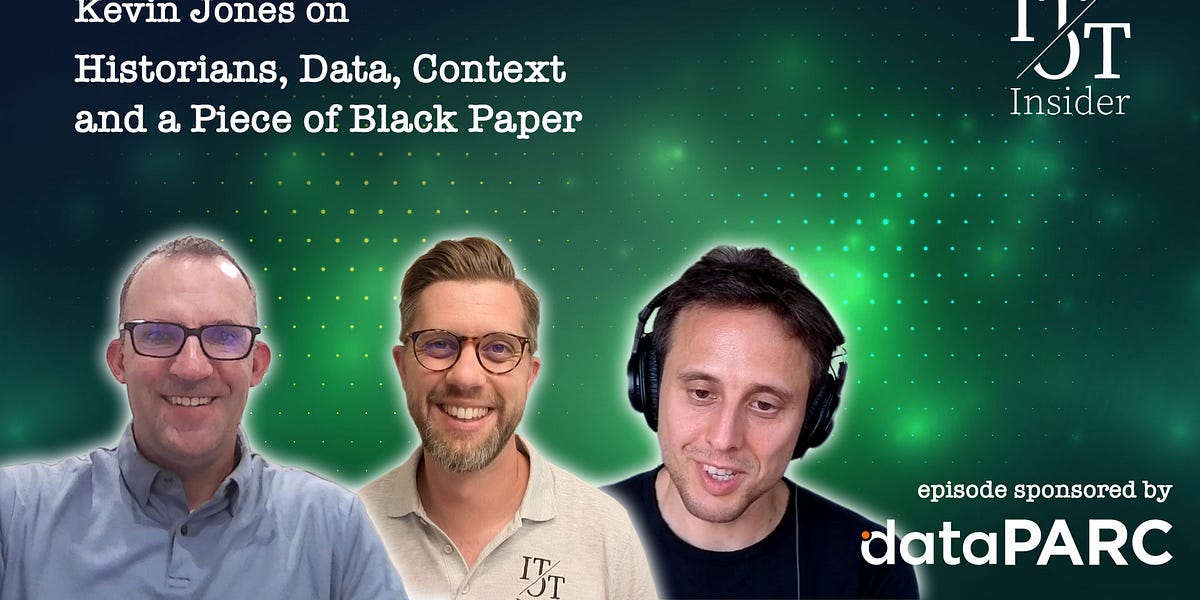
Kevin Jones from dataPARC on Historians, Industrial Data, Context and a Piece of Black Paper
Kevin Jones from dataPARC walks us through 40+ years of industrial historians and shares the unforgettable “black paper” story that explains why operator buy-in still beats every architecture diagram.
In This Episode
- Kevin Jones has spent his entire 26-year career at dataPARC on industrial data, moving from early application-level work (APC, control implementation) into 20 years focused on data architecture and management; dataPARC has deliberately stayed narrowly focused on the data-management and analytics layers the whole time.
- dataPARC traces its roots to a homegrown historian built in 1981 at what's now Georgia Pacific, after the plant's founder realized replacing single-loop controllers, with their physical strip-chart paper records, with a new distributed control system had actually eliminated their historical data entirely, a genuine step backward that drove the original vision of a digital record.
- Kevin's clearest illustration of industrial data's real scale: a hyperscaler once proudly advertised storing 500 data values as a showcase use case, when "in the industrial world, a big fish tank can have 500 data points," real plants run to thousands or millions of high-frequency signals.
- Kevin argues a unified namespace built purely on MQTT only answers "what's happening right now," not "when did this problem actually start," so a genuinely useful semantic layer needs to connect current values, full historical data, and machine-learning-ready access under one common language, rather than treating UNS and historians as competitors.
- Kevin's favorite story: a 2am control-room callout traced to an operator who'd taped a carefully cut piece of black paper over a monitor to filter 16 trend boxes down to the 8 he actually needed, a low-tech but genuinely insightful act of pattern recognition dataPARC now treats as real design feedback rather than dismissing.
- Kevin's formula for real organizational data maturity is "the three T's," team, trust, and technology, alongside a concrete rollout checklist requiring an executive sponsor, an operations manager, a technology implementer, and willing frontline operators, with deliberately tracking and advertising early wins as key to building the trust that lets adoption snowball.
Meet Kevin Jones: 26 Years at dataPARC, Industrial Data From APC to Architecture
00:00 – 01:17Kevin Jones has spent his entire 26-year career at dataPARC working on industrial data, starting with application-level work like APC and implementing controls using live data, before spending the last two decades focused on data architecture and data management specifically.
dataPARC itself has stayed deliberately narrow the whole time: the data management layer (collecting, storing, and moving data between systems) and the analytics layer built on top of it, resisting the temptation to expand into other business lines. Today the company employs over 150 people globally, working purely on industrial plants' data stacks.
“That's really all we've done... the data management layer, the collecting store of data, the movement of data between systems, and then the analytics layer. That's been our focus from day one.”
Kevin Jones · 01:17
From Strip Charts to a Homegrown Historian: dataPARC's Origin at a Paper Mill
01:17 – 05:58dataPARC traces its roots back to the early 1980s, when the company's founder built a homegrown historian in 1981 at what's now Georgia Pacific. The real motivation was a striking realization: single-loop controllers came with physical strip-chart or circular-chart paper recorders, a genuine historical record you could walk to a file cabinet and pull a sheet from. When the plant installed its first distributed control system and ripped those controllers out, it actually lost that historical record entirely, a real step backward that drove the founder's original vision of building a digital record to replace what paper used to provide.
Kevin traces the historian market's later "historian is dead" narratives, first data lakes in the 2000s, then open source, neither of which fully played out, since cost and the purpose-built functionality a real historian provides kept it genuinely relevant. In a nice bit of irony, when dataPARC first became a standalone commercial company in 2000, the founders deliberately decided not to build their own historian at all, assuming the real opportunity was visualization and analytics since historians already existed elsewhere. They only built one three years later, once they realized that assumption had been wrong.
“When they put in their first distributed control system and ripped out all the single loop controllers... they lost their historian... that was really what first drove his idea to let's now get a digital record of what we used to have with paper.”
Kevin Jones · 02:50
What a Historian Actually Is: Millisecond-Frequency Time Series at Scale
05:58 – 07:30Kevin offers a precise definition: a historian specifically handles the time-series slice of industrial data, sensor signals collected and stored robustly at very high frequency, up to millisecond resolution, for years at a time, forming a complete digital record of all sensor data across a plant or enterprise, accessible quickly and easily by anyone who needs it.
“We're specifically talking about the time series pieces of the industrial stack... the ability to robustly collect and store... very high frequency, up to millisecond frequency data for years of storage.”
Kevin Jones · 05:58
Why a "Big Fish Tank" Beats a Hyperscaler's Demo Numbers
07:30 – 08:44Hyperscalers genuinely excel at storing huge amounts of data, but Kevin points out that time-series data has real, specific architectural requirements very different from transactional or relational data, closer to a credit-card purchase record than a simple table lookup. His sharpest illustration is a memory of a hyperscaler proudly advertising a showcase use case storing 500 data values, a genuinely modest number in industrial terms.
“In the industrial world, a big fish tank can have 500 data points.”
Kevin Jones · 07:30
Architecting for Real Use Cases: Pulling a Year of Data for Machine Learning
08:44 – 10:48Real industrial scale runs to thousands, sometimes millions, of signals stored at high frequency, amounting to gigabytes to terabytes of data every year. The real architectural test, Kevin says, is whether a system can quickly retrieve something like a full year of a thousand tags on demand for a machine-learning exercise; if that specific retrieval pattern isn't designed for upfront, the architecture simply breaks down under real use.
“You're talking... thousands if not... millions of these signals being stored at very high frequencies... if you don't think about all those use cases ahead of time, the architecture kind of breaks down.”
Kevin Jones · 08:44
Why Context Matters as Much as the Data Itself, and Why AI Needs a Real Semantic Layer
10:48 – 12:56dataPARC recognized industrial context as a genuine gap even at their first historian release in 2003, which shipped with a basic asset and process-area structure specifically to make data findable and organized, not just stored.
Today, Kevin sees that same semantic or context layer as one of the most important ingredients for making large language models genuinely useful. He deliberately prefers the word "repeatable" over "deterministic," but the underlying need is the same: an AI system needs to reliably know where to find the right data, and a strong semantic layer is exactly what makes that possible.
“One of the most important things for any kind of a large language model is to have a really good semantic layer or context layer so the AI knows where to find data... if we can have a good semantic layer, we can be more repeatable.”
Kevin Jones · 10:48
UNS: A Universal Semantic Layer That Needs More Than Just "Right Now"
12:56 – 16:28Kevin distinguishes the broad concept of a unified namespace, a universal naming and semantic layer so everyone across a plant refers to something like the "main flow pump" the same way, from a narrower, almost branded implementation people sometimes fixate on: an MQTT layer that only ever exposes the instantaneous current value.
His real critique of that narrower version is practical: it answers "what's happening right now" but not "when did this problem actually start, was it just now, or overnight?" A genuinely useful semantic layer, in his view, needs to connect current values, full historical context, and machine-learning-ready access to a full year of data, all under one common language, treating UNS and historians as two sides of the same coin rather than competitors.
“You only now have the most instantaneous current value for this UNS. What happens now if you say... when did that problem start?... I think having this universal semantic layer is key, but it should also be able to give you the historical values if you need it to.”
Kevin Jones · 12:56
Start Where the Problem Actually Is, and Don't Let the Plumbing Steal the Spotlight
16:28 – 18:11Kevin's pragmatic starting point is that the right first step depends entirely on the actual problem at hand; sometimes basic, instantaneous visibility across machines is exactly the right, sufficient place to begin, given a company's real digital maturity.
He makes a broader point about vendor behavior too: both UNS and AI conversations are, at bottom, architecture plumbing, and vendors often end up marketing the plumbing itself simply because it's the current buzz. His preferred framing is that customers don't actually care about new pipes, they care about the new washroom those pipes make possible, so the technology itself should recede into the background in favor of the real value it delivers.
“It's easy to kind of advertise the plumbing sometimes because that's the buzz. But at the end of the day, when you hook all that plumbing up, what problem are we trying to solve?”
Kevin Jones · 16:53
Five Stages of Digital Maturity, and Why Everyone Wants to Skip to Stage Five
18:11 – 22:01dataPARC uses a five-bucket framework to categorize companies, purely as a way to find a useful starting point rather than a rigid ladder to climb. Stage one means minimal to no automation; stage two means companies still tracking things manually in Excel who are ready for their first real industrial historian, a conversation dataPARC has less often than it used to, but still has; stage three covers companies with existing historians looking to expand enterprise-wide or take a genuine next step.
The recurring pattern Kevin sees across nearly every conversation is that everyone wants to leap straight to stage five, which requires constant education that maturity is a real process, both technology maturity and organizational maturity have to develop together, since knowing how to actually use a capability to extract value matters just as much as having the capability in the first place.
“What hasn't changed... is that everybody wants to be stage five... you've got to mature technology wise, but also as a company, you've got to mature. It's not just the technology.”
Kevin Jones · 19:48
The Culture Shift: From SOP-Driven to Data-Driven, Top to Bottom
22:01 – 23:59Real maturity, in Kevin's view, requires a genuine culture shift starting at the plant floor: empowering people to make real decisions rather than operating purely by rigid standard operating procedures, replaced by a mindset of operating based on what the data actually shows. That same belief has to extend all the way to the top of the organization too, a company-wide, genuine commitment to being data-driven and trusting data-based decisions, which Kevin frames explicitly as an evolution rather than a single switch that gets flipped.
“You have to have that empowerment, that willingness in the organization... moving the company in that way to believe the data, use the data, and that's how we make those decisions. That's an evolution.”
Kevin Jones · 22:01
The Three T's: Team, Trust, and Technology
23:59 – 24:53Kevin distills what actually gets an organization to genuine "stage five" maturity into a simple formula: getting people genuinely involved in the process, not just told what they're going to do, matters as much as anything technical. His shorthand for a successful data-driven organization is the three T's, team, trust, and technology, all three genuinely required together, none of them optional.
“The three characteristics of a successful organization to be at that stage five, it's the team. It's the trust and then it's the technology. So you kind of have to have those three T's.”
Kevin Jones · 23:59
The Middle-of-the-Night Phone Call as a Sign of Real Buy-In
24:53 – 27:03dataPARC founder Ron Baldus believed from the start that plant operators, the people making decisions around the clock, every day of the year, are where the real value gets created, and that genuine buy-in from them is the truest measure of success. The tell-tale sign dataPARC loves hearing about: a shift operator calling the on-call engineer and waking them up in the middle of the night over a system issue, real evidence that people rely on and trust the tool enough that its absence feels genuinely urgent.
That sets up one of Kevin's favorite specific stories: a control-room monitor normally showing 16 small trend boxes, where an operator reported only 8 were visible, triggering a 2am troubleshooting call and, eventually, a drive into the plant to investigate in person.
“We'd hear from a customer, hey, there was an issue with the system. The shift operator overnight called up the OT on-call guy, woke him up in the middle of the night... this means they live by it, right?”
Kevin Jones · 24:53
The Piece of Black Paper: A Perfect Lesson in What Operators Actually Need
27:03 – 29:48Arriving at the plant, the on-call engineer discovered the real cause: the previous shift's operator had taped a carefully cut piece of black paper over the monitor, exposing only the 8 of 16 trend boxes he personally cared about tracking, a deliberate, surprisingly elegant act of pattern recognition and information filtering. The engineer, who Kevin describes as a real character and who now actually works at dataPARC, simply ripped the paper off in frustration and walked out without a word. Nothing was technically broken; the system had worked exactly as designed.
The deeper lesson Kevin draws from the story is that the operator genuinely felt like he was flying blind without the specific data he needed to run a complex unit operation, urgent enough to justify a 3am phone call. Kevin hopes it also sparked a real conversation with that operator about exactly why those particular 8 variables mattered and the other 8 didn't, since plant workers hold deep tacit process knowledge that should feed directly back into system design, a form of distributed human expertise he explicitly likens to "AI already running around our plants, in the heads of our people."
“What he found was that the person before him had taken a piece of black paper and really eloquently cut out eight squares of the eight trends he wanted to see... he felt like these were the only eight ones he needed to see.”
Kevin Jones · 27:03
Four Roles You Need on Board, and Why You Should Track and Advertise Your Own Wins
29:48 – 33:46Kevin's practical rollout checklist requires at least four roles: an executive sponsor who can actually fund the work, an operations manager who owns day-to-day change on the plant floor, a technology person handling implementation, and willing frontline operators providing real buy-in. He strongly advocates starting small to get quick, visible wins that build genuine trust and let adoption snowball naturally from there.
His favorite concrete example is one of dataPARC's largest customers by tag count, who built a formal internal system to explicitly track and report their own data-driven successes, the same way they'd track a production event, which doubled as an internal marketing tool. It made ROI easy to justify at the executive level while also spreading knowledge and genuine buy-in across the plant floor.
“You need an executive sponsor who can sign the check... an operations manager... a technology person... a willingness to start small, to get the quick win, because that's where that trust part of the equation comes into play.”
Kevin Jones · 31:05
Sharing the Win, and a Standing Invitation to Come Back
33:46 – 36:04Kevin is candid that the natural engineering instinct is to just fix the problem and move straight on to the next one, an instinct he admits is in his own DNA too. But the real, observed successes he's seen come specifically from deliberately sharing wins, a simple act of transparency he thinks engineers can genuinely get behind once they see it as providing useful information rather than unnecessary showmanship.
He closes on a personal note, explaining the collection of youth-baseball team caps visible in his space, one from every season he's coached his sons' teams over the years, and warmly floats the idea of coming back for a follow-up conversation, given how much ground they didn't get to cover.
“Just tell us the problem, we're going to solve it, and then we'll walk on to the next problem. I get it, it's in my DNA too... just where we've seen the successes of that, just really sharing the successes... it's really just a transparency thing.”
Kevin Jones · 33:46
Full episode transcript raw feed ▸
Speaker 2 (00:01) Welcome to the ITOT Insider Podcast. David, how are you doing? Great, how about you, Willem? Still recovering from Hannover Messe it was quite intensive, lots of noise, lots of people. Week. Absolutely, absolutely. Speaker 3 (00:15) But we are back into our say our normal schedule, our normal super interesting podcasts. uh And our guest today is Kevin Jones from dataParc. Kevin, welcome to the show. Hey, thanks guys. Really happy to be here. So um as always, Kevin, let's start with a short introduction. What do people need to know about you? Speaker 1 (00:36) Sure, well, uh so I've been with dataParc now for 26 years and really spent my entire career on industrial data, oh both from an application standpoint, doing some work with APC and implementing uh controls using data. And then the last 20 years really on the data architecture, data management side. uh So, you know, just that's where I've spent my career. Speaker 3 (01:05) 26 years, that's amazing. Speaker 2 (01:08) So what does dataParc focus on what you guys do besides working with data, which is probably a common theme when you listen to this podcast. Speaker 1 (01:17) I'd say that's really all we've done in really looking at the kind of the data management layer, you the collecting store of data, the movement of data between systems, and then, you know, the analytics layer. That's been our focus from day one and over the years I've looked at, you know, kind of where can we do other things from a business standpoint, but decided to just stay really focused. So we're, you know, 150 plus people across the globe that really just work with industrial plants oh on their data stack. Speaker 3 (01:54) It's indeed gonna be uh data episodes and historian episodes. I think that's something where, I don't know whether that's true, but I have the feeling, correct me if I'm wrong, that in lots of conversations we're having right now, the historian seems to be something which is somewhere at the beginning of a data architecture, maybe people don't really see the value, uh but I, well. I'm sure I'm wrong because my life was also, my professional life has always been historian focused versus a data engineer and later with different larger scale installations. um What I would like to discuss today, Kevin, uh take us a bit through that journey. Like where did the historians start in the, I guess in the nineties or so and where are we today? Speaker 1 (02:50) Yeah, I think even if you look at the history of Data Parc, we trace our roots back to the early 80s. The founder of the company and kind of our visionary implemented a historian back in like 1981. So it was a homegrown system for what's now Georgia Pacific. And I think his real original idea for it was, well, one, as an engineer, one data didn't really have access to a lot of it. But some of it was he felt that when they had their single loop controllers that had the old either strip charts or circular chart recorders, that they kind of had a historian. They had a history of the data. They could go to the file cabinet and pull it out and look at the sheet. And then when they put in their first distributed control system, and ripped out all the single loop controllers that uh they lost their historian. uh And so he's like, we actually took a step back in some ways when we got rid of the single loop controllers and we had this paper record. ah And so that was really what first drove his idea to let's now get a digital record of what we used to have with paper. And so I don't think he was alone in that. And so that kind of I think in the 80s and 90s, we just needed that digital record. And then you saw in the 2000s, things kind of evolved. then there was a real push to either go to the cloud or the data lakes came out. So the thought was, the historian's dead. Everything's going go to the data lake. And I think for a few reasons, cost, the purpose-built functionality of a historian that didn't quite uh work out. then there's kind of the, well, open source, open source is gonna kill all these proprietary historians. And uh I think kind of what we're seeing now is that it's like most things, it's not an either or, all these technologies have a fit. And the historian I think is the foundation of everything we're trying to do. uh In fact, dataParc, when we first became a commercial company, when the founders had left the paper mill, decided, let's go do this commercially. ah It was 2000, and they thought, well, we don't need a historian. We just want to focus on the visualization and the analytics, uh because everybody's got one. They're already out there. And so we didn't actually develop a historian for three years uh because we didn't think there was a need for it and realized pretty quickly that our assumption was wrong there and there was a need and still today uh I think that exists. Speaker 2 (05:58) Okay, now we're all talking here about historians, assuming everybody knows what makes a historian. So maybe my next question is, yeah, Kevin, does, what makes a historian? What's the core functions that you need to find in a system to say like, yeah, this is what we a historian. Speaker 1 (06:19) Yeah, so I think, you know, when I talk about historian, for sure, we're talking about industrial data. We're specifically talking about the time series pieces of the industrial stack, the sensors that are generating the signals. And then, you know, the ability to robustly collect and store, you know, very high frequency, you know, up to millisecond frequency data for years of of storage. really that digital record of all the sensor data that you've got in a plant or in an enterprise, uh a way that can be accessed quickly and easily by everybody. Speaker 2 (07:01) and what makes it different. Why can't you just say like, the text file until infinity and off we go. Speaker 3 (07:09) and now I'm playing the devil's advocate, I know Microsoft and the other hyperscalers will probably say like, yeah, but our data lake, whatever solution is also perfectly capable in storing massive amounts of data. Well, they do say that. where is that difference? Speaker 1 (07:30) So, certainly especially the hyper scaler is a great one. They do store huge amounts of data in certain contexts, right? It's, you with the time series data, there's some very specific architecture nuances to it that allow you to access that data really quickly. It's one thing to have a transaction data, you you go to the store, you've got your credit card transaction and you very relational piece of information that the time series is not really by nature that relational. And so the way you architect the underlying binary historian is, it's kind of unique. And we've done some testing with various hyperscaler systems. I remember we were in one meeting and a customer was talking about a meeting with one of the hyperscalers and the hyperscaler was, you know, Talk about this use case they were advertising and, we stored 500 values and did all these great things. And uh in the industrial world, uh a big fish tank can have 500 data points. Speaker 3 (08:44) I was going to say that's like half of a machine. Speaker 1 (08:47) So, you know, we're talking it's a scale to, you know, thousands if not, you know, up to, you know, millions of these signals being stored at very high frequencies. The amount of data you're storing is huge, know, gigabytes terabytes per year and an architected way that you can then go say, hey, I want to, you know, for my machine one, I've got a thousand tags. I want to go. grab all thousand of those tags for a year because I want to do some machine learning exercise. Well, that's got to come back pretty quickly. And if you don't think about all those use cases ahead of time, the architecture kind of breaks down. Speaker 3 (09:26) Yeah, and by the way, also a cost perspective, um especially in most cloud systems. I think people start realizing that, but it's wanting to store something, to write something in your cloud system, but getting all that data back, for example, to calculate, I don't know, weighted averages or something like that, that's actually becoming really quickly very, very expensive. m But you know, you talked about the time series part. uh For those people who've been uh reading our earlier art, it's I think already two years or so ago when we started publishing articles on data, data platforms, that type of things. And we have this series where uh first we start with what is data and what is time series data, you mentioned that. And then I think in the second to the third article, it's like, but what actually makes the industrial world, the industrial world is the context, the industrial context. can be your asset structure, can be your production context, but in any case, you want to get data in a certain contextual way. um How have you seen, how did you see the evolution there? What's changed from the 90s to today? And also how did that change within Data Parc? Speaker 1 (10:48) I'm glad you brought that up because that industrial context is really important. That was one of the gaps that we saw when we decided to build our first historian was a really easy way to model the data and provide that context. so uh our first version of the historian released in 2003 had a, I'd say it was a very kind fundamental basic. asset structure where you could easily create process areas and just really organize data uh from a catalog stamp, how do we find it easily? And that's certainly evolved. I think in today's world, and I'm sure we'll get into AI at some point, but one of the most important things for any kind of a large language model is to have a really good semantic layer or context layer so the AI knows. where to find data. You talk about oh determinism or making your AIs, I call it just repeatable as possible. And if we can have a good semantic layer, we can be more repeatable. oh So the use cases are really prevalent and it's becoming just as important as ever. Speaker 3 (12:08) it's a subtle or not so subtle, linear into unified namespace. that's, think that's, we, like on the IT/OT insider, we prefer to talk about um contextualization or data management from a very, yeah, from a more high level perspective. Speaker 2 (12:31) Maybe more complete. It's like, I mean, in the end, the challenges when you're working with data, there's a lot to learn from the field of data management. And I think we take a lot from that. So it becomes more, how do you manage data, metadata? Speaker 3 (12:51) maybe first of all like UNS in your words or how you see that. Speaker 1 (12:56) So I think there's, I guess, the broad definition of UNS. And then think there's become a very specific, almost branded understanding of it. broadly, idea of having, we think about a unified namespace, so a uh universal naming for all of the sensors and the elements you have in your enterprise is absolutely important. We talk about the main flow pump to our machine. We want to make sure that every plant has a common definition of that. It's really the semantics. We want to make sure we've got a common semantics so we're talking the same language uh across the plant. That was really our first goal is we wanted to have this common language that everyone understood. So absolutely important. uh I mean, think where we sometimes get little wrapped around the axle of, you know, well, do you have the right UNS, the right implementation of this can get a little bit skewed because you want to make sure you're also solving the problems you have. You know, I think the specific kind of definition and implementation where you've got an MQTT layer on top of all your data gets you quite a ways. But you only now have the most instantaneous current value for this UNS. What happens now if you say, well, should I have got a problem with this main flow pump? When did that problem start? Was it just now or did that start on the night shift? So now you want to go look at your history. Well, now how do you kind of navigate back that? I think it's, having this, this universal semantic layer is key, but should give you the current value. It should be able to then go give you the historical values if you need it to. uh You know, want to give it to a machine learning model. You should go point that machine learning model at this context layer that can pull in the year of data. So uh I think, you know, it's just a bigger, broader uh need. But certainly, we're talking the same thing here and maybe two sides of the same coin. Speaker 2 (15:18) I think it at least opened the discussion about, know, if you would start the discussion on, we need a semantic layer. can imagine most people say like, my God, here's the professor going to give us some speech about some concept I don't need. I think with UNS it became at least something that, Speaker 3 (15:36) yeah, something that people said, Speaker 2 (15:38) I need this. I don't fully grasp all the details, but I do know that I do need to work on something more than just the data values. Speaker 3 (15:46) Yeah, I've seen that quite a lot where people just, you know, they come to me or whatever and like they ask like, we need a UNS. then that it's, well, it can mean two things. First, it could mean a brilliant start of a very interesting conversation and a very interesting project. It could also mean that there is a mismatch in expectations. Speaker 2 (16:12) Yeah. now and that something more is probably connected to whatever we were mentioning before, that semantic layer. Of course, you will need those other things that are not included. You would like to have a graph of the history. Yes. Speaker 1 (16:28) Yeah, I think, you it comes back to, you know, what are the problems we're trying to solve? And maybe the problem you're trying to solve is just we need to have instantaneous visibility of, you know, all of our machines. That's, you know, that's where we're starting from a digital maturity standpoint. And perfect, that great place to start, oh because that solves that immediate need. Speaker 3 (16:53) no, and so we were not planning to do a recap on Hannover Messe type of podcast, but looking back to last week and comparing that to a year ago, I think one of the changes you can feel, I wouldn't say at every each and every boot, but at a lot of those is that maybe a year ago or two years ago, was more about slapping the, we are UNS compliant or our solution is UNS or build your UNS. And we've seen that, I don't know if you've seen it changing, Willem, but I've seen that changing in the narrative where people don't start about, but you need this concept. No, we're gonna use that as the foundation, as the starting point of the discussion. Speaker 2 (17:44) I think the understanding in industry is also maturing over the past few years. least, Kevin, I don't know how you're experiencing it, but I'm starting to see people to grasp these concepts at a bit more of a fundamental level, beyond just, need these five elements, these five technical things and they will solve my problem. Speaker 1 (18:11) Yeah, think so. And think that is maturing on a few layers, whether it be your, the UNS topic or the AI topic that, yes, lot of this is, it's plumbing. uh It's architecture plumbing. And I feel like as vendors, it's easy to kind of advertise the plumbing sometimes because that's the buzz. uh But at the end of the day, when you hook all that plumbing up, what problem are we trying to solve? How are we now giving you new places to wash your hands and a new washroom you can use uh for the plant? That's what's important is the value that that plumbing provides and um kind of moving away from being front and center with some of that just under the covers uh technology is best for the customer. Speaker 3 (19:09) Let's move away a bit from the historian as such. um And I want to talk a bit more um about when our company's ready, maturity. It's um also there. I'm going to put a link also in the article in the show notes. Also a while ago, we published something which we call our uh data journey uh model or data journey maturity model. m I'm sure you'll have a couple of interesting stories to share about stuff you encountered. The good, the bad and the ugly, maybe, I don't know. Speaker 1 (19:48) Yeah, I mean, I think the idea of maybe four or five years ago, the buzz was all digital transformation, the digital journey. But certainly that's the reality and every company's on a different path. And even within an enterprise, it's not homogenous. There are different plans, different business units that are on a little different path. We've always looked at companies and tried to categorize them in five buckets just to generally know who they are, where they are, and where we should start. It's really just about giving people a starting point. ah think for us, stage one was very, very basics, really no automation. So first step for them is they need the automation layer where you can even digitize data. So really where we would start talking with companies is in our stage two, uh they're really ready for that first step. And I think we used to see more and more of those companies that were in that stage two, they're tracking things in Excel and now they're really ready for their first true industrial historian. And I've been a lot less to those discussions uh more in the stage three where they at least have had industrial historians and have had starting points. Now they're looking at how can we either look at things enterprise-wide or really take the next step in ah what they're doing. But what hasn't changed, and I think it's interesting, is that everybody wants to be stage five. And a lot of them want to go, how do we get to stage five? And so that constant. ah for us anyway is education is, there's a process here and oh you've got to mature technology wise, but also as a company, you've got to mature. It's not just the technology. You have to know how to use it to get the value from it also. Speaker 2 (22:01) How is that people aspect? You need to mature. What does that mean in practice? between from three to five, let's say. Where's the difference? Speaker 1 (22:12) Um, well, I think it's, it's a couple of things. One is it's the, I'd say starting at, know, I think the foundation of the plant floor, having a culture where, know, where you're, you're, empowering people to make decisions, um, versus just being straight, know, we're SOP driven. This is how we operate versus, Hey, we're going to operate based on the data. You have to, you have that, that empowerment, that willing, um, in the organization. And I think you also have to have, you know, now we go all the way to the top level of an understanding that we have to be data driven and using that data to make decisions. So it's, I think, moving the company in that way to believe the data, use the data, and that's how we make those decisions. that's an evolution. Speaker 3 (23:07) Yeah, and there is the really important part of taking those operators on the journey. And it's actually really interesting because many of them, like first thing they do when they enter a plant is put away their iPhone or Android phone or whatever, and then... and then step back to using something where I go like, yeah. But on the other hand, there is also a large portion of the operators who've never really been introduced in those new technologies because when they started working at the company, things were problematic or manual. So it's important to take them into that journey. Speaker 1 (23:59) Yeah, and making them part of it, not just being told here's what you're going to do, but getting their buy-in. think having buy-in is really important. uh One of the things that I look at, the three characteristics of a successful organization to be at that stage five, it's the team. uh It's the trust and then it's the technology. So you kind of have to those three T's to really get to that stage five in a real kind of like a successful way. Speaker 3 (24:43) uh in our conversation we had before we started the podcast, you shared something about black paper on the screen and I love that story. I think you should share it with the audience as well. Yeah. Speaker 1 (24:53) So, you know, I would say, you know, and have our first 10 years as a company. I talked a little bit about kind of the original vision of of the replacing the strip chart recorders and the the paper recorders. So are, you know, Ron Baldus, our founder, really believed in getting the operators involved, you know, that that's he's always that's where the money's made. They're the ones making the decisions 24 7. 365 days a year. uh So we always really loved it when we'd hear from a customer, hey, there was an issue with the system. uh The shift operator overnight called up the OT on-call guy, woke him up in the middle of the night, and made him come fix the problem. Because they're like, this means they live by it, right? If there's an issue and they don't call, that's not good. When we hear these stories, we're like, know, unfortunate there was an issue for whatever it was, but we're just really glad that we have that buy-in. one of my favorite examples of this was a plant in the Southeast part of the US. And they had a couple of monitors that were in the control room. were kind of these little mini box trends with three or four tags. each there like it's like a four by four, so like 16 box trends. And the on-call person got woke middle of the night and the operator said, hey, not working. And then he said, well, what's not working? said, well, normally there's 16 trends up here, but I only see eight of them. And he's like, how can that be? I must be mishearing this. Well, try rebooting. You know, set up it automatically come back up and yeah, yeah, we step on right, know, especially at 2am. Speaker 2 (26:57) And yeah. And. Speaker 1 (27:03) And that and that didn't didn't fix it. So, you know, guys are all right, I've got to drive in. you know, kind of pick up and 20 minutes later walked in the control room. And uh what he found was that the person before him had taken a piece of black paper and really eloquently cut out eight squares of the eight trends he wanted to see. it is a pattern recognition part to this. And this guy felt like these were the only eight ones he needed to see. So he really nicely taped a black piece of paper over the monitor with cutouts for eight of the trends that he wanted to see and, you know, hit the other ones. And so the, the shift guide, sometimes we'll have to get this guy on the call. He actually works for us now and he's a character. So I just, I just picture him walking in, you know, this big personality and he sees it and he just, you know, grabs the corner of the paper, rips it off the screen. And he said, I just threw it on the floor and walked out. Didn't say anything. Speaker 3 (28:13) As Willem said, also have fair share of stories to tell, but I've never had that. Speaker 2 (28:20) if I would be very abused sitting there at three o'clock in the morning, Speaker 1 (28:25) half awake, seeing paper. a piece of paper taped on the screen. The technology was working as it's supposed to. So it was a good story. But it also, I guess, reinforced dust. We really enjoyed hearing the story. And of course, the fact that I wasn't there and having to be the one to wake up and do it, it was really funny to me. But the idea that this operator felt like he was flying blind. Hmm. needed the data to be running a pretty complex unit operation enough that he give the guy call at three in the morning. Speaker 3 (29:03) simple example, but there are so many variants on that example. And one of the variants is, no, we don't want an operator to use their personal password and change every time the shift changes or whatever. You just want them to be like, enter the control room, sit down and see whatever they need to see. Like you wanna uh put that threshold as low as possible. Speaker 2 (29:27) I do like those stories though, because it's also showing this person that put that paper on, they did that with great care. They knew I only want to see this data and not the other data. It wasn't just some random pattern. It wasn't, don't want to see anything. So it's also uncovering a difference. One guy needed it. The other said, I don't need it. Speaker 1 (29:48) And I don't remember the details, but I would hope that also led to a discussion with the person who put the paper up there, like, hey, why did you think you only needed to see these 30 variables, not the other 20? Because these people working in the plants, they know these processes really well. And if we don't take advantage of that knowledge and use that as a feedback into the system we build, we're missing an opportunity. We've got a lot of AI running around our plants. It's in the heads of our people. So it's a good opportunity to get that feedback. Speaker 2 (30:30) Now, we know that some of our listeners are of course working on tech and data systems. We also have people who work in plants and just work more on the field. And very often they see technology as a solution, but like you said, also that organizational part is important. Now, if you're, well, maybe first question, who are like key people you need to get on board? in a plant, in a manufacturing site to make that transition happen. Speaker 1 (31:05) Well, I think there's at least three roles that you have to have on board. I mean, you need an executive sponsor who can sign the check. mean, that's just the reality. And then you need an operations manager, kind of whoever sees the operations to be on board, because that's That's where the change is going to start on the day-to-day operations. And then you need some technology person to help with the implementation and make sure that all the technology is in place. At least those three. And then the fourth, that plant floor, some willing operators to get that buy-in. I think that goes hand-in-hand with the operations management. uh I think at least those three. I think also a willingness to start small, to get the quick win, because that's where that trust part of the equation comes into play, is if we can get some wins, advertise it. oh I think that just, it snowballs. I look at one of our most successful customers and largest by tag count. One of the things they did was actually put in a, as part of the data park system, they put in a way to track their successes. So just like you would track a production event or you would track something in the process, they track their successes with the data. And I it was kind of a marketing tool, but it also really helped like spread the buy-in and both at the top level because they could They could justify really easily. was all, there was a report you could pull up of the successes and kind of knowledge sharing across the plant floor. That was a really great idea because it just helped build that trust and reinforced it quickly. Speaker 3 (33:14) Ah, absolutely. Internal marketing is so underestimated. It's extremely important because even if within your plans it's a success, you still want to export the success to the other plans in the company. So important. Speaker 2 (33:35) It's still a word that many engineers don't like marketing feels like ah it's not in our genes to go and make publicity and those kinds of things. Speaker 1 (33:46) want to just tell us the problem. We're going to solve it. And then we'll walk on to the next problem. And I get it. It's in my DNA too. just where we've seen the successes of that, just really just sharing the successes. And it's really just a transparency thing, which I think as engineers, we can get behind that part of it, that we're really just providing more transparency and providing information. Speaker 3 (34:13) Absolutely. Talking about marketing, like you have all these heads uh behind you. um Is that like a personal hobby to collect as many heads as possible? Speaker 2 (34:25) Baseball caps. a human head sitting behind Kevin. Speaker 3 (34:29) Yes, we might want to redo this thing, but I'm not gonna do that. Speaker 1 (34:35) Baseball caps, thank you Willem. ah Yeah, so these are all uh team baseball hats from youth sports. One of my side hobbies is coaching uh youth baseball. And so these are all teams of my boys that I've coached over the years. So every year I put the team hat on the wall and have gained quite a collection. Speaker 3 (35:03) Yeah. Super cool. Hey, time flies when you're having fun, as always. um I think we still have a lot of other things we can discuss and why don't we do that uh in a later episode. for now, Kevin, thank you very much em for donating your time and uh your knowledge to us. Speaker 1 (35:24) Yeah, my pleasure guys. I really enjoyed it. This is a fun conversation and uh I feel like there was lots of topics we could have unpacked some more. So let's do it again. think there's a couple. I'm pretty sure. Speaker 3 (35:37) Also, big thank you to dataParc for sponsoring this episode. m And as always, if you like our work, you can find us at itotinsider.com, um itot.academy, and also now on itotbook.com because we have a book coming out really soon and it's all about organizational and change stuff as well. So Kevin, I'm sure you're gonna like that as well. Speaker 2 (36:00) and stuff like that. All right. Speaker 3 (36:04) Thank you very much, Willem, Kevin, and until we meet again, take care, bye bye. Okay, thanks guys, bye.