
IT/OT Builds 14 min
HiveMQ: From MQTT Broker to Full Data Platform | IT/OT Builds
HiveMQ is best known for one thing: a very good MQTT broker. In this first episode of IT/OT Builds, we sit down with Shashank Sharma (Director of Product Marketing at HiveMQ) to talk about why that's no longer the whole story.
In This Episode
- HiveMQ is moving from individual products, best known for its enterprise MQTT broker and HiveMQ Edge, to a single platform covering connectivity through to operational intelligence.
- Shashank Sharma: reliable connectivity isn't the end of the problem. Citing the European Commission, 80% of industrial data is never used, and one large manufacturer told HiveMQ it can't trust 60% of what it collects.
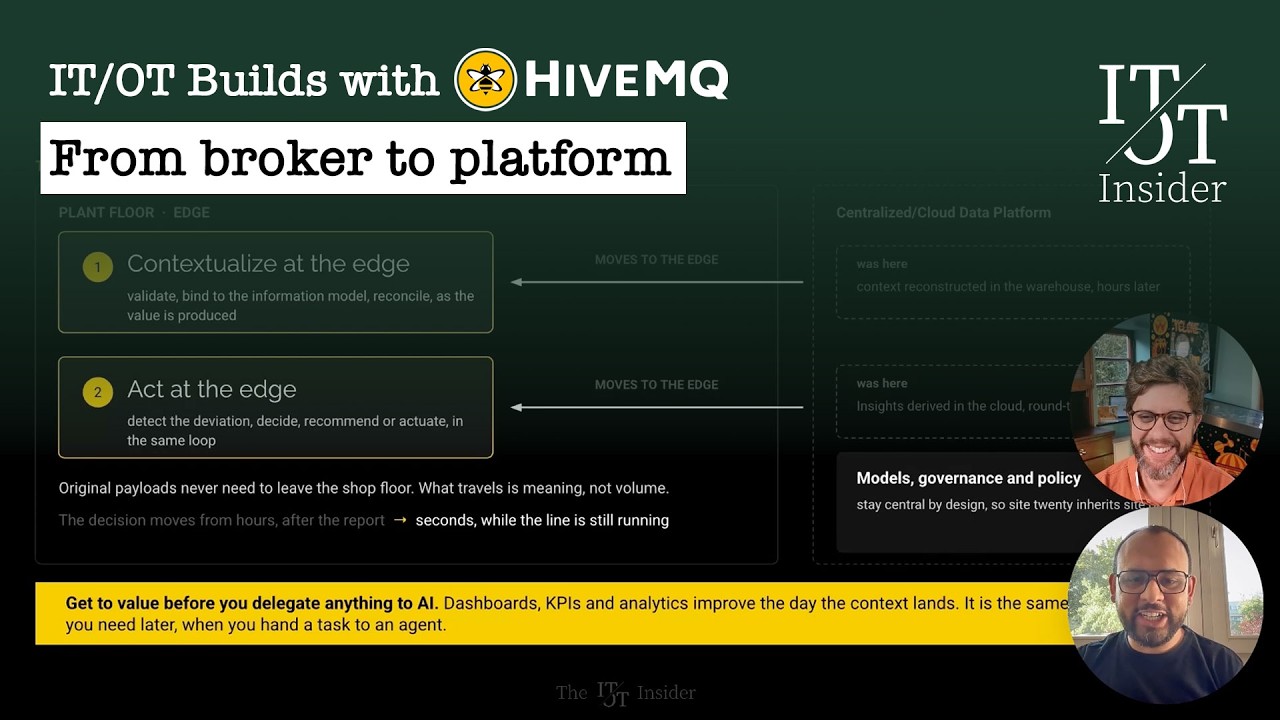
- HiveMQ proposes two architectural shifts away from the central data lake: contextualize data at the edge where it's produced, and move closed-loop, agentic actions to the edge as well.
- Some things should stay central, Shashank says: governance models, data policies and AI models need company-wide standards, and balancing edge and central is the real architectural shift.
- The platform has four layers: Connect (Enterprise Broker and Edge), Contextualize (modelling, metadata, validation, with HiveMQ Pulse fully absorbed), Analyze (data health and trust) and Act (governed agents).
- David: without a context layer, scaling AI in a plant is even harder than serving human users, because people at least know their own tag names and data sets.
Director of Product Marketing — HiveMQ
Welcome to IT/OT Builds: A HiveMQ Series on a Simulated Industrial Bakery
00:00 – 01:25David opens the first episode of IT/OT Builds, a new format about real implementations rather than just talk. For this series he has invited HiveMQ, with Shashank Sharma and Kudzai Manditereza, to show off the newly announced HiveMQ platform.
To keep it practical, everything is built on the IT/OT Insider's fictional industrial bakery, Sweet Harmony Treats: deploying HiveMQ Edge, onboarding it onto the platform, building and governing a namespace, and extending it with calculations. First up, Shashank explains why HiveMQ is moving from individual products to a platform.
“Welcome to the IT/OT Builds. That's where we are building solutions to technical problems. Not just us talking, but real implementations.”
David Ariens · 00:00
Why Reliable Connectivity Was No Longer Enough
01:25 – 03:37Shashank, Director of Product Marketing at HiveMQ, recaps where the company comes from: most people know HiveMQ for its enterprise MQTT broker and for solving reliable data streaming across machines, systems and applications.
But working with manufacturers, HiveMQ kept seeing that connected data still wasn't being acted on. People asked where a value came from, or what an anomaly meant. He cites two numbers: according to the European Commission, 80% of industrial data is never used, and one large manufacturer told HiveMQ it can't trust 60% of what it collects. The missing piece is context, and that's the problem HiveMQ set out to solve next.
“When you work with manufacturers, we increasingly saw that providing connectivity, or reliable connectivity, is not the end of the problem.”
Shashank Sharma · 02:08
Two Architectural Shifts: Contextualize and Act at the Edge
03:37 – 06:44David connects this to the IT/OT Insider capability map and its two big bottlenecks: data availability, and contextualization, which goes well beyond adding some enterprise or line hierarchy and needs multiple data sources, calculations and restructuring. He asks whether that wasn't what HiveMQ Pulse was doing; Shashank confirms Pulse is now part of the platform.
Shashank argues that the common approach, collecting everything in a central data lake and deriving insight later, often fails for operational data because it's too slow. HiveMQ proposes two shifts: bind data to its information model at the edge where it is produced, and move agentic, closed-loop actions to the edge too. The result is a trusted data foundation that dashboards, KPIs and AI can all share.
“The original payload never leaves the shop floor, and the part that travels becomes the meaning part.”
Shashank Sharma · 04:23
Why Missing Context Hurts AI Even More Than Humans
06:44 – 07:51David adds that the problem is even worse for AI. A human engineer usually knows their data sets and tag names, and can search, integrate and clean data, slowly but feasibly.
Scaling AI across a plant is different, whether it's used in an advisory role or more autonomously, as discussed in the IT/OT Insider video Can AI Run Your Plant?. Without a context layer, every one of those approaches becomes very hard to scale.
“If this context layer isn't there, it's gonna be very, very hard to scale those AI initiatives.”
David Ariens · 06:57
Edge Versus Central, and the First Two Layers: Connect and Contextualize
07:51 – 10:37Shashank notes that not everything belongs at the edge: for a company with many sites, governance models, data policies and AI models need central standards and maintenance. Getting the balance between edge and central right is the real architectural shift.
He then walks through the new platform from the bottom up. The Connect layer is the HiveMQ Enterprise Broker and HiveMQ Edge, the products people already know and the foundation for reliable, bi-directional data movement. On top sits the Contextualize layer, which moves from transporting a signal to understanding it: modelling assets, enriching metadata, governing structure, validating payloads and building a reusable semantic model, with HiveMQ Pulse's capabilities folded in.
“The balance between what happens at the edge versus what happens centrally is the true architectural shift here.”
Shashank Sharma · 07:51
Pulse Fully Absorbed, Plus the Analyze and Act Layers
10:37 – 13:20David asks whether Pulse still exists separately. Shashank says it's fully absorbed: nothing changes in how customers use it, only how it's packaged, so everything sits in one place.
The Analyze layer shows overall data health: how much data is governed, how much can be trusted, and alerts when something deviates from its agreed meaning, which David finds especially useful for admins of large environments. The Act layer creates a governed path from insight back into the workflow: an agentic layer that might start by recommending actions to a human operator, with autonomy possible but, in Shashank's view, uncommon.
“The challenge is not to make an AI do something autonomously. The challenge is to create an agent with sensible guardrails in place so that your governance becomes easy.”
Shashank Sharma · 11:42
From Slides to Implementation: What's Next with Kudzai
13:20 – 14:26David thanks Shashank for the overview but promises the series won't stay on slides. The follow-up videos with Shashank's colleague Kudzai Manditereza go deep and technical, exploring each pillar of the platform live: by engineers, for engineers.
Shashank signs off hoping viewers enjoy those deep dives.
“Slides are very nice, but we wanna make sure we also put this live in front of our audience.”
David Ariens · 13:20
Full episode transcript raw feed ▸
David: Welcome to the IT/OT Builds. That's where we are building solutions to technical problems. Not just us talking, but real implementations. In this series, I've invited HiveMQ, and I'm joined by Shashank Sharma and Kudzai Manditereza We'll be showing you the new HiveMQ platform, which is just announced. And to make all of this practical, we have a really cool demo of our industrial bakery, Sweet Harmony Treats. and there we will be deploying HiveMQ Edge, we'll be onboarding it onto their platform, building a namespace, governing the namespace, extending it with calculations, and much, much, much more. Now that is for the next few videos. First up, we have Shashank to explain why HiveMQ made this move from products to this platform. Enjoy the video. David: So welcome to this new ITOT build video. I'm joined here by Shashank Sherman, who's working for HiFMQ. and in this short video we're gonna talk about a very interesting move HiveMQ is currently doing, and they're moving from we all know them from the HiveMQ Edge and HiveMQ as an MQTT broker, but they're moving from individual products to more a platform approach. So that's lots of think lots of things to to talk about. and with that, Shashank, welcome to this video. let's start with a short introduction first. Shashank Sharma: Thank you, David. Hi, everybody. I'm Shashank Sharma. I'm director of product marketing at HiveMQ and an engineer by education and profession. So yeah, thank you very much for inviting us here. I I want to talk about a little bit about where we have come from. So, you know, like everybody knows HiveMQ I think most people are known HiveMQ for solving a critical problem of reliable. data streaming across machines, systems, and applications with our enterprise MQTT broker. And that is one of the foundational things that remains in our company and the products that we sell to our people. We have worked with manufacturers. David: Few Shashank Sharma: Yeah. But as you know, you know, when you work with manufacturers, we increasingly saw that like providing connectivity or reliable connectivity is not the end of the problem. And you could have machine connected and send a lot of data, but we we realize that our customers still are not able to act on that data. And a lot of it you know, the the the questions arise like where this machine value comes from? why did it have this anomaly reading? Like the does it represent something? So the next challenge wasn't connectivity, or in our cus, like you know, when you look at the data, once it's connected, the second step is usually making understanding clear what that data represents. And the other thing that we are also hearing and also seeing in the market, the broader market trend, is that the data goes unused and untrusted for for a lot of three same reasons like lack of context. So 80% of industrial data is not never used according to European Commission. And also like a large global manufacturer told us that whatever they collect, 60% of it they cannot trust. So all in all to boil that connectivity does not solve all the problems, which Hive MQ, MQ DT broker does it very well. So we want to help our customers, that's why we had to solve the context problem as well as the next step. Yes. David: Very important. It's also something we talk about in our capability map. we we have these two major bottlenecks I think everybody is facing. First is just the data availability. and and yes, technology exists, but yes, there are still lots of steps to take for Shashank Sharma: Yes. David: many manufacturers, for many companies in general. and then the second bottleneck is indeed this yeah contextualization problem, which goes I would even dare to say way beyond just introducing, you know, some side enterprise line type of type of logic. Yeah, we need more, we need several data sources, we need calculations, we need data restructuring, et cetera, et cetera. so I think that's that's definitely Shashank Sharma: Great. David: by the way, isn't that also what Pulse was going to do or was already doing? Shashank Sharma: So yes, the good news is that the pulse is now part of the platform. And I'm gonna tell you like in a second why. And I think David, you talk about a very important thing. So I want to make sure that we are like a lot of things exist in the market in one form or the other form. But you know, like a lot of there are a lot of vendors in the market, not just there are vendors on the IT side, OT side, the whole ecosystem. Has a lot of companies solving problems in different ways. And there are like people are trying to solve the problems already, the way that we talk about. today, a very common sort of way is to collect everything sent in a central data lake warehouse and you know, like derive insights because you have more data. Maybe like the hypothesis is like like with more data, you can build more context. however, for operational data. Like we we need to r realize there is an enterprise data and then there's an operational data. And for the operational data specifically, this sometimes doesn't work because it takes too long. And you need operational intelligence in real time. So for that, we propose two architectural shifts from that centralized model. So the first one is bringing contextualization to the edge instead of the cloud, and this means you validate, you bind data to the information model where the data is being produced. That's at the edge. And the second is for your agentic part or closing the closed loop system where you want to actuate something based on the data availability, that also should move to edge. So the original payload never leads the shop floor and you know the travel the the part that travel becomes the meaning part. So this gives Everybody, especially the operations, trusted foundation for intelligence. So this is the data you can trust. And this also becomes foundation for AI. And why I'm talking a lot about AI, because AI uses the same data foundation, dashboards and KPIs and analytics use today. And if we don't solve that problem, then AI projects will suffer from the same challenges today that the analytics do. David: Yeah, and it's it's even it's the the the problem is even worse. It's also something we the yeah we talked about in several previous articles is that if a human uses data, then you can you you you could assume that they know Shashank Sharma: Yes. David: their data sets and they know their tag names and they are able to to to search for the data, find the data, integrate the data, maybe clean some clean some data sets, which is very time consuming. Not not gonna debate that, but but still I would say possible. From an AI perspective, if you really want to scale the way you're using AI in the plant, several ways. There is also a very interesting video which we which we titled Can AI Run Your Plant? So it's some a video I'm gonna link here as well. But there we also describe that there are different ways AI is getting is getting implemented. There is more from an advisory point of view, there is more from an autonomous operational point of view. But all of these things have one thing in common, and that is if they if this context layer isn't there, it's gonna be very, very hard to scale those in AI initiatives. Shashank Sharma: Yes, yes, that's absolutely so true. That's also what we see with our customers. And I wanna talk about one thing that we should try to keep centralized. you know, like when you have a large company and you have more than one factory or one site, you can't do everything locally. So some things like governance model, your policies, data policies or your AI models, in fact, they they need to have a certain standard or they need to be maintained, operationalized, update, and maintain perhaps centrally. So some things still remain central. But I think it's like the balance between what happens at the edge versus what happens centrally is the true like architectural shift here. and thank you for calling out a couple things, especially about yeah like your previous video because that's very exciting talk about and and In the new Hive MQ platform that we have, we are bringing different components of some of the products that you already know and some new products together in a single place so that everybody, like the enterprises, can solve all these problems that you have from data connectivity to operational intelligence in a single place. So let's talk about what we have. So I'll start from the bottom. and bottom is the Connect layer. Connect layer consists of the HiveMQ Enterprise Broker and HiveMQ Edge. So they these are the two products you are most familiar with, but and we this is the product where we also started our journey as a company to provide reliable data streaming. And we continue to provide this, and it is the foundation of the whole platform because. To have a contextualized data, you need reliable data connectivity across your systems and in a bi-directional manner. And HiVMQ does that well. We have a lot of happy customers and who have done and used us in challenging situations. But the as we talked about, the problem doesn't stop there. I think like for an existing like people who use us, this is very familiar. But what changes is what happens next. The second layer is contextualized. We simply move from transporting a signal into understanding what it means. We can also model assets, data, enrich metadata, govern structure, validate payloads, you know, build a reusable semantic model. So people who are familiar with Hype MQ Pulse, we have integrated the Pulse capabilities into the platform. David: And the spell still exists separately or is it now like fully absorbed? Shashank Sharma: it is fully absorbed. So with the customers who are already using it, we are already in touch and contact. But anybody who wants to use, please talk to us. There is no change in you know, like how you use, it's just how you package. We have changed a little bit, make it easier to have everything in one place. Yeah. and like after that, we have an analyze layer. the analyze layer as of today gives you An overview of how your overall data health is, like if you have how much is of the data can you actually trust? So is it covered, how much is ungoverned, and gives it gives really good visibility into how much trust you should put in your data. it also gives you deviations if like something's from a trusted agreed meaning deviates a little bit, so you get notifications. David: I looked at that and actually from an an admin perspective that's very, very interesting data. Especially for those of a very large environment. Shashank Sharma: No, thank you. Thank you for saying that. I I and I agree. And the finally we have an ACT layer. An Act layer is it creates a governed path from your intelligence back into the workflow. So it's an agentic layer, but you can add governance. you can that might begin with a recommendation for a human operator for a use case that it controls, or you can ask even act to act. Autonomously, which I don't think would be a very common use case. But as you said before, you know, like the the challenge is not to make an AI do something autonomously. The challenge is to create an agent with sensible guardrails in place so that your governance becomes easy. And things that you do manually today, you could decrease some of the cognitive workload and make sure that. AI is doing a lifting for you while you and it delegates all the important decisions to the human operators. So bringing all of this in one platform where you can see the journey of your data starting from signal in a machine to like shared foundations, from shared foundations to the shared meaning. And from there, you can actually act on the data within the single platform. So with this. We are bringing some new capabilities. some of it is the old capabilities of the broker that you trust, but we want to do more than broker for our customers and we want to help them bring operational intelligence on the factory floors. David: Thank you very much for that. Shashank, interesting overview. Now, don't get me wrong, like slides are very nice. but we wanna make sure we also put this, you know, live in front of our audience. So for those who've been watching this video, there are a couple of follow-up videos where we have your colleague Kudzai. and those are gonna be deep technical and we're gonna we're gonna move or we're gonna yeah move over from slides To actual implementation. and we're gonna actually start to explore these different these different pillars of your of your new product. but really I'd say by engineers for engineers. so that's a shout out to the rest of those videos, which you can also find on our channels. in the meantime, Shashank, thank you for joining us. and until we meet again, take care, bye bye. Shashank Sharma: Yeah, thank you. Thank you so much. And I hope you like those deep technical deep dives with Kudzai