
Podcast Episode 38 min
Building a Broker to Learn a Protocol: Andreas Vogler and the Story Behind MonsterMQ
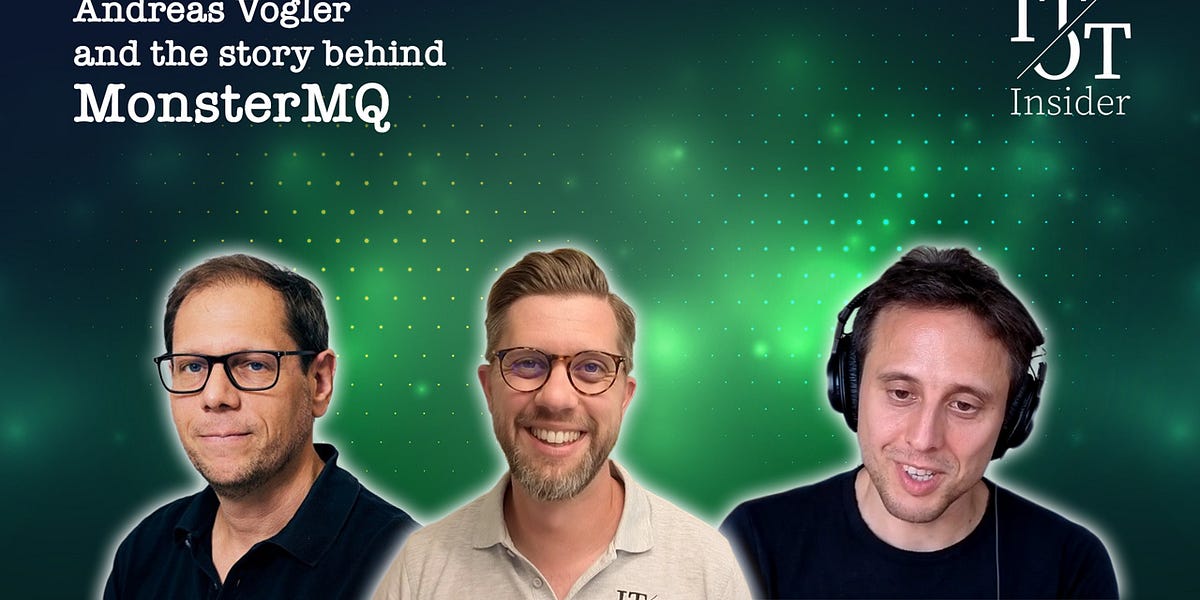
Andreas Vogler, Chief Innovation Officer at ETM, didn't set out to build a product, he set out to understand MQTT as deeply as possible, and MonsterMQ is what happened next.
In This Episode
- Andreas Vogler is a long-time ETM/Siemens employee (WinCC Open Architecture SCADA) and creator of the open-source MQTT broker MonsterMQ, built specifically to deeply learn the MQTT protocol and the Kotlin programming language, named as a nod to Frankenstein's monster after an earlier open-source project of his was jokingly compared to Frankenstein.
- Andreas deliberately stores MonsterMQ's data in real, queryable databases (PostgreSQL, MongoDB, or SQLite) specifically so he can inspect sessions, user management, and message data directly with plain SQL rather than an opaque proprietary format.
- Andreas runs his own MonsterMQ instance at home 24/7, connected to solar, power-grid, and temperature sensors, including a small AI agent that checks recent solar production and temperature trends every 30 minutes to decide whether it's a good time to heat his outdoor jacuzzi.
- Andreas's clearest gap in open-source industrial adoption: companies consistently ask about formal support and maintenance contracts once they consider using MonsterMQ in production, something that simply doesn't exist yet for a purely open-source, one-person project.
- At Siemens/ETM, AI coding is used extensively to speed up engineering tools and processes, but humans still review anything touching the actual core of their SCADA systems, since that software controls real power plants; a video-streaming proof of concept that once took three people three to four months was rebuilt from scratch with AI coding, in a new language, in one to three weeks.
- Andreas's caution about chasing every new trend: once a feature ships inside a commercial platform, it has to be maintained indefinitely for whichever customers adopt it, even if that particular trend turns out to be a passing fad nobody cares about a year later.
Meet Andreas Vogler: An IT Guy at the Heart of Siemens' SCADA World
00:00 – 03:08Andreas Vogler is the maker of MonsterMQ, an open-source MQTT broker, and a long-time employee of ETM, an Austrian company fully owned by Siemens and home to WinCC Open Architecture, one of Siemens's SCADA systems. He describes himself as fundamentally an IT guy rather than an OT person.
He started his career as an Oracle developer, engineer, and database administrator, traveling globally to help customers build high-availability Oracle clusters paired with WinCC OA. He fondly recalls physically carrying an Oracle reference book to customer sites to look up commands he couldn't yet remember.
“I'm always saying about myself that I'm an IT guy, so I'm not so much at the OT level... I started my career as an Oracle developer, Oracle engineer, Oracle database administrator.”
Andreas Vogler · 00:41
From Memorizing SQL Execution Plans to "I Don't Know How I Built That"
03:08 – 04:09Andreas reflects on how dramatically things have changed: he remembers hand-optimizing SQL queries, reasoning through execution plans, creating and testing new indexes, and writing full, one-to-two-page SQL statements by hand as one of the genuinely hardest parts of the job.
He contrasts that with newer colleagues now building things with AI who, when asked how something actually works, simply answer "I don't know," a shift he's honestly not sure is heading in the right direction.
“That was one of the hardest parts to optimize SQL queries... we had really full blown SQL statements, really one or two pages. But... colleagues... are programming something with AI and then I ask how did you do that? They say I don't know.”
Andreas Vogler · 03:08
From Oracle Expert to Siemens Employee to CIO of ETM
04:09 – 05:27ETM was eventually acquired by Siemens, and Andreas spent the last six years working directly for a Siemens department, still based in Austria, building proofs of concept exploring current market trends applied to Siemens's SCADA systems, including a GraphQL interface for WinCC Unified.
Today he's "half back" at ETM as CIO, Chief Innovation Officer, while remaining 50 percent embedded within Siemens, which continues driving the future of their SCADA and HMI systems.
“The last six years I have been working directly for Siemens department... I was the guy to create proof of concepts, how this can work together with our SCADA systems, like GraphQL interface for WinCC Unified... Now I'm the CIO of ETM.”
Andreas Vogler · 04:09
Chasing New Trends: MQTT and the UNS Wave
05:27 – 06:57Andreas describes a consistent pattern in his career of following whatever's currently trending, and notes that what feels genuinely new in OT and SCADA circles is often already well established in mainstream IT.
Roughly two years before this recording, MQTT and the broader unified namespace wave, driven heavily by Walker Reynolds's evangelism, became the trend he wanted to understand deeply. His conclusion was simple: the best way to truly understand a protocol is to build your own implementation of it.
“MQTT, a huge trend on the market. Walker Reynolds was driving it with the UNS... I was thinking what will be the... best way to really, really understand MQTT... let's build my own broker.”
Andreas Vogler · 06:19
Building MonsterMQ in Kotlin, and Why It's Named After Frankenstein's Monster
06:57 – 08:47Building the broker was explicitly a learning exercise: Andreas wanted to learn functional programming and Kotlin, which he describes as a modern, functional-style successor to Java still running on the JVM. He built it on Vert.x, a reactive framework that provided the core TCP/IP and MQTT protocol basics, leaving him to build everything else, user management, message queuing, quality of service, entirely from scratch.
He'd had an earlier open-source project too, called Automation Gateway, assembled from many different open-source pieces, which a colleague jokingly compared to Frankenstein's monster. When the new MQTT broker came together, the name stuck: Monster MQ.
“I've built the MQTT broker. Then I thought about the name Frankenstein. His kid was the monster. So now this is the Monster MQ.”
Andreas Vogler · 08:47
No UI, a Database You Can Query Directly, and How AI Coding Changed Everything
08:47 – 11:56Andreas openly admits he's not a UI developer, so MonsterMQ was originally configured entirely through configuration files. He deliberately chose real databases, PostgreSQL, MongoDB, or SQLite for smaller setups, for storage, specifically because it let him inspect sessions, user management, and queued or retained messages directly with plain SQL, rather than trusting an opaque proprietary storage format.
He describes the arrival of ChatGPT and Copilot-style AI code suggestions as genuinely fascinating at first, and how today's agentic coding tools let him do things he couldn't manage alone before, like building a proper administrative dashboard for MonsterMQ, exposed through an open GraphQL API, which significantly boosted the project's traction once he posted it on LinkedIn.
“For the storage, I'm using databases... I always have the possibility to go into the database, look into the database tables, and then I see the sessions, the user management, all of the configuration... I can create with SQL.”
Andreas Vogler · 09:35
From "MQTT Plus" to Powering Andreas's Own Smart Home
11:56 – 14:58MonsterMQ grew well beyond a pure broker by absorbing connectivity capabilities from Andreas's earlier Automation Gateway project: PLC4X-based PLC connectivity, writing to various databases, scripting and flow-based data transformation, and even integrated AI agents via the A2A protocol, a shift he and colleagues from Coreflux jokingly termed "MQTT Plus" during a conversation at the Hannover fair.
Andreas runs his own MonsterMQ instance at home 24/7, wired into real sensors: solar production, grid import and export power meters, and temperature sensors, including a small outdoor jacuzzi. He built a genuinely practical AI agent that runs every 30 minutes, pulling recent solar production and temperature history as context, and answering a simple prompt about whether now is a good time to turn the jacuzzi's heater on or off.
“Now it is way more than just the MQTT broker... maybe we coined the term, it's MQTT plus... I even integrated AI agents in it with this A2A protocol.”
Andreas Vogler · 12:07
Open Source in Industry: Great Until Someone Asks "Can I Get Support?"
14:58 – 18:04Andreas is candid about open source's real limits in industrial settings. Companies like starting with open source partly for the reassurance of owning the actual source code if the vendor behind it disappears, and AI-assisted maintenance increasingly makes self-maintenance more plausible than it used to be.
But in practice, potential customers evaluating MonsterMQ consistently ask about formal support and maintenance contracts, something that simply doesn't exist yet since it remains purely open source. Andreas is direct about why: being formally responsible for a piece of production software inside a large company means you genuinely can't say "if something breaks, I'll go find people to fix it" after the fact.
“Can I get support? Can I get the maintenance contractor?... that is currently not available for MonsterMQ, right? Because it's purely open source, as of now.”
Andreas Vogler · 14:58
Real Production Use, and How AI Coding Is Changing "Build vs. Buy"
18:04 – 21:42Andreas doesn't have exact adoption numbers, but knows of several companies using MonsterMQ, including one larger company running it in production for a limited portion of their operation, consolidating what used to be a separate MQTT broker plus multiple Docker or Kubernetes containers for data transformation and database writing into a single deployment, though Andreas flags the honest tension: that consolidation also concentrates risk if MonsterMQ itself fails and data is lost.
He connects this to a broader shift in his own build-versus-buy instincts driven by AI coding: where he used to search for an existing open-source tool that roughly fit a need, often either too limited or unnecessarily complex, for genuinely small, non-complex tasks today he increasingly just builds exactly what he needs himself, using AI prompts.
“Before they had a MQTT broker, had some Docker or Kubernetes containers running to transform the data... the responsible guy said, if MQ, you can do all of that in one piece... with AI coding... for small things, not complex tasks, you just can build it with AI, with just prompts.”
Andreas Vogler · 18:04
No Clear Plan for the Future, and a Solar Battery That Didn't Pay Off
21:42 – 25:11Andreas is candid that he has no defined roadmap or business plan for MonsterMQ going forward, despite conversations with several interested people and companies, joking with the hosts that he's open to offers.
On a personal tangent, he describes running a similar analysis to one the hosts had discussed: having had solar panels for over ten years, he wrote Python scripts years ago to simulate the economics of adding a home battery, using his own collected production and consumption data. His conclusion was that it simply didn't pay off financially, though he remains genuinely unsure whether his own calculation might have been flawed, and notes the core winter problem regardless: an economically sized battery still won't have enough sunlight to charge in the first place.
“As of now I still do not have a clear plan for it... I have been talking to several people and also companies... I can't tell you anything more about it as of now.”
Andreas Vogler · 21:42
Still the Architect: Why Human Oversight Matters More for Some Code Than Others
25:11 – 27:31Andreas's take on AI-assisted coding is genuinely nuanced. For MonsterMQ itself, he still actively reviews AI-generated code, checking whether it's structured sensibly and pushing back on the AI's tendency to spin up unnecessary new classes or files when an existing one already fits, meaning the human still has to act as architect and product manager, knowing exactly what's actually wanted.
For lower-stakes side projects, though, his approach is completely different: a personal MQTT Explorer tool he built purely for his own use, connected to WinCC OA and Unified SCADA systems, was written entirely through vibe coding, and he never once looked at the generated source code, since the tool's correctness for his own casual browsing simply doesn't carry the same stakes.
“You still have to guide the AI into the right direction so that the software does not get too fragile... you must be the architect and maybe also the product manager... but... with wipe coding, I've never ever taken a look on the source code.”
Andreas Vogler · 25:11
AI Coding at Siemens: Faster Tools, But Humans Still Review the Core
27:31 – 31:27At Siemens and ETM, AI coding has been used for roughly a year to speed up their engineering process, but with humans explicitly kept in the loop reviewing anything touching the actual core of their SCADA systems, genuinely high-stakes software controlling real power plants. Their newer, fully web-based engineering tool for WinCC Open Architecture fully supports AI-driven development for engineers, since the time savings there are, in Andreas's words, incredible.
His standout example: a video-streaming proof of concept that originally took two to three people three to four months to build years ago was rebuilt from scratch with AI coding, in Rust, a language he'd always wanted to learn, in just one to three weeks. He's careful to credit the earlier manual effort's accumulated knowledge as exactly what let him effectively guide the AI toward the right solution the second time around.
“We already started several months or a year ago to use AI... to support our people so that they can do their job way more faster. But still, of course... the human must review everything there. Because that is a very important piece of software. It is controlling power plants.”
Andreas Vogler · 27:31
Connecting AI Directly to Live Protocols: MCP, OPC UA, and Modbus
31:27 – 32:13Extending Siemens's WinCC Open Architecture external engineering environment, shown live on stage at this year's Prove It event, connecting an MCP server for a protocol like OPC UA, or simply handing the AI a device's Modbus documentation, lets it figure out what configuration is relevant and automatically wire up the right driver connection, all achievable through prompts inside the engineering tool itself.
“It speeds up a lot of things because you connect the MCP server for... OPC UA or whatever. Or you give the AI the documentation of your device which is based on Modbus. It can figure out what kind of things are relevant for you and then it automatically connects the Modbus driver to that device.”
Andreas Vogler · 31:27
The Recursive Absurdity: Writing a Spec With AI, Then Summarizing It With AI
32:13 – 34:38Andreas shares a genuinely funny early memory of ChatGPT: using it to draft an email to his kids' school, producing a beautifully written one-to-two-page letter, and then immediately wondering whether the eventual reader would simply run it back through AI to summarize it, a recursive absurdity of using AI to expand a thought into a full document, only for someone else to use AI to compress it right back down again.
“I thought, what will happen on the other side? Oh, it's too much to read. Let's summarize it with AI. That's a strange note because you use AI to create such a document and then use AI to bring it back to what I wanted to ask.”
Andreas Vogler · 32:39
Innovation Speed vs. Long-Term Maintenance in a Conservative Industry
34:38 – 37:28Andreas closes on pacing innovation in a genuinely conservative industry where factories run for a decade or more: the real constraint isn't whether AI coding gets used, it's whether real customers are actually open to adopting new trends and features at all.
His broader caution is about chasing every new trend simply because it can be built quickly: once something ships as a platform feature, it has to be maintained indefinitely for however many customers adopt it, even if that particular trend turns out to be a passing fad nobody cares about a year later, a genuine, ongoing cost-benefit judgment call, not just a technical decision. He closes warmly, mentioning he got to meet one of MonsterMQ's contributors in person for the first time at the Hannover fair.
“If you build something into your platform, then you have to maintain it... if that new feature... was an innovation just this year and the next year, no one is interested anymore, then you still have to maintain it... you still have to think about that. Is it really worth to build it?”
Andreas Vogler · 35:34
Full episode transcript raw feed ▸
Speaker 1 (00:00) Welcome to another podcast of the IT/OT Insider. With me is course David, like always. And David, this time we invited somebody we met at Hannover Messe. Absolutely. Speaker 3 (00:12) um So super happy to have Andreas Vogler here with us and Andreas, I'll let you introduce yourself. uh But a couple of weeks ago, we were at the dinner in the evening and we never actually physically met, but I knew your name and I think you also know my name. It went like, that's a familiar face. uh We started talking and here we are. Thank you for joining our podcast. So why don't you kick things off with just a brief introduction of yourself and your role. Yeah, sure. Speaker 2 (00:41) So first of all, thanks for having me. It was really great to meet you at the dinner, by the way. So yeah, my name is Andreas Vogler. I'm the maker of Monster MQ, right? So the open source MQTT broker. And I'm a long-term employee of ETM. ETM is a company located in Austria, but we fully belong to Siemens. And ETM is the home of WinCC Open Architecture the SCADA system, one of the SCADA systems of Siemens. Yeah, I'm always saying about myself that I'm an IT guy, so I'm not so much at the OT level. And also from my uh education, I started as an IT programmer, let's say a lot of things with databases that is still in my heart, databases, all around data and data streaming and so on. started my career as an Oracle developer, Oracle engineer, Oracle database administrator. And of course, always together with our SCADA system, WinCC Open architecture. And I did many projects together with WinCC OA, with database, with Oracle, and went all around the world to support and help our customers, to build up this formerly full blown Oracle clusters, high availability. So that was really fun. And I still can remember the time when I was sitting at the customer and having a book with me, an Oracle book, and searching in the book. How is the command to... I don't know what that is. So, you'll see more. Speaker 1 (02:13) We saw those book laying around, like Oracle 6 or Oracle 9 and they're like Bibles. Speaker 3 (02:20) Yeah, we also had our fair share of Oracle in our part jobs, which is really cool because this is just a completely going sidetrack here. you know, the interest is a while ago, I was talking to a junior OT developer and he at a certain point, he had to write a bit of SQL code to generate some reports. He just went to whatever code, LLM, know, I don't know what he was using, but something. like he asked to write a piece of code which was ah very, I would say resource intensive, didn't work really well. then ah I asked him like, can you explain to me like what the thing it is you're now executing against your database? And he just went like, no, like I don't. Speaker 2 (03:08) And then I go like, Jesus, like there are a couple of basics you should still be able to master. I mean, that things are really, really changing. I can remember that was one of the hardest parts to optimize SQL queries, right? So you had to what kind of execution plan in creating new indexes and check it again. And we had really full blown SQL statements, really one or two pages. But you mentioned that nowadays I also already had the experience with other colleagues and so they are programming something with AI and then I ask how did you do that? They say I don't know. And this is somehow a little bit I'm not sure if that is going into the right direction. Speaker 1 (03:52) people said the same thing when they moved away from Assembler to like higher level languages. That's the big question. Is it the same? Speaker 3 (03:59) I think I was not really finished. Speaker 2 (04:09) I started my career as an Oracle expert and then of course with SCADA Systems and platforms. Then we got acquired by Siemens, a big company. The last six years I have been working directly for Siemens department, 100 percent, still located in Austria. And there we did a lot of things in the direction of new technologies, finding current trends in the market. And I was the guy to create proof of concepts, how this can work together with our SCADA systems, like GraphQL interface for WinCC Unified and so on. And now I'm half back to ETM again. So ETM is still our uh own legal company. Now I'm the CIO of ETM Chief Innovation Officer, but I'm still 50 % also within Siemens and they are still responsible to drive the future of our SCADA and HMI systems. So just to finish that. Speaker 3 (05:10) Yeah. maybe we should also talk a bit about what's like upcoming innovations at the end of the podcast. Haha, yeah, that's it. Speaker 1 (05:17) think it would be very interesting to know what's happening in that field in terms of innovation. It doesn't feel always so lively if you compare it to the tech world. ah Speaker 2 (05:27) to be honest, I'm always saving new things like this new things in the market there because new things in it all. That's it. New things in the OT IT level or SCADA HMI. Yeah, we have the industry. New things are maybe already for a long time available in the IT world. So, yeah. true. Speaker 1 (05:46) That's always true. The advantage is like the first diseases always disappeared by the time it starts to go into this kind of world. uh Andreas, you're also known, like you said, for Monster MQ. So you've been working with around with MQTT for a long time and especially around industry 4.0. There's quite some buzz around MQTT, but I think you really... understand this at a fundamental level. Speaker 2 (06:19) Maybe I already forgot something about it. yeah, two years, I think roughly two years or so ago, also MQTT, a huge trend on the market. Walker Reynolds was driving it with the UNS and so on. And I have used MQTT also already before. But at that point in time, I was thinking what will be the, what is the best way to really, really understand MQTT. in deep as much as possible. And then I thought, okay, let's build my own broker. Speaker 1 (06:52) And yeah, obviously. Speaker 2 (06:57) So implementing by my own, I will learn how it works. And I had the luck. I really love the Java ecosystem, JVM. And also at that point in time, I started to learn Kotlin. I'm always saying Kotlin is the new modern better Java, let's say, still based on the JVM you still have the full ecosystem, but it is functional style. And I wanted to learn functional programming. And then I thought, okay, let's build a new broker. And okay, I'm starting to learn Kotlin. Let's build it in Kotlin. And there are already a cool frameworks out there like this WordX. I think this was initially built by ABM. So it is some kind of a reactive framework for Java and also for Kotlin. They also already have the core, the TCP, IP, stack, the basics of MQTT are already implemented there. But all the things around user management, queuing of messages, quality of service, and so on, that one you have to build by your own. And so started with this stack to build Monster MQ. And before I also had already another open source project, the Automation Gateway. which was also built in Kotlin. I added more and more features to it, to this automation gateway. I can remember I also posted a lot of things about it on LinkedIn. Then a colleague from the state said, you're using so many different open source pieces and put them together. This is like... Frankenstein. Speaker 1 (08:47) And I was thinking, ah, okay. Speaker 2 (08:52) Frankenstein, that's a cool name, open source product sometimes have cool names. That was the automation gateway. And then I've built the MQTT broker. Then I thought about the name Frankenstein. His kit was the monster. So now this is the monster MQ. Speaker 3 (09:11) That's where the name comes from. Now finally I know the... I was always going like, but what's the monster part? Speaker 1 (09:24) Yeah, but it took off somehow. mean, it's, it's, it's, it's became more than just, I want to understand how MQTT work. Let me just go to broker and, uh Speaker 2 (09:35) Yeah, that's a good point because as I two years ago, I started to build it and I'm not a user interface developer. So I have no hand and I have I know JavaScript, of course, but I have never built web pages or dashboards or user interfaces and so. So everything was based on configuration files in my MonsterMQ. And then I was more or less finished. It worked fine. And also interesting is For the storage, I'm using databases, not because I'm a database guy. I'm using PostgreSQL or MongoDB or SQLite for smaller uh implementations. That was also why I'm loving it because I always have the possibility to go into the database, look into the database tables, and then I see the... the sessions, the user management, all of the configuration, also the cube messages and also retained messages. I can create with SQL. And I'm a little bit lost, so what I wanted to say. Yeah, but anyhow, so I was finished with it, and then I was done. And then one or one and a half year, this crazy ChatGPT thing came out, where you started with Visual Studio Code and Co-Pilot, where you... was typing a code section and then it was suggesting you the next code. And sometimes I felt a little bit, how can this thing know what I want to program now? That was already fascinating, but far away from where we are now with AI coding, agentic coding and so on. now... I can also build cool dashboards. And so I decided to build a dashboard for MonsterMQ. And it has an open API. It is based on GraphQL, the MonsterMQ itself. So everything has an API. So you can build on top of that API very easily a dashboard. And then it started to gain more attraction also posting it on LinkedIn, having a cool administrative administration interface dashboard to configure it. So now it's getting more traction. Speaker 3 (11:56) What are the different um parts of the application you built? it, I would say, purely a broker? um Speaker 2 (12:07) That's a good point. I started with it as a pure broker, let's say. And then, I said it before, I have this automation gateway where I also have lot of connectivity, PLC4X and other open source projects, getting the data and writing the data to databases and so on. And I started to take this from the automation gateway and build it now into the MonsterMQ broker. And so now it is way more than just the MQTT broker. And recently also at the Hannover fair, I had a podcast with the guys from Coreflux and Dylan. And they are more or less, maybe we coined the term, it's MQTT plus. So it's not MQTT anymore, it is way more. So it has connectivity to those PCs via this PC4X open source project. You can write data to different databases, add a scripting possibility so you can transform the data with flows. I even can't remember anymore. I also integrated AI agents in it with this A2A protocol, say. So now you can create agents inside of the broker and they're running there. And I have it running at home. I really have to use them. My monster cube broker at home is running 24x7. I have a lot of sensors in my house and also power meters for my photovoltaic and also how much power I'm getting from the grid and how much power I'm sending to the grid. Also temperature sensors. recently I've bought a very small cheap jacuzzi. Well, it is outside. Then I thought I always have to take a look. uh Does the sunshine? Do I have enough photovoltaic? What is the temperature of the jacuzzi? Should I turn on the heater or not? Because the heater uses a lot of energy. Then I thought, hey, let's build an agent. This agent is now running every 30 minutes or so. And it will get from the broker, the context. gets... the history of the last three or six hours of the photovoltaic production, the last six hours, the temperature, if it is raising or falling, and so on, some context. And of course with the prompt, and so I'm saying, you are my house agent, tell me if it is a good time to turn on or off the heater. And it is writing me and telling me now is a good time to turn on the heater. And that is really helpful for me. Speaker 3 (14:58) As automation engineers do, Open source, this is, I wanna zoom in a little bit on that. um Like in our industrial worlds, like there are haters and lovers. ah There are pros and there are cons. uh There are people who go like, yeah, I know I'm. Either they even don't know it, it's something from IT maybe, em or they go like, yeah, but I don't want to take the risk or maybe even overuse it. Like, what is your take on open source in an industrial context? Speaker 2 (15:41) Yeah, that's a hard thing, let's say, a hard question. I mean, everyone wants to have everything open source nowadays. In the industry, maybe not. But also in the industry, they want to start maybe with open source, to know that if something happens to the company behind, then you have the source code. You can, in theory, maintain it by your own. But now with AI, maybe it is really turns out that you can maybe maintain it by your own. But on the other hand side, and also I talk to some potential customers, let's say, or companies about using MonsterMQ, for example, and then at the end of the day, they are asking, can I get support? Can I get the maintenance contractor? Yeah, and that is currently not available for MonsterMQ, right? Because it's purely open source, as of now. Speaker 1 (16:39) you to have the skills in-house that you would maybe contract out. Speaker 2 (16:45) And what do you mean? Speaker 1 (16:47) Let's say if you do not have a support contract you will have to find people who know the software well enough if there's a problem to find out what's wrong, etc. Speaker 2 (16:56) honest, if you use it in a big company, you can't... How to say? If you would be responsible for that piece of software, then you will not say, okay, if something happens, then I start to find people. Speaker 1 (17:10) Yeah, yeah, there's no... Speaker 3 (17:13) a very, because now we are also stepping a bit into this buy versus build discussion, which isn't per se linked to the open source discussion. Like you could perfectly buy a tool, which I would say on the foundation is purely open source, but still you have this company who not just provides you support, but also everything around cybersecurity, for example. Uh, sure. Let's take, uh just recently we published our first article on this too, but from a software supplier point of view, you're actually obliged now to follow the, well, in the year at least, the CRA, the Cyber Resilience Act. I actually don't, have you come across that type of questions as well? Speaker 2 (18:04) For the CRA uh not yet, let's say. But yeah, to be honest, I don't really know how many people are using it. I mean, I know at least of some companies, and also there's a big company which is really using it in production, but also only for a small part, let's say, of the whole production. But they also said... Before they had a MQTT broker, had some Docker or Kubernetes containers running to transform the data, another container self-made which writes the data to a database and the responsible guy said, if it MQ, you can do all of that in one piece. And for that kind of use, it seems to be not, I'm not sure. Maybe it is already also critical because if he loses the data, then it is still. But anyhow, also a good point what you mentioned is build versus buy. Also, this is now a little bit transforming with AI before AI coding. I was also, if I needed something, then I was looking for an open source tool, fits to my needs or to my use case. But then you find some which is maybe not doing all of that, or you find some which is too complex and this is doing way more. Nowadays for small things, not complex tasks, you just can build it with your eye, with just prompts. Speaker 3 (19:40) It's interesting, like the... We started writing on cybersecurity as well because there is this. um almost intrinsic link uh between the software you will not only buy but especially the software you get from open source or the software you built yourself because uh the so we have Edmys too in the CRA and maybe for our listeners there is this article on the blog you can find it but like These two are the, I say the cybersecurity, the framework, the risk management, the things you need to do from an end user perspective. Speaker 1 (20:19) So they just do whatever they, yeah, companies, absolutely, absolutely. uh But the interesting thing there is that, uh Speaker 3 (20:31) Now manufacturing companies are in scope and there are a lot of things you need to do. You need to know your uh asset inventory, you need to know what you have. C-level can become personal liable, you need to do instant reporting, et cetera. But that's from an end user perspective. From a software supplier perspective, you have this CRA thing the Cyber Resilience Act, where, yeah. The EU uh requires certain things a vendor needs to adhere to if you want to sell software uh to EU companies. uh And that means that the vendor also needs to have, for example, their entire development process under control. It also needs to have their entire supply chain. The libraries you're using under control. needs to uh post, for example, security reports and all that kind of things. And actually that brings you, guess, in a situation where at a certain point you'll probably have to choose between like what is going to happen with MonsterMQ if companies keep on asking me like, we want to use this, but. Speaker 2 (21:42) Yeah, yeah, that's I mean as of now I still do not have a clear plan for it. Yeah, what will happen with it in future? Yeah, I said I have been talking to several people and also companies and Yeah, let's see I I can't tell you anything more about it as of now. Yeah you're accepting offers. Speaker 3 (22:10) No, no, no, no, no, no, no, no, no, no, no, no, no, no, no, no, no, also had a small side project when solar batteries were a thing. I thought before Chat GPT and VibeCoding and all that stuff, I thought I can actually create a battery simulator to simulate based on PV data, simulate what the effect of a battery in a house could be and whether there is a business case to buy or lease or whatever a battery or not. it was a bit the same, like I built the platform, I just opened it to the community, just, everybody like you can upload whatever data you want. Big problem for me was that batteries weren't that interesting. So my big plan was to sell the software to like, I don't know, battery installer companies. Speaker 1 (23:24) And they all found out like the business case is negative. Speaker 3 (23:28) the simulator almost always said like, there is no business case. Speaker 2 (23:34) That's interesting. I also did the same two, three years ago. So because I have my photovoltaic already for 10 plus years. And I collected all of the data of it and also how much power I consume. So I power meters. And then I also implemented those days also by my own some Python scripts to read the data and simulate what would happen if I have a battery. And the outcome was... It does not really pay. And I always thought maybe my calculation is wrong. But I still don't know. Maybe it was wrong, but maybe not then. Speaker 1 (24:13) I think it's not an easy case to make in the summer you have too much and in the winter you don't have enough. um Speaker 2 (24:18) exactly the problem in the winter. You can have a big, big, big, big, big battery, but that will get so expensive. But even though you can't load it, there's no sun. Speaker 1 (24:29) Maybe uh another topic that you also touched upon in the beginning is an industry required to lead with accepting things and with trying out new things. I do think though that the impact of agentic coding is not going to take 10 years to find its way. I mean, you're already experimenting quite a lot with it. You're working on the innovation side of things. How does that change things? Because we're in a very... regulated environment very often. They do expect strict controls and the code that comes out of an agent agent, like we said in beginning, if you know what's happening might also bring risks. Speaker 2 (25:11) absolutely. when I started with really this vibe coding is maybe too much. When I started with AI coding, also with MonsterMQ, I always still had a look on the source code if it is doing the right thing in the right class, in the right file. Because a lot of times it decides just to create a new class for it. then I'm telling it, hey, there is already Mmm. a file or a class or whatever where this fits into or we already have it and so you still have to guide the eye into the right direction so that the software does not get too fragile let's say. you have I think currently you must be the architect and maybe also the product manager because you must know what you want to have and then but maybe also this will change and to be honest also with other sidelines project like I don't know, recently I've built a MQTT, Monster MQTT, but it has nothing to do with the Monster MQTT broker. Explorer, yeah, it is like a MQTT Explorer, just built for me for my use cases, yeah. And also it has connectivity to our SCADA platforms, WinCC Open Architecture, WinCC Unified, where you can also browse those SCADA systems, right? But anyhow, it doesn't matter. I've built that really. with wipe coding, I've never ever taken a look on the source code. And to be honest, for those kinds of software, it's not a critical thing. It's just for me to take a look into the broker, to take a look into our scada systems. It doesn't really matter. And I'm really getting lazy because I don't want to take a look on this kind of code, JavaScript or so. I don't care. It works. Speaker 3 (27:01) Like, and so I get that from the point of view of your personal explorer or whatever, but you are also the chief innovation officer for a company who provides uh software to a very, very big part of the industry. And how, what do you see happening on the, uh let's say, yeah, on that side and maybe not going into too much product names, but just like. in general what is happening on that site. Speaker 2 (27:31) mean, we are on the frontier level, however this is called. we are really also now already, we already started several months or a year ago to use AI, to use this in our key land process, to support our people so that uh they can do their job way more faster. But still, of course, touching, for example, not the core of our skater system. is still that the human must review everything there. Because that is a very important piece of software. It is controlling power plants or whatever. So we will not do coding there and say, OK, maybe it works. But anyhow, also for the things around, for example, for our new engineering tool for WinCC Open architecture, which is fully web-based, also has full support for AI-driven development for the engineer. Also there, to be honest, we are using AI coding a lot because the time is incredible. And also I have another example. Two years ago, we have built a proof of concept to bring, I don't know, I think it was about videos streaming or so. doesn't really matter. Two or three people working three, four months on a proof of concept. And then it was finished. It was a proof of concept. Some piece of software, a little bit fragant, not really functional, complete, not really well implemented because it doesn't matter. We just wanted to prove something. But then some months later with AI coding, thought, hey, let's build that piece of software from scratch again with AI coding in Rust, a programming language. I always wanted to learn, but I have never learned it. Yeah, save you. And it took me, I don't know, one, two, three weeks or so. And built that from scratch. It works perfectly. It is also open source, the way. RTSP streaming, video streaming software. And imagine that, three people, three months, compressed to, I don't know, three weeks. But to be honest, I have to say, we learned or I learned a lot about how to build this software. So that knowledge I already gained. at the free months. And so I was able to tell the AI to guide him into the right direction to do the right thing. Speaker 3 (30:07) extremely and there are so many bad examples about people who have like, like my example from the beginning, the junior have never actually wrote it. Yeah, more than a select star from whatever, but like, we didn't get stings we hear she doesn't understand but like, I want to do one step or want to come back to the point of view of the engineer. Like, em so em obviously, at home we are using we are using tooling to write some whatever code for home usage. You already mentioned that you also see the way engineers interact with uh Speaker 2 (30:47) Absolutely. mean that is incredibly powerful. Also we see that with our WinCC Open Architecture, an external engineering environment, what we by the way have shown at the ProveIT this year, on stage live. So it speeds up a lot of things because you you connect the MCP server for I don't know, OPC UA or whatever. Or you give the AI the documentation of your device which is based on Modbus. It can figure out what kind of things are relevant for you and then it automatically connects the Modbus driver to that device. And all that can then be done with just some prompts in this engineering tool. Speaker 3 (31:27) And what does that, so let's say I'm implementing uh a control loop like that. So something which is engineered. So I know, okay, this is the way I'm gonna control this equipment and these are my boundaries and these are my alerts that out. it's in your typical design spec documents, right? Where in the past, yeah, or maybe even now uh partly, yeah, you would. one-on-one implements like whatever is in the Word document or wherever the design spec is in. An engineer would then implement that logic in a SCADA DCS system, whatever. Like how do you see that work changing? Speaker 2 (32:13) Not really sure if I'm getting it. So you mean that the spec from the end customer is given to the engineer and then that way? Speaker 3 (32:20) so typically you would write down your spec. Somebody would write down the IO and what is happening and the steps and the logic which you would implement in your SCADA system. uh And then an engineer would build that logic. Speaker 2 (32:39) based on that specification. We have that term because we can give the specification to the AI. Maybe it can do the job. The question is who has written the specification? Someone with some prompts that is written by AI. By the way, uh that brings me to when ChatGPT was announced, let's say, and everyone was using ChatGPT. The first time I have used it to write... a letter, an email to the school of my kids or so. And I thought, let's use ChatGPT to write this email. And it did it well. was a one page or maybe two pages of email just for a simple thing. And then I thought, wow, that's not a lot of thing to read. I perfectly written, nicely written. And I thought, what will happen on the other side? Oh, it's too much to read. Let's summarize it with AI. that's a strange note because you use AI to create such a document and then use AI to bring it back to what I wanted to ask. Speaker 1 (33:53) It's like a very inefficient API. uh So like, I don't like this. Write a very big letter then compress again so the guy can read. don't like this. uh Now, happy. uh Now, we're still going to find out like how does AI coding work in this... in this environment, do you think that it's going to result in faster innovations, faster change on that OT layer or are we still going to run 10 years behind? Speaker 2 (34:38) I think that is maybe not a question of if you are doing it with AI coding or not because that is more a question of if the real customers will be open enough to use such new features or whatever and new trends if they are jumping on it. I mean the industry is very stable on the other hand. have factories running for 10 plus years or so. Speaker 1 (35:05) Yeah, because I still remember that, for example, not that long ago, was like, we must have everything on premise. okay, it took a while before trust was gained. Okay, okay. Maybe we can accept some activities in the clouds. Now that's becoming a bit more common. Now, of course, with AI, will they accept one, the functionality of AI, but also the faster pace of innovation? Is it some resistance that you think that we have in industry? so. Speaker 2 (35:34) mean, to be faster in innovation is... I mean, that's something what is driving the company, which is building something. And the end customer then has a faster access to new things and to new innovations. But for sure, on the other hand, maybe you can also think about it in another way. You can think about, okay, I can jump on any kind of new trend or innovation and then build it and integrate it into our software. But I think that is maybe also not the best way because at least for our platforms in the industry, if you build something into your platform, then you have to maintain it. And then one customer jumps on it, then you have to maintain it. And if that new feature, because it was an innovation just this year and the next year, no one is interested anymore, then you still have to maintain it because you have some customers. So you still have to think about that. Is it really worth to build it? Speaker 3 (36:40) uh It's an interesting uh takeaway um for those who are using. I think the most important takeaway for people who are using AI is consider your life cycle, consider your internal life cycle, like who is going to support this? What are you going to do with it? um So we are through our time, but for those who want to... Take a look at MonsterMQ, I will put the links in the show notes and the article. I think, Andreas, you would also be really happy if people are contributing to the project, which you can, because it's on GitHub, so you can send in your enhancements. Speaker 2 (37:23) By the way, I met uh one of my contributors at the Hannover fair in real life. Speaker 3 (37:28) That was also a cool experience. that's really, really cool. um And I'm sure we will also put a couple of additional things in uh our links. So definitely take a look at it. Definitely take a look at the code base. Andreas, thank you so much uh for being on our show. That's a wrap for this episode of the IT/OT Insider podcast. uh There are lots of ways to become an ITOT insider now, Willem. uh We have our blog, we have our podcast, which you know, uh we have our upcoming book, which you can find via itotbook.com. You can pre-order it there. uh And we still have our ITOT Academy as well with the next cohort starting in September. You can go to itot.academy to figure out, to find out all the information there is. So with that, thank you very much. And until we meet again, take care. Bye-bye. Thank you Bye, others.