
Podcast Episode 34 min
100 and Counting: Looking Back, Looking Forward
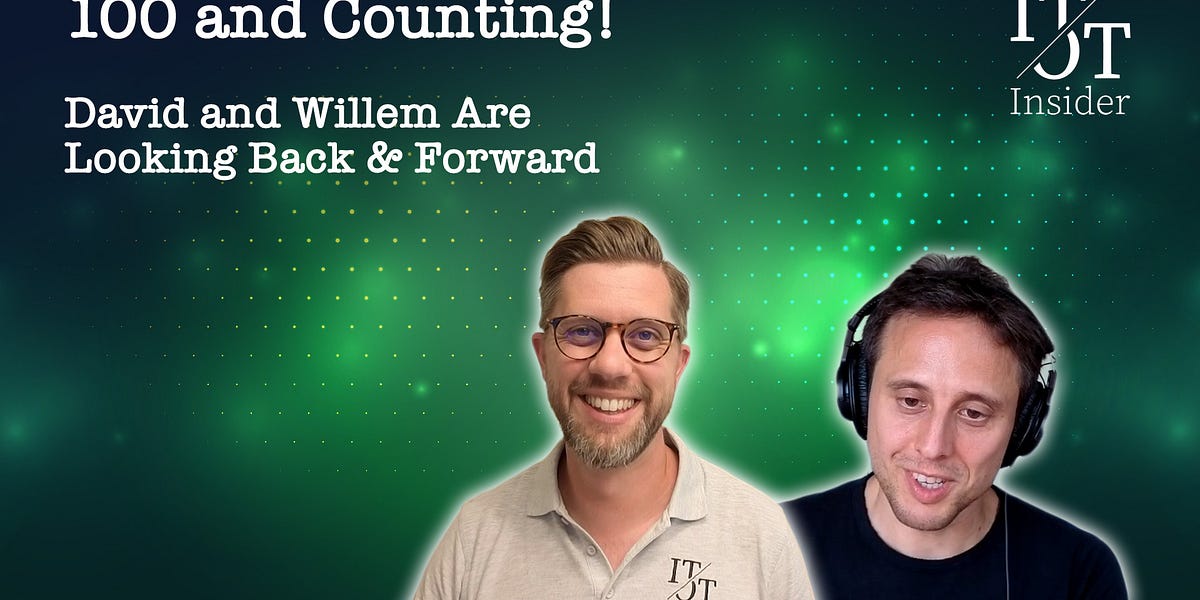
A special David & Willem episode — no guest, just us, a living room, and three years of IT/OT stories.
In This Episode
- This episode marks ITOT Insider's 100th published piece of content (articles and podcasts combined) and the first time David and Willem recorded together in person, roughly three years after starting the blog and two years after launching the podcast (first guest: Shiv Trisal of Databricks).
- Willem's top podcast picks: Dan Jeavons (applied computing, ex-Shell) for taking AI seriously beyond chatbot-level hype, and Nikki Gonzalez (Automation Ladies) for representing smaller manufacturers with teams as small as 20 people, a segment they don't usually cover given their focus on large multinational petrochemical and energy companies.
- Their trip to Las Vegas for IT Revolution's Enterprise Technology Leadership Summit was a useful barometer of the broader tech world's pace: an almost entirely IT-focused audience dominated by generative AI discussion, with very little manufacturing content, plus a memorable lunch encounter with authors Gene Kim and John Willis.
- David's favorite article, "Ceci n'est pas IT/OT convergence" (a nod to Magritte's "This is not a pipe"), argues the term "IT/OT convergence" has become so overused, spanning everything from adding an Ethernet port to a sensor to advanced AI models, that it's effectively lost real meaning; it remains one of the blog's most-read pieces despite being written in under an hour.
- Their Academy training program, born from a tram conversation in Hannover, deliberately stays non-technical (aimed at strategic, architectural, and team-lead roles rather than protocols or products) and interactive rather than one-directional, and has found vendors to be an unexpectedly valuable participant group since they often only see part of what's happening inside a customer's IT/OT organization.
- ITOT Insider's next major focus area is cybersecurity, driven by Europe's incoming NIS2 and CRA regulations and David's own cybersecurity background (roughly the first eight years of his career), covered with the same people-and-organization-first approach as their existing content, alongside a teased "major announcement" still to come.
Celebrating Episode 100: Recording Together for the First Time
00:00 – 01:17This episode marks a genuine milestone: ITOT Insider's 100th published piece of content, articles and podcasts combined, and the very first time David and Willem recorded together in person, sitting in David's living room rather than each working separately from home as usual, despite living not too far apart.
The timing lines up neatly with the blog's own anniversary: ITOT Insider started just under three years before this recording, in April, which happens to also be both David's and Willem's birthday month.
“This is actually our hundredth article we will be publishing... That means... we started, yeah, just under three years ago. So in April, the ITOT insider turns three.”
David Ariens · 00:33
From First Article to 100 Pieces of Content in Under Three Years
01:17 – 03:05The idea for ITOT Insider started in April roughly three years before this recording, but it took months of deciding what to actually write about, and how to write it, before the first article was published that August, revised more times than either of them can remember. The podcast came a year later, with the very first episode recorded about two years before this recording, featuring guest Shiv Trisal from Databricks.
Between articles and podcasts, they've now published 100 pieces of content, averaging more than 33 a year, a pace they jokingly apologize to their wives for.
“It took us a couple of months to decide on what we would be writing about... we only published our very, very first article in August... The very first one was in April two years ago, with Shiv Trisal from Databricks.”
David Ariens · 01:17
Setting the Format: Top Podcasts, Articles, Events, and Trips
03:05 – 04:05For this milestone episode, David and Willem deliberately skip a guest and instead run through their own personal highlights: top podcasts, top articles, and top events and trips from the last few years.
“I think it would also be interesting just to have like conversation because we talk all the time about a lot of topics, including IT and OT.”
Willem van Lammeren · 03:05
Top Podcast: Dan Jeavons on AI Beyond the Chatbot Hype
04:05 – 06:17Willem's first pick is the conversation with Dan Jeavons, who heads applied computing after previously working at Shell. What stood out was how far ahead of typical marketing material his thinking on AI actually was, taking a genuinely fundamental look at how AI could reshape manufacturing rather than just bolting a chatbot onto an existing application.
David connects it directly to his own recent article on industrial AI's core challenges, the lack of an integrated digital twin and the lack of real understanding of the underlying "physical twin", noting Dan's thinking pointed toward understanding physical reality without needing to manually model every single thing in a plant, since that kind of manual modeling is extremely hard to scale, error-prone, and time-consuming to maintain even once built.
“What I liked about that interview is just the way he looks at AI... a real fundamental look at how AI could reshape [manufacturing].”
Willem van Lammeren · 04:05
Top Podcast: Nikki Gonzalez on the SCADA/MES World Smaller Manufacturers Actually Live In
06:17 – 08:11Willem's second pick, from the opposite end of the spectrum, is the conversation with Nikki Gonzalez of Automation Ladies, focused squarely on the SCADA, MES, and OT world. What made it stand out is that it represented smaller manufacturers, companies that can field a team of maybe 20 people total, rather than the mega-multinational petrochemical and energy companies they usually cover.
David adds a plug for Nikki's North American conference, OT SCADA Con, recommending it directly to anyone focused on the SCADA and HMI layer.
“There's like a whole world of non-mega multinational global integrated companies that are in manufacturing and that also would like to work on digitalization on their shop floor. They can hire a team of 20 people. They are 20 people.”
Willem van Lammeren · 06:28
Top Trip: Vegas and the Enterprise Technology Leadership Summit
08:11 – 11:40One of their most memorable joint trips was to Las Vegas for IT Revolution's Enterprise Technology Leadership Summit (ETLS), the publisher behind several books they frequently reference on the podcast. It was a genuinely IT-centric event with only a handful of manufacturing-related sessions.
The conference's overwhelming focus, Willem notes, was generative AI, a useful real-time barometer for how fast that shift is moving in the broader technology world outside manufacturing, prompting a brief, half-joking tangent about "vibe coding your PLC."
“While there were of course a couple of excursions into manufacturing, there were far and few between... The focus of the conference... was absolutely everything that had to do with generative AI.”
Willem van Lammeren · 10:04
The Hoover Dam, and Meeting Gene Kim and John Willis in the Speaker Lounge
11:40 – 13:55The trip included a side visit to the Hoover Dam, built in the early 1900s, genuinely striking architecturally and, in David's words, clearly "built to impress" while still being fully functional.
A highlight of the conference itself was the speakers' lounge, where they found themselves unexpectedly sharing lunch with IT Revolution luminaries Gene Kim and John Willis, authors whose books they'd read and referenced many times, suddenly just people eating nearby.
“There's Gene Kim. Here's John Willis. I mean, it's like you start to see people that you know from whose book you read and then you're there eating lunch.”
Willem van Lammeren · 11:19
Top Trip: Hannover Messe, and Its Village-Sized Scale
13:55 – 17:24Their trip to Hannover Messe the previous year was David's first time even learning the event existed, while Willem jokes he'd never been able to get approval to attend in past jobs and now simply takes the days off himself. Both describe the sheer scale of the event as essentially its own village, everything is there.
The real value, they agree, is face-to-face conversation: seeing what companies are actually presenting, sensing where industry focus and momentum are genuinely shifting, and, increasingly, being recognized by returning vendors who now invite them to speak. They plan to return again this year.
“It's a village. Everything's there. It's crazy.”
Willem van Lammeren · 12:29
"Ceci n'est pas IT/OT convergence": David's Favorite Article
17:24 – 22:11David's top article pick carries a title borrowed from Belgian surrealist painter René Magritte's famous "Ceci n'est pas une pipe," rendered here as "This is not IT/OT convergence." It's one of the blog's most-read pieces, and notably one David wrote in under an hour, unusually unedited by Willem, who normally cuts roughly 80 percent of David's first drafts.
It was written, David admits, almost out of frustration: the term "IT/OT convergence" has been stretched so far, from something as trivial as adding an Ethernet port to a sensor all the way to advanced AI models, that it's effectively lost real meaning, conflating a genuine organizational dimension with a purely technical one. That distinction became a core focus area of their Academy training.
“This is one of those articles which didn't take me a lot of time to write... it was almost written out of frustration.”
David Ariens · 15:09
The Cooperation Models Article, and Why Alignment Meetings Don't Work
22:11 – 25:22Willem's favorite is one of their earliest pieces, written in their first year, on IT/OT "cooperation models." Its core insight is that most real IT/OT friction isn't technical at all, it's about how two fully-formed, independently critical technology teams actually work together, a genuinely different dynamic from a typical IT relationship where one side is technical and the other isn't. The article drew inspiration from IT-world DevOps thinking and the book Team Topologies, adapted specifically to an IT/OT context.
Their thinking has evolved since: they were initially dismissive of "simpler" cooperation models, rating them as inherently low maturity, but now recognize simple models work perfectly well for simple problems, nobody needs a full cooperative project structure just to request a laptop, while genuinely complex problems still require real structure.
“One of the best ways not to work together is just have like a meeting together and say, I think we should work together more often. Let's have more alignment meetings. Nothing really ever came out of alignment meetings.”
Willem van Lammeren · 19:18
How the Academy Was Born, and Why It Needed a Real Paper Certificate
25:22 – 28:41The idea for their Academy training program was born on a tram in Hannover, motivated by shared frustration with typical corporate training: a slide deck emailed afterward, quickly forgotten or, before remote work, filed straight into a bin. They deliberately designed something genuinely engaging instead of another passive lecture.
Willem was insistent on one specific detail: a real, hand-illustrated paper certificate rather than a generic PowerPoint-template certificate nobody actually cares about, simply because it's a nice, tangible thing to send participants. Their first two cohorts ran with around 40 to 45 people combined, built around real interactivity rather than one-directional broadcasting, which forced them to genuinely learn how to engage and run virtual teams themselves.
“We had almost 45 people or so in our first two groups last year... it's not one directional communication. We have interactive moments in the group itself, which is also a learning from us.”
David Ariens · 24:39
Iterating the Academy, and What's Next: Cybersecurity, Hannover, and a Cliffhanger
28:41 – 34:09Feedback from each Academy cohort now cascades directly into improving the next one, and they've deliberately kept the program non-technical, aimed at strategic, architectural, and team-lead audiences rather than specific products or protocols. Vendors emerged as an unexpectedly valuable participant group, since they often only see part of what's happening inside a customer's IT/OT organization, illustrated by graduate Jessica from Software Toolbox, who found the training helped her have higher-level, non-technical conversations with her own customers. Their next cohort starts May 22nd.
Looking ahead, ITOT Insider's next major focus area is cybersecurity, driven by Europe's incoming NIS2 and CRA regulations bearing down on their largely European audience, and by David's own background, roughly the first eight years of his career were spent in cybersecurity. They plan to cover it with the same people-and-organization-first approach as everything else on the blog, addressing real recurring obstacles like a legacy PC that can't be patched because it needs to run uninterrupted for months at a time. They close with concrete plans to return to Hannover Messe at the end of April, record another episode on-site (recalling their improvised Vegas setup, a camera balanced on an ironing board after arriving jet-lagged), and a deliberate cliffhanger tease of a "major announcement" still to come.
“How do we talk to the plants? How do you find a way around it?... I have a PC that cannot be patched whenever you want to because this thing is running months and needs to run for months uninterrupted... How do you start that discussion? How do you start that organizationally?”
Willem van Lammeren · 31:53
Full episode transcript raw feed ▸
Speaker 2 (00:01) Welcome to the ITOT Insider Podcast. Speaker 1 (00:04) And David, this is a special one. So for the ones who are listening, as the majority is, they won't hear any difference. this is actually the very first one we're recording when we are sitting together. It actually happens. It actually happens from time to time. Now, for those who are wondering, I do see Willem from time to time. We don't live too far from each other. No. But typically our podcasts, we do them at home. At home. Speaker 2 (00:29) Yeah. So you have a good view of our desk. Speaker 1 (00:33) This is on the other side. This is now in David's living room. In my living room, absolutely. There is a special reason to record this one. Tell me. This is actually our hundredth article we will be publishing on Famous 100. Famous 100. That means how many per year we started? So we started, yeah, just under three years ago. So in April, the ITOT insider turns three. So that's. calls for a celebration cake or... also my anniversary. Speaker 2 (01:14) My birthday in April. Speaker 1 (01:17) Mine as well, that all comes perfectly together. Having said that, it took us a couple of months to decide on what we would be writing about. So we started the idea in April, but we only published our very, very first article in August. Yeah, we started writing... During the summer break, I still remember that first article. think we did, I don't know how many revisions of that first article. A lot. I mean, you need to start somewhere, right? It's also about finding the right tone, obviously. What is the thing you want to bring to the audience? How you are going to bring your message, et cetera. ah But in any case, back then, we only had our articles. ah And then... one year later. You came with the idea. Let's do podcasts. Do we have time for that? Well, it's actually a very fun way to get to talk to other people in the industry which have a we had so many conversations already. Tons. We'll get back to them later. But so the very first one was in April two years ago. with Shiv, Shiv Trisal from Databricks. Shout out Shiv. So that's two years ago and now we are at our, yeah, yeah, 100 piece of content. Some only article, some in the form of a podcast, but still that's... 33 a year on average? That's more than 33, yeah. That's more than I thought. Sorry to our wives. Yes. It does take some time. does take some time. Anyway, um I thought it would be a fun idea uh to look back and look forward. Yeah, maybe not have a guest. Not have a guest in this one. No, no, this one is just me and you. Speaker 2 (03:05) I think it would also be interesting just to have like conversation because we talk all the time about a lot of topics, including IT and OT. ah I think it would be interesting just to have sessions about that. I didn't know you had a life outside IT and OT. Okay, guess I'm not inviting you to do barbecues. Speaker 1 (03:29) Yeah, absolutely. So... um We're gonna do our top podcasts, our top articles, our top events. Our top trips. Yeah, events, exactly. Yes, absolutely. So which one do we take first? Speaker 2 (03:44) Let's start with podcasts. Speaker 1 (03:45) Top podcasts. Okay, cool. So actually, I didn't count them. I think we are at about 40 podcasts. Could be, could be. More or less. So from those, I say 40 conversations, what are your most fun ones or whatever you want to call them? Speaker 2 (04:05) I'm going to take one on the IT spectrum. I'm going to take one really close to the OT spectrum. Both of course related to the digitalization in manufacturing context. So for me, the first one is with uh Dan Jeavons. Yeah, so it was all about AI. you, me, I guess all our listeners are like overwhelmed with AI is going to change the world and all the vendors are coming with AI. It's everywhere and it's going to change the world. Speaker 1 (04:36) He's a smart guy. He worked at Shell before. he was lead. Yeah, now he heads up applied computing. Exactly. Speaker 2 (04:44) So what I liked about that interview is just the way he looks at AI. is so much more ahead than everything else that you can consume and find on the internet or in marketing material. It's really like taking a fundamental look at what are we missing? How can we make AI really change the way that we manufacture and think about how we operate within manufacturing? um If you didn't... Listen, definitely do. think if you need to know where AI is heading, but a bit more on the long term. Yeah, go to that one. So not just about chat bots. No, it's not about it's not about adding a chat bot to your application, which just reads the the help file, you know, like a real fundamental look at how AI could reshape. Speaker 1 (05:34) Now the interesting thing is, so for those who uh listen to our previous video, the previous article, so the one from last week, I talked about our industrial AI um challenges. um One, the first one was the lack of an integrated digital twin. The second one was the lack of understanding of the physical twin. And that's exactly where I think Dan was making a lot of very good progress in like, can we understand that physical reality out there without the need, if I look back to my early years in data science uh modeling and without the need to, yeah, manually model every single thing in that plant, Speaker 2 (06:17) is very hard, extremely hard to scale and even then still error prone. Speaker 1 (06:23) Still error prone and even if you have those models, extremely time assuming to maintain as well. yeah. Speaker 2 (06:28) So you cannot do that for everybody, anything there. Again, you need to listen to one of my favorites. uh The other one, completely different end of the spectrum is with Nikki Gonzalez from Automation Ladies. Focused 100 % on that SCADA MES OT world, but I also like that the smaller manufacturers because we usually talk to... companies or provider suppliers that work with the biggest of the biggest, know, the big petrochemical, chemical, big energies. But there's like a whole world of non-mega multinational global integrated companies that are in manufacturing and that also would like to work on digitalization on their shop floor. They can hire a team of 20 people. They are 20 people. Speaker 1 (07:21) Yeah, yeah, absolutely, absolutely. And by the way, also shout out to Nikki. She has, for those who are uh North American based, uh she has a conference called OT SCADA Con, is next one is in uh July somewhere. We'll put a link in the show notes. But I think if you're really into that SCADA HMI layer, that's a... Take a look, take a look. Speaker 2 (07:42) I mean, it was a lot of fun to talk to Nikki about those topics and we could have talked for much more. So Nikki, if you're ever in Europe. Let us know. Let us know. know Belgium is really beautiful. Just don't go for the weather. Okay now David we did some trips because we don't do just writing and podcasts. I mean we also do talks, we go to conferences and stuff like that. So if you had to pick one. Yeah. Speaker 1 (08:11) So unfortunately, most of them I still do my own because you still have an actual job. Yes, yes, it's a bit harder for me. You still have an actual job, but for me, I'm now 100 % dedicated on the ITO, the insider. But there were two which we did together, which were. a lot of fun, by the way. would even say traveling is always more fun. Together. Yeah, I can imagine it's a bit more boring alone. Having said that, number one, was our uh trip to Vegas last year. So we were invited there to speak at the... um ETLS conference, the Enterprise Technology Leadership Summit. Yes, I had to write it down. It's a long name. it's organized by our friends. That's IT Revolution. So, that's another shout out. They have a bunch of very, very good books. And we've talked about many of them uh in our podcast, but especially during the Academy as well. And so, the cool thing... besides the fact that it was my first trip to Vegas. here. But the cool thing about that was this is an IT audience. Speaker 2 (09:29) I just checked the agenda again and while there were of course a couple of excursions into manufacturing, there were far and few between. Absolutely. The focus of the conference, but you can still look it up, you can see the videos, was absolutely everything that had to do with generative AI. Yeah, yeah. Speaker 1 (09:48) So it's interesting to see how that uh change is taking place in the. Yeah, let's say the non manufacturing world. So the world outside manufacturing is not just one segment, obviously, there is finance and marketing. Speaker 2 (10:02) You had manufacturers there, of course. Absolutely. Speaker 1 (10:04) focus was really technology. So it's interesting to see how fast that goes with Vibe coding and all that stuff. let's not go into that direction here in this podcast. Maybe we should do one later this year or so on that type of topic. But Vibe coding your PLC. Speaker 2 (10:21) Vibe coding your PLC. I we know somebody who does that. Speaker 1 (10:25) Yeah, but still then we come back to the deterministic side of things, right? That's true. Anyway, back to Vegas. Back to Vegas. So I think what I did like was we were a week there. We had our talk. We talked to other people. um Got a lot of, I would say, interesting perspectives, uh especially those from the non-OT world. um lot of interesting people there as well. And then um our trip to the Hoover Dam was definitely worthwhile. really nice like architecturally. it's I forgot the date but it's there since the early 1900s and then they still built you know it's built to impress. Speaker 2 (11:07) Yeah, right. really oh functional. It is functional, but also beautiful. it's amazing. If you go into the production hall and everything, it looks really nice. Speaker 1 (11:18) Build your impress. Speaker 2 (11:19) What I also liked is if you're a speaker, there's also like the place for speakers to go where you can have a bite and just a bit of quiet between all the noise. It's like, oh, there's Gene Kim. here's John Willis. I mean, it's like you start to see people that you know from whose book you read and then you're there eating. lunch was also a lot of fun. So John-Gene, shout out. Speaker 1 (11:40) absolutely. And then, and I think, so you also had two things, I would say, on both sides of the IT OT spectrum. Of the ocean, maybe? Of the ocean. So my second, yeah, think my second thing was, my second fun trip obviously was the one to Hanover Messe last year. I to be honest here, I knew the thing existed. Speaker 2 (12:08) I never got approval from my boss to go to Hanover Vest in the past, so now I'm just taking days off. Speaker 1 (12:13) So now I ask your approval and you ask my approval and we go like, yeah, sure. then we go. we went over there and must say, the size. Speaker 2 (12:29) It's a village. Everything's there. It's crazy. Speaker 1 (12:33) So um I think from my perspective, it's good to have the conversations, to shake hands, um to see what companies are presenting. It's also interesting to see where the focus is. Speaker 2 (12:50) You can definitely feel where the... where the vibe is going. Like if you go to the big tech vendors, if you go to the small vendors, you do see common themes coming up. Plus, they start to recognize you and say, hey, do you wanna have a talk? Speaker 1 (13:07) So that was actually really fun and we'll get back there. But we'll talk about that later on, but we'll go back this year. Oh, definitely. As well, yeah. Speaker 2 (13:15) Then, David, so we do podcasts. Yes. We do trips. Yes. We also still write. or articles. Speaker 1 (13:23) I think the interesting thing about writing an article is it requires you to think about the topic. It's a lot of work. Speaker 2 (13:35) It's enormous. It's actually the writing is the easy part, but getting it down to, I think we found out like around 800 words and just one core idea that you can remember after you the article. um takes a lot of iterations, but it forces you to think through your own ideas and they often change while writing. Speaker 1 (13:55) And that's interesting from different perspectives because obviously, often we just write something which feels like the right piece of content at that time. that's typically that's inspired by me or you having a uh with somebody or somebody asking a question about something or you know, um in my case, it's also often uh as preparation for a presentation I'm about to give. So the articles on data platforms, on AI, on I don't know what else. So several of those articles, that's really the preparation of a presentation I'm about to give and then that process is really, really helpful for me. my top here, so I'm deliberately not gonna pick the technological article. I think we had quite a lot of sessions about those. You can read them for sure. Absolutely. So my first topic is the article called, this is in French, Ceci n'est pas IT OT convergence. uh It's a subtle or not so subtle. It's a nod to Belgium. Speaker 2 (15:08) It's a nod to Belgium. Speaker 1 (15:09) So the famous painter, Rene Magritte, surrealistic painter, has this painting uh of a pipe. It's a pipe and it's called Ceci n'est pas une pipe. This is not a pipe. So our article in English is called This is not IT/OT Convergence And the cool thing about that article is um it's one of the most read articles on the blog. uh Lots of art lovers. Probably because of the drawing of the pipe. Anyways, um this is one of those articles which didn't take me a lot of time to write. ah I think I wrote that in less than an hour, maybe even in 30 minutes. You didn't ask me even to check it. No. Speaker 2 (15:53) Because most people don't know. whenever David writes something, I just kill like 80 % of it. I'm like, David, this is fluff, this is useless. I do not understand what you mean here. Like, puff, puff, puff. Speaker 1 (16:04) yeah, yeah. Lots of words gone to the entirety of the universe. Speaker 2 (16:11) Yes, no, yeah, yeah. So usually I'm the one killing and like, no, can be shorter, fluff. So no, this one was actually... Speaker 1 (16:18) Yeah, this was just a one shot and... That was really, it was almost written out of frustration. Speaker 2 (16:26) Most of our articles, many articles have been written out of frustration, I have to say. It's like hearing stories from people, a lot of stories from people we talk to that you visit or other situations like that. Speaker 1 (16:36) absolutely. So the reason I wrote this article called, This is Not ITOT Convergence, is, and you know, if you wanna read it, you just go through it, I'll put a link in the show notes, but. there is this problem that ITOT convergence, the term, it already dates back from the introduction of the term industry 4.0. So the term ITOT convergence is misused because it has a organizational component and it has a technical component. And... Most people don't understand that they bring the two together and then you have the haters or the lovers. You have the people who go like, it's never ever ever ever ever gonna happen. em And then you have the ones, they go like, of course it needs to happen because. Speaker 2 (17:24) The meaning can also, it goes all the way to let's say, we added an ethernet connector to our. to our sensor or something like that, it's now IT OT converged all the way to super advanced AI models. So I mean, it sort of loses its meaning because it's so wide. Speaker 1 (17:48) Exactly. because of the that the term is so wide and so misused, I think it was a little bit my, yeah, that was the reason why I wrote that article. So I really love that one. um I also think so uh if we again step bit forward to our academy, that this is one of the topics we really have a lot of focus on to explain not just the term ITOT convergence, but the entirety of the, say, the ITOT equation, whatever you want to call it. Anyways. Speaker 2 (18:16) Well, I say wide. still of my friends still don't understand what I do. But within the world, yes, it's quite wide and it's definitely a point that we talk about in the academy. um Another one that I like, it's still one of our earlier ones, also quite high is everything on the cooperation models. Absolutely. Speaker 1 (18:38) This one, you wrote that. Yes. uh And you also wrote that really quickly. uh And that one is, so we start in August. I think we're seeing a pattern here, Speaker 2 (18:50) like we should do less reviewing and just like post whatever. The less we think about an article, the better it becomes. Okay, check. Thank you. That's really flattering for my intellect. Speaker 1 (19:02) This one is from October or November in our first, so yeah, really, really early. Speaker 2 (19:05) Absolutely. And also I think one of the most read also and shared. Speaker 1 (19:08) yeah, absolutely. So just uh for the ones who might not have seen it, What are our corporation models about? It's about the fact that, again, Speaker 2 (19:18) when you're working IT and OT together, you have technical problems. You know, I have data from a PLC that needs to go all the way into a machine learning model in the clouds. I mean, there's a technical part. And I think the data series covers that part really well, eh like with different functions, et cetera. There's a lot of attention on that, also in the academy. If we go to the problems that, let's say, I face every day, and you too, rarely are they technical in nature. It's all about how do we work together. Absolutely. And one of the best ways not to work together is just have like a meeting together and say, I think we should work together more often. Let's have more alignment meetings. nothing really ever came out of alignment meetings. You don't feel more aligned. Everybody just says their own thing. So we started to take inspiration from uh the IT world, from DevOps and from team topologies that's really shaped our thinking on... What does cooperation mean? What does it mean to work together? Is it always good? Is it? And what's the new ones that you need to bring in the discussion? And we took those elements and we started to look at it from an ITOT perspective. um And... To be fair, that article was like almost three years ago, two years and a half. Since then, of course, it's been evolving. Absolutely. I think one of those additional insights, if you say it, you think, yeah, of course, why don't you know that? We're working with two technology teams. Most IT relationships in a company are technical versus a non-technical. group. ITOT, we're really talking about how do you get two groups that are fully formed technological groups. They do have systems they need to maintain. Both are critical for the company to work. uh that changes the way you collaborate and how does it change? mean those are things that we've been exploring further. Something else that we started to see, I think we were a bit more dismissive about the more simpler forms of cooperation in beginning of the article. We even rated them as low maturity. And we're coming back from that. I think the inside there is that actually those simple models are great if used properly in the right context and for the problem that you're trying to solve. Because I do not want to start a full-fledged cooperative project with a team lead just because I want a laptop. Simple is good. But simple, when you have something complex to solve, doesn't work. And I think that's something that we really evolved in. Yeah, yeah. Speaker 1 (22:11) And we discussed it a couple of times as well, is that uh from a content perspective on our blog, this is something which... um In that period, we didn't write a lot of additional content, so we didn't really share those new insights. uh We will be doing that this year, so no worries about that. However, uh most of that updated content did make it into the Academy. Speaker 2 (22:39) Yeah, as we were preparing for it, we were like, let's make... You remember when we were thinking about the Academy first time? It was in Hanover. Was it in Hanover? It was Hanover in the tram. was like, wouldn't it be great to have a training that you would like to follow yourself? Because you and I both followed enough trainings that you're like, great. The person reading slides, they send you the slides and you put them on a shared drive or if you got them in paper before Corona, they end up in the bin anyway. Yeah. Speaker 1 (23:19) Actually forgot that you're right. So shout out to everybody at Hanover. You inspired us. oh You like shout outs. Yeah. Yeah. Yeah. And then I can tag them and then maybe they like this. Speaker 2 (23:32) Yeah. It's like we want to do something fun. And we were like brainstorming what would be something fun to do within not too much time. It's like those. uh wouldn't be a week long course. No, no, no, no, no. And I think one of the things that we did really early like I would like a nice certificate. Speaker 1 (23:50) You know what I hate? I'm gonna take, wait, wait, wait, Willem, this is a live podcast. Yeah, it's a live podcast. I'm gonna take this one I have with me. And I'm not gonna edit this out. Speaker 2 (24:03) Ta-da. Yeah, so one of the things I wanted was like, I want a real... paper certificate. That's not something you know somebody took a PowerPoint template that says like you are now certified like nobody cares about certification nobody's gonna ask for it but yeah it's nice to have something that's pretty. Like I like animation and illustration and I wanted to have something hand drawn by an artist that we could send out. Speaker 1 (24:28) Just to get some extra months but anyways. Speaker 2 (24:32) yeah yeah so not so important about the academy but something that I really was strong about about having a fun training. But yeah, it worked out. Speaker 1 (24:39) Yeah, so we had I think almost 45 people or so in our first two groups last year. We had 40 people. It was crazy. It was a lot in our group in January. We even experience at a certain point because it was just too much. Reason is that it's not one directional communication. we have interactive moments in the group itself, which is also a learning from us. How do you work with virtual teams? How do you make them interact? How do you, yeah, so that's, it's not easy, but I think it's also a very interesting learning path for us. So thanks again for everybody for giving feedback. Speaker 2 (25:22) We really, really appreciate it. We also use it. Absolutely. Like I the feedback from the first group was already cascaded down to the second group. ah And that combined feedback is going down to the next group. I also feel like it's getting better. And we're also learning what delights people. Because to be clear, one thing that we quickly realized is like, it wouldn't be like a... one direction, big call with hundreds of people just listening to you talk. Yes. Speaker 1 (25:59) And also the type of profiles or the job descriptions, you want to call it that way. For who do we make it? Yeah. Also in the beginning, it a bit unclear for us, but I think we made the decision not to do a technical academy. It's not about products. It's not about... protocols or about programming or programming whatever. um So that means that it is more aimed at people who are sitting at a strategic level, an architectural level, project management level, team leads, managers, that type of people. Speaker 2 (26:35) think also vendors really came up as an important group because uh you've worked at the vendor side also. they only get part of what's happening within a company when it comes to IT and OT and they sit on the outside. And I think it's also giving an insight into what's happening with your customer. Speaker 1 (26:55) I met with uh Jessica who was in our first group, she works at Software Toolbox, shout out Jessica, uh last week or two weeks ago um in uh Sweden. uh And we had this conversation about, obviously she is... so experienced in this domain. She solves every connectivity problem. But it's again not it was not about solving the problem. She also had to to me She's like hey you gave me insights in how to have that conversation with my customers on a Non-technical level on a higher level within such a company So that's that's exactly why we do it I guess and the next one is starting in May so May 22nd uh So our next group starts in May and then the next the one after will be in uh one. Speaker 2 (27:49) I think it's interesting for us also. I really love the interaction of the students. You can be certain that the feedback or the things that you say when you challenge us, we remember that and we really work with that. I still remember very vividly some people saying a couple of things that really stayed in my head for weeks and that you really start to rethink your assumptions. Speaker 1 (28:17) It's, it's, it's, and even there it's, it's bi-directional. So, so we are, we are teaching but at the same time also learning. I also learned that it's also about the people teaching within a group. Speaker 2 (28:29) Absolutely. Yeah. It's also about getting that close interaction with people from a different background, from a different view, still working on fundamentally you'll find out the same type of problem. Yeah. Yeah. Speaker 1 (28:41) um That brings us maybe to the what's coming. Yes. Yes. What are we up to? um So we obviously will keep on publishing stuff on data and AI and we have a couple of very interesting partnerships coming up as well where we will be sharing some fun stories. uh But, but and this is. I have to say it's a big bit for me coming home. To put it that way, we'll step into cybersecurity. Speaker 2 (29:12) We had to choose, it was like, are we going to focus or we did a lot of data, but like what's the next focus? And I saw two big things. It's like one is AI and the other is cybersecurity. well, AI is exciting and I'm also working on the AI part. uh Cybersecurity is everywhere. Non-negotiable. Non-negotiable. And also within the academies that we get, everybody's working on cybersecurity. And I also noticed that not everybody has the same level of understanding on what it means. Is it a problem of IT? Is it... uh No, it's not applicable to me because I'm in manufacturing and we're very different. I mean, we've all heard the stories and I'm sure everybody's special, but nonetheless, we need to that problem. Absolutely. Speaker 1 (30:00) now, okay, the majority of our audience is in Europe, obviously. So it's with NIS2 and the CRA. It's definitely coming to your company, whether you want it or not. And I think this is again. So first of all, why did I say coming home again? Because uh my first... um think eight years or so of my career was cybersecurity. Speaker 2 (30:22) So, yes, you got to do all the fun travels. Yeah, you got to go to South Africa or that one plant in the mountains in Switzerland. Speaker 1 (30:31) Oh, yeah. Nice one. Nice plant. So, but it was all about cybersecurity. I have been, I was out for a while, but and I'm gonna mute my phone. So I was out for a while. So I'm getting back in again. This is perfect timing. We're going to do it the way we've been doing it with all our content. again, yeah, a bit neutral view. Speaker 2 (31:02) Translating and going through the there's a lot of translation where because I mean, it's cool that you know that there's a nice tool, but What does it mean? I I've been reading through the legal texts. There's each to each is definition of fun, of course. Speaker 1 (31:18) Yeah, and again, like what does it mean? And there again, what do we do with the IT/OT insider? We're always focused primarily on the people organizational side of things. And then obviously we'll talk about technology as well because you need that understanding of how you're going to solve it. But here again, cybersecurity is more about the people, more about the procedures, your processes. Speaker 2 (31:40) A lot of the things that are still active in a lot of the problems that you see in manufacturing when it comes to security, it's not that we don't know what we need to do from a technical point of view. Speaker 1 (31:51) It's like. Speaker 2 (31:53) How do we talk to the plans? How do you find a way around it? What's the problem? are the factors? I mean, classic one is I have a PC that cannot be patched whenever you want to because this thing is running months and needs to run for months uninterrupted. Okay, yeah, so. There's a couple of simple solutions, but how do you start that discussion? How do you start that organizationally? So many topics. Speaker 1 (32:18) Anyway, we have a couple of very interesting articles already in the pipeline. um We'll share some stories, fun stuff. Finally, we will go back to Hannover Messe. Most definitely. Most definitely, end of April, oh we will be there. We already have... Tons of meetings planned. Feel free to reach out to us. You can find our details on the website. um If you want to meet up, uh if you want to be, maybe we still have a little bit of time left to be in a panel somewhere or so, but just reach out. And we will record another podcast. somewhere in Hanover we will figure we'll find a place. Speaker 2 (33:00) We've done it before like in Vegas when we had that one interview on an iron we had the camera installed on the ironing board. Speaker 1 (33:11) Yeah so actually the first day we arrived so we arrived completely jet-lagged. Sunday evening late and then on Monday morning totally jet-lagged I think even before we had our breakfast or after I don't know. Speaker 2 (33:24) I don't remember time lost its meaning. We installed everything on the ironing board. Speaker 1 (33:31) Anyways, so uh we'll do a podcast in Hanover, Cliffhanger will do uh major announcements. Absolutely. I'm looking forward to that announcement. Not going to say anything about it yet, but it's definitely the most important one. Speaker 2 (33:50) So on that note. On that cliffhanger. You need to end on a cliffhanger. Speaker 1 (33:57) I read this book. Anyways, so with that cliffhanger, thank you very much uh for... Speaker 2 (34:03) listening in or for watching and looking at your garden in very, very early spring. Speaker 1 (34:09) Yes, it's early spring here. not too much green yet. But anyways, so for those who were watching, this was the first time we were sitting together. For those who are listening, thank you very much. If you aren't subscribed yet, go to itotinsider.com to subscribe. If you want to know more about our academy, go to itot.academy. And until we meet again, take care. Bye.